

Australian Rural & Regional News sought and received a response to this article from CSBP Fertilisers: CSBP Fertilisers GM Ryan Lamp responds regarding supply
As the Iran–USA–Israel conflict ripples through global fertiliser markets, Western Australian farmers are discovering just how fragile their supply chains really are. At the centre of it is CSBP, which has reached for the force majeure clause in its contracts to step away from its contractual obligations. The legal issue is straightforward: has CSBP been prevented from performing, or has it made a commercial decision not to?
Farmers, many of whom had fertiliser contracts in place well before the beginning of the conflict, are now caught in the middle of this legal and commercial dilemma. This opinion explores the historical context of force majeure, its application to the fertiliser supply chain, and the potential legal and commercial consequences for CSBP in light of their actions.
Force majeure, derived from French civil law, translates to “superior force,” and is designed to protect parties from fulfilling their contractual obligations when unforeseen events make performance impossible. Its origins lie in the Napoleonic Code of 1804, replacing the Roman legal concept of vis major—acts of God that could not be controlled. In modern commercial law, force majeure clauses are used to excuse non-performance due to events such as natural disasters, war, strikes, or government action.
However, the use of force majeure is far from automatic. In the context of a commercial contract, a party seeking to invoke force majeure must prove that the event in question has prevented or delayed performance, not merely made it more difficult or more expensive. Courts have consistently scrutinised the use of these clauses, often requiring that the event fall outside the ordinary risk profile of the business and beyond the reasonable contemplation of the parties.
Since early January, urea prices have moved from around US$400 per tonne FOB to over US$800 by 1 April—equating to roughly A$1,400 landed ex Kwinana, if it can be secured at all. This was no sudden shock. The global market began pricing in war risk as early as 12 January 2026, when Trump stated that “help is on its way” during unrest in Iran.
Despite this, domestic suppliers such as CSBP continued to take orders, evidently confident they could manage both price and supply risk—no doubt informed by prior experience.
That position held until the first bombs were dropped on 26 February 2026. Yet for a further two weeks, it remained business as usual. It was not until 7pm on 10 March that CSBP formally changed course, issuing notice:
CSBP gives notice to you under the Contract that events beyond CSBP’s reasonable control have occurred which are affecting our ammonium phosphate supply chain…
Yet despite invoking its force majeure clause—drafted in terms that are among the most expansive in the fertiliser sector—a critical question remains: has supply in fact been prevented, or has it simply become more expensive to obtain?
Global markets have not ceased to function. Cargoes continue to trade, and other buyers continue to secure product, albeit at elevated prices—prices still within the range of previous dislocations, including the 2020–22 Russia–Ukraine shock.
The issue, therefore, is not the absence of nitrogen-based products, but the cost of participating in that market.
This distinction becomes central when considering the legal limits of force majeure. Courts are generally reluctant to allow a party to rely on force majeure where the alleged “supervening event” forms part of the ordinary risk profile of the business. In fertiliser markets, geopolitical volatility in the Middle East, disruptions through the Strait of Hormuz and the Red Sea, and the periodic withdrawal of Chinese exports are not new or unforeseen events. They are recurring features of the global nitrogen trade. Where a supplier’s business model depends on sourcing product from these regions, those risks are inherent to the supply chain. As such, a court may take the view that these risks should have been anticipated, priced and managed within the contract, rather than relied upon after the fact as a basis for non-performance.
That legal position is closely tied to the commercial structure of the market itself. Many fertiliser supply arrangements operate on a just-in-time model, where product is effectively sold forward before physical supply is secured. In stable markets, that approach maximises margin. In volatile markets, it exposes the supplier to significant risk. An alternative model—importing, storing, and then selling from inventory within Australia—carries higher upfront cost but materially reduces exposure to supply shocks. Where a supplier has chosen the former approach, it may be argued that it has consciously assumed the risk of disruption in exchange for improved returns. In those circumstances, invoking force majeure when those known risks materialise is unlikely to sit comfortably with the courts. Even less so where those risks could, or should, have been factored into pricing at the time contracts were written.
A close reading of the relevant contractual provisions used by CSBP will be of particular interest to commercial lawyers. Clause 9.1 provides that a party “is not liable for failure to comply… if the failure arises from a Force Majeure Event,” but requires prompt notice and “reasonable steps” to mitigate. It allows delay or cancellation only where the supplier’s “ability to perform is directly impacted.” Clause 9.2 further limits any reduction in supply to the extent of the actual constraint. This is not a general right to withdraw, but a qualified right tied to demonstrable limitations on supply.
These clauses impose an active obligation. The supplier must attempt to secure supply—through alternative sourcing, participation in tenders, or logistical adjustment—and demonstrate that those efforts failed. The legal threshold is not whether supply is expensive (within reason), but whether it is unavailable despite reasonable or diligent efforts.
A central issue in any assessment of force majeure is whether the supplier has complied with its obligation to mitigate. If such steps have not been demonstrably taken, reliance on force majeure becomes materially weaker.
The duration and proportionality of any relief will also be scrutinised. Under clause 9.2, any reduction in supply must reflect the actual constraint. Where supply continues to trade globally—albeit at higher prices and reduced volumes—farmers may reasonably question whether the inability to perform is ongoing, or whether it reflects a commercial decision to defer procurement.
From a purely commercial perspective, the incentive for CSBP to delay locking in new shiploads in a rapidly rising market is obvious. Where contracts have been written at pre-war pricing and replacement product is now trading some US$400 per tonne higher, the potential exposure is substantial. On volumes in the order of six cargos totalling 180,000 tonnes, the differential runs to approximately US$64 million—a figure unlikely to sit comfortably with its parent company. In those circumstances, a strategy of deferring purchases in the hope that prices soften is commercially rational, albeit not in the interests of farmers holding unfulfilled supply contracts as seeding begins.
No doubt such a strategy has created tension within CSBP’s various divisions—legal seeking to stay out of the courts, marketing seeking to retain farmer confidence, and finance seeking to minimise losses. At present, the financial position appears to be prevailing, with cost and risk effectively pushed downstream to growers.
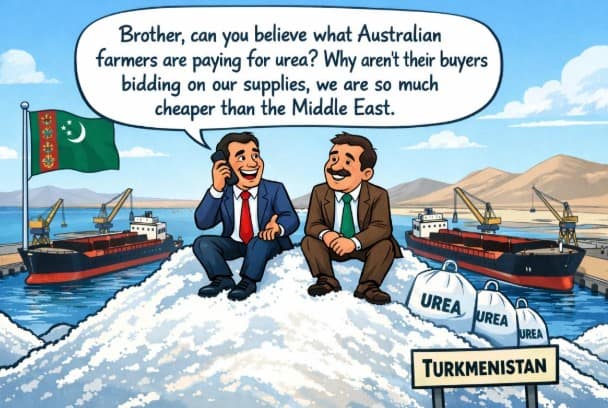
This will hold only so long as CSBP is not required to explain why supply cannot be secured when others appear able to do so. A review of global tenders shows that, over the past month, bulk supply has been available from sources including Saudi Arabia, the United States, Malaysia and Turkmenistan.
To date, CSBP has not indicated to contract holders that it has secured even modest volumes of replacement product.
There is an additional layer to this which will not be lost on any court examining the sequence of commercial decisions. As the conflict unfolded, CSBP responded by increasing its exposure to liquid nitrogen as a contingency strategy, proceeding on the apparent assumption that Chinese supply would provide a reliable substitute for disrupted Gulf-origin urea.
On one view, this was commercially expedient—allowing contracts to continue, new contracts to be issued, and, in some instances, existing obligations to be varied into alternative nitrogen products while the urea market remained constrained. In effect, CSBP used the “China option” to maintain its market position. What was not disclosed to growers, however, was that the underlying risk profile had shifted materially—and that growers were now carrying a significantly enlarged share of that risk.
That additional risk was neither novel nor unforeseeable. China has a well-documented history of intervening in fertiliser markets through export controls, quotas and abrupt withdrawal of supply. By electing to rely on that channel, CSBP did not reduce supply risk; it duplicated it across two inherently unstable jurisdictions.
In doing so, CSBP has materially increased both its supply-side exposure and its legal liability. Where a party adopts a substitute performance pathway, it assumes the risk that the alternative will be available.
That pathway now appears to have failed. On 25 March, CSBP issued a further notice to contracted growers, invoking force majeure in respect of its UAN products. Notably, no other major WA supplier appears to have taken the same course—raising an obvious question: is this a deliberate attempt to transfer risk onto growers, or simply the consequence of having taken a more aggressive position on the duration of the disruption?
Either way, CSBP now faces a problem that is compounding by the day. Where the risk of supply failure was foreseeable, the inability to perform can no longer be attributed solely to external events, but must be considered in light of the supplier’s own commercial decisions.
That distinction is critical. Where contracts continued to be entered into, and existing contracts varied, on the premise that alternative supply could be secured—and that premise has now proved incorrect—the issue moves beyond force majeure. The question becomes whether CSBP has, by its own conduct, contributed to or caused the very inability to perform upon which it now seeks to rely. In those circumstances, the threshold for invoking force majeure is materially weakened, and exposure to claims for non-performance correspondingly heightened.
Force majeure is a necessary protection, but it is not a licence to transfer commercial risk onto counterparties. Where supply continues to exist and markets remain functional, the legal threshold for invoking it remains exacting.
CSBP now finds itself in a clear dilemma: caught between its legal obligation to perform and its commercial reluctance to absorb a significant financial loss and avoid long-term reputational damage. The result is a form of paralysis—deferring procurement in the hope that the conflict subsides, prices fall, and counterparties refrain from seeking legal recourse.
In the meantime, a considered opinion from senior counsel would provide clarity as to the extent of CSBP’s exposure. More importantly, it may compel action—forcing a return to first principles: securing supply and honouring contractual obligations. Or, alternatively, sourcing product at the contracted rates which may just keep everyone happy.
In the end, the issue is a simple one. If contracts can be set aside when they become inconvenient, they cease to be contracts at all.
And that is a proposition the courts have historically been unwilling to accept.
Australian Rural & Regional News sought and received a response to this article from CSBP Fertilisers: CSBP Fertilisers GM Ryan Lamp responds regarding supply