

Forestry Australia, Media Release, 21 May 2026
Public claims that timber harvesting increases bushfire risk are based on narrow and contested evidence, and should not be generalised across Australia’s diverse forests, according to a new evidence review released by Forestry Australia.
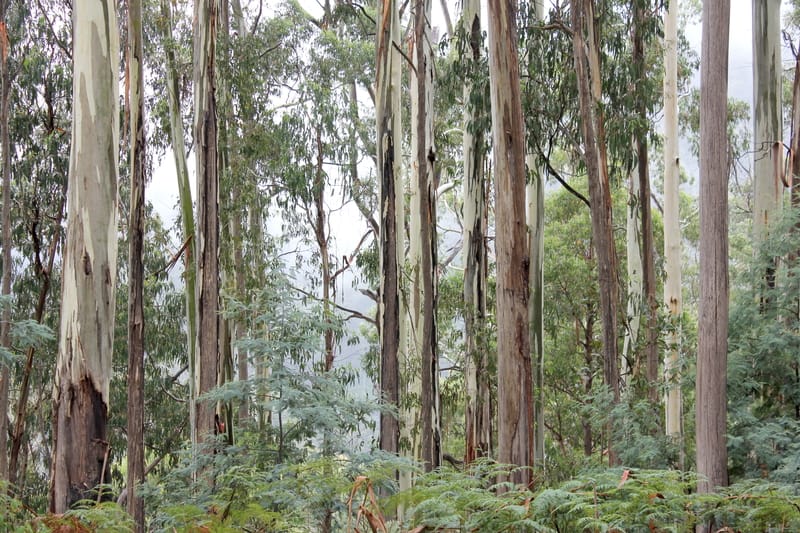
Photo: Kathie Nichols.
The review, Contested Evidence About Timber Harvesting and Bushfire Risk in Australian Landscapes, examines claims that timber harvesting increases forest flammability and bushfire risk. It finds that many public claims rely on evidence from one particular forest type and management system – tall wet eucalypt forests in south-eastern Australia that have been previously clearfelled – and that these findings are often presented as though they apply universally across all Australian forests.
Forestry Australia President Dr Michelle Freeman said the review was developed to help clarify a complex and often misunderstood area of forest science: “Public discussion about timber harvesting and bushfire risk is often highly contested, and at times, confusing,” Dr Freeman said. “The purpose of this evidence review is to unpack the science. It looks carefully at what the evidence does and does not show, where research findings are contested, and why terminology matters when discussing bushfire risk, fire severity, flammability and fire intensity.”
Dr Freeman said the diversity of Australia’s forests meant evidence could not be applied uniformly: “Australia’s forests are highly diverse. Evidence from one forest type, management system or landscape context should not be generalised across the country without careful qualification,” she said.
“The review highlights that different forms of forest management can have very different outcomes, and that it is inappropriate to reduce complex forest and fire dynamics to a simple claim that timber harvesting always increases fire risk.”
The review also highlights the importance of using fire terminology accurately.
“Terms such as fire risk, fire severity, fire intensity and flammability have different meanings,” Dr Freeman said. “When these terms are used interchangeably, public understanding suffers. Sound policy depends on precise language and careful interpretation of evidence.”
The review notes that landscape-scale analyses of major bushfires, including the 2019-20 bushfires, have found that extreme fire weather and topography are dominant drivers of fire severity, while timber harvesting, stand age and land tenure have comparatively minor effects at landscape scales. It also notes that while young regrowth forests may experience higher site-level fire severity under some conditions, large areas of mature and old growth forests, including forests in conservation reserves where timber harvesting is excluded, have also burnt at high severity.
Dr Freeman said Forestry Australia hoped the review would support a more informed and constructive public conversation. “Forestry Australia represents a large cohort of professionals with deep scientific and practical expertise in Australian forests,” Dr Freeman said. “Our role is not to prosecute simplistic arguments. Our role is to support evidence-based discussion, grounded in forest science, so that policy makers, media and the broader community can better understand what the research is actually saying.”
“Forests are central to some of the most important challenges facing Australia, including climate adaptation, biodiversity conservation, bushfire resilience, regional livelihoods and sustainable resource use,” she said. “These issues deserve careful, evidence-based discussion. We encourage journalists, policy makers, community leaders and all those engaged in forest debates to read the review and consider the full body of evidence.
Find the review here.
Related stories: Open for Debate: Bushfires, Logging, Burns & Forest Management.