


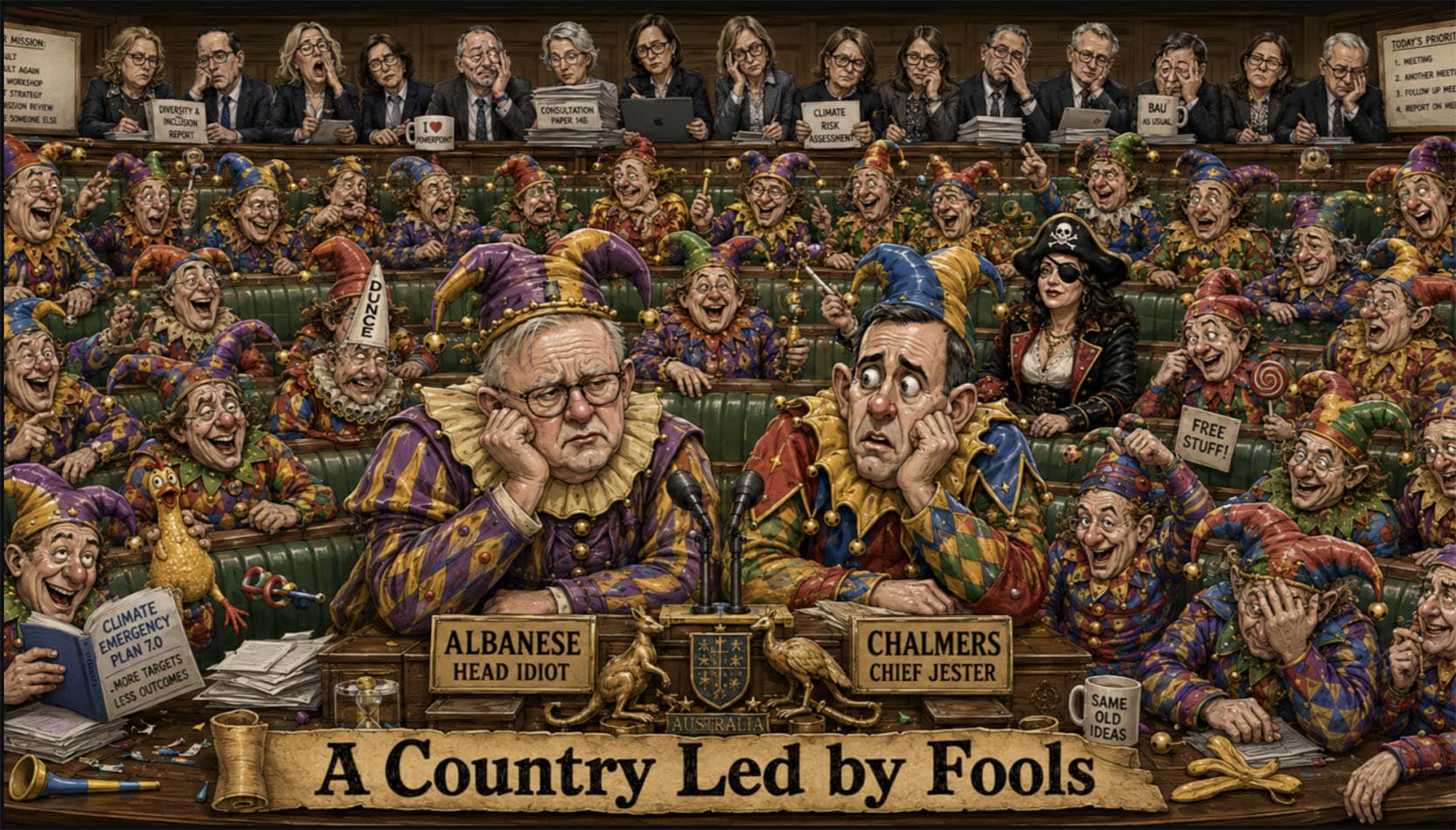
If you ever wondered why so few of our political class appear genuinely effective, the answer can largely be explained by three principles that govern human organisations everywhere: the Pareto Principle (1890s), Price’s Law (1960) and the Peter Principle (1969).
Together they explain why modern governments become bloated, mediocre and increasingly detached from the productive economy that keeps them alive.
The first is the Pareto Principle, developed by Vilfredo Pareto. Pareto’s Law explains the distribution of outcomes. The famous 80:20 rule suggests a minority of causes drive the majority of results.
In politics, this means a handful of ideological hang-ups held by a small number of elites often end up dominating a government’s priorities. Progressive woke values, reconciliation, class wars, climate change and wealth redistribution — the 20 per cent — can shape governments far more than the hundreds of secondary policy areas that fall into the 80 per cent camp.
Other examples include the small number of marginal seats that decide who governs, the minority of ministers who dominate Cabinet decisions, the power of a small number of powerful interest groups that have sway over government. Most political debate matters far less than people imagine because a small number of forces determine most outcomes.
Pareto’s Law is about the concentration of influence. A small number of things or people matter disproportionately.
Price’s Law, developed by Derek J. de Solla Price, is different. It explains who produces the outcomes.
Price observed that the square root of the people in an organisation produce half the output. In a department of 10,000 staff, only about 100 people are doing half the meaningful work.
This explains modern bureaucracy perfectly.
In agencies like the federal or state department of agriculture, a relatively small number of specialists are on the front line approving agricultural chemicals, monitoring biosecurity threats or dealing with real frontline production issues. The rest increasingly exist in support structures around the productive core — drafting ministerial speeches, preparing diversity reporting, attending consultation meetings or producing PowerPoint decks explaining why another review process is required before anything can occur.
Once you understand Price’s Law, modern government suddenly makes sense. A vast army of bureaucrats attending endless meetings, strategic frameworks and consultation papers reviewed by committees reviewing earlier consultation papers.
Most large organisations survive because a productive minority quietly gets on with the job while a growing administrative class exists achieving very little for their day’s effort.
Pareto explains why a few issues dominate politics. Price explains why a few people do most of the work.
Then comes the Peter Principle, coined by Laurence J. Peter. People are promoted until they reach their level of incompetence.
A capable electorate officer becomes an average ministerial adviser. A decent researcher becomes a hopeless senior officer. A competent local member becomes a useless minister.
Politics is especially vulnerable because advancement often rewards survival rather than competence. The system favours caution, factional loyalty and “Yes Minister” cow-towing above originality, bravery or outright ability. A minister who avoids controversy and achieves nothing is considered successful. A head of department that fails to provide frank and fearless advice is rewarded with a contract extension.
The Peter Principle is alive and well across key positions in government.
Combine these three principles and Australia’s political drift becomes easier to understand.
Australia has a small and shrinking political class capable of making Australia a wealthier and better-run country. Few of the existing cohort are worth the money they are paid, and even fewer would survive in the real world if they had to build a business on their own and survive on their own skill set.
Australia has entrenched a system that allows people working entirely within the political and bureaucratic world to rise beyond their competence.
It has allowed hundreds of thousands of bureaucrats to coast along working from home, nodding away to the latest progressive idea while believing they are indispensable to the running of Australia.
The result is a managerial political culture that mistakes process for achievement and announcements for outcomes, while promoting policies that are steadily sending Australia backwards.
Australia should be one of the most prosperous and effective countries on Earth. We possess enormous mineral wealth, abundant agricultural land, cheap energy resources and the protection of geography. We inherited stable institutions and a culture that once respected practicality, competence and productive work.
Yet increasingly we are led by elected fools who have entrenched fools at the top of the bureaucracy, who in turn have employed an army of fools below them.
How does a country this fortunate become a nation managed by fools?
Because modern politics increasingly rewards symbolism over competence, process over productivity and ideological conformity over practical achievement.
Because the productive class carrying the system is becoming proportionally smaller while the administrative and political class feeding off it becomes bigger.
And so Australia drifts along — wealthy enough to survive poor leadership, but increasingly unable to convert its immense advantages into long-term prosperity, productivity or national confidence.
The three principles explain why we are living in a fool’s paradise.


Trevor Whittington, CEO of WA Farmers, presents a thesis on the three principles behind Australia’s Fool’s Paradise, which is irrefutable and commands a place in the opening session, with prayers, for all tiers of over-governed Australia, especially the Federation circus.
The question arises as to how to wedge these hinderances apart. We need can-do, entrepreneurial leaders.
His successful policy and sectoral operational expertise makes him a natural for the task.
There is no time to waste as incumbents are hell bent on pawning our futures.
Michael Stormer for Pope!
Bang on Trevor. I’ll go to my grave still disullusioned by the reality that these parasites have prevented Australia reaching even a quarter – and falling – of its potential. Reminiscent of the commanders and advisors in the wheelhouse of the Cruise Ship of Fools, MV Australia, as it meanders it way aimlessly and endlessly around the Southern Ocean with no idea where the next port is.