Iluka Public School alumni Glen Braz has risen through the ranks of the Royal Australian Air Force (RAAF) over the past 39 years and last Friday he was appointed Defence Force Chief of Joint Capabilities.
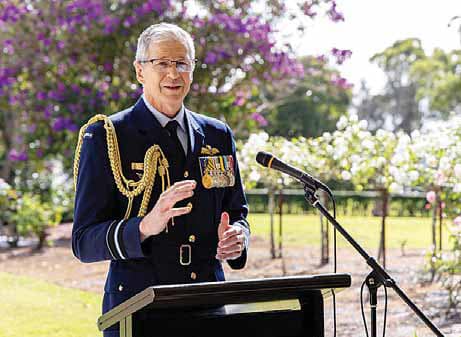
Born at Grafton Base Hospital, Glen’s mother Sue told the Clarence Valley Independent her son says he had “the ideal childhood” growing up at Iluka with his elder brother Mark.
“He went to school in Iluka until he finished primary and then he went to Woodlawn in Lismore boarding,” said Mrs Braz.
“He loved fishing, swimming, cycling; it was Iluka, he was free, he could do whatever he liked…if they were up to mischief, I was the first to find out about it.
“They had so many aunts and uncles who lived in Iluka and so did both their grandparents…so they were well known and well loved.”
Growing up in Iluka, Glen experienced many flyovers of the town by F-111’s and the family used to go camping at Jerusalem Creek in Bundjalung National Park, near the Evans Head bombing range.
But Mrs Braz said it wasn’t until almost the end of high school until he decided his career path.
“He was close to year 12 before he definitely made the decision to join the RAAF,” she said.
There is a strong connection with the Northern Rivers region in this appointment, with Air-Vice Marshall Braz replacing Kyogle born, Lieutenant General Susan Coyle, who made history last month when she was the first female appointed as Chief of the Australian Army.
“Susan and Glen are good friends,” Mrs Braz said.
The Australian Defence Force Academy was launched in 1986 with an aim of bringing the Army, Navy, and Air Force together, and Mr Braz entered the Academy in 1987 as an officer cadet.
After graduating from the Academy with a Bachelor of Science in physics in 1989, Mr Braz got his pilots wings in 1991 and was posted to No. 1 Squadron RAAF at Queensland’s Amberley RAAF base.
Mr Braz then qualified as a flight instructor and returned to No. 1 Squadron RAAF as flight commander of weapons and reconnaissance, before he was posted to the Middle East in 2003 as part of Australia’s contribution to the invasion of Iraq.
During his service, Mr Braz was Deputy Director of the Super Hornet Transition Team which led to him being appointed commanding officer of Australia’s first Super Hornet squadron.
In 2011, Mr Braz was awarded a Member of the Order of Australia in the Queen’s Birthday honours, followed by a Conspicuous Service Cross for his role in the Super Hornet program.
As Director of the transition, Mr Braz oversaw the introduction of the Boeing EA-18G Growler into service with the RAAF, before being deployed to the United Arab Emirates as commander of the second rotation of Air Task Group 630 where he was responsible for six F/A-18F Super Hornet strike aircraft, a E-7A Wedgetail Airborne Early Warning and Control aircraft, one KC-30A Multi Role Tanker Transport and 400 personnel in conducting operations against the Islamic State.
In addition to holding Commanding Officer, Officer Commanding and Force Element Group Commander appointments, he was the Commander Australian Air Task Group of the Middle East Region in 2015, recognised for his dedication and service with a Distinguished Service Medal.
From January to June 2023, Mr Braz served as Deputy Chief of the Air Force, before succeeding Air Vice-Marshal Darren Goldie as Air Commander Australia, a role that saw him command the RAAF combat arm and oversee its operational capability.
As the Chief of Joint Capabilities, Air Vice-Marshal Braz will lead Defence’s Joint Capabilities Group, which is responsible for delivering integrated support across cyber operations, cyber security, logistics, space, and national support to enable Defence to operate effectively across all warfighting domains.
He will continue the development of the Joint Capabilities Group to meet the capability priorities set out in the 2026 National Defence Strategy, including the uplift in Defence’s logistics infrastructure and an increased investment in space and cyber capabilities.
Mrs Braz said Glen’s family has been a massive support while he is away on deployments for up to six months at a time.
“There were a couple of times when I was really concerned when Glen was on a deployment, but I had to have confidence in their training and preparation and hope for the best, there’s nothing you can do to change the situation,” she said.
When he starts his four-year tenure as Chief of Joint Capabilities in July, Air-Vice Marshall Braz will be promoted to Air Marshall.
“The whole family is extremely proud of what Glen has achieved during his career,” Mrs Braz said.
Minister for Defence and Deputy Prime Minister, Richard Marles congratulated Air-Vice Marshall Braz on his promotion.
“Air Vice-Marshal Braz brings the experience, insight and leadership needed to deliver space and cyber power, national support, logistics and joint training ensuring the ADF is prepared to safeguard Australia’s sovereignty, security and prosperity for decades to come,” he said.
Australian Defence Force Chief, Admiral David Johnston said Air Vice-Marshal Braz brings extensive experience from his roles across Defence and the Australian Signals Directorate.
“His strong track record refining and developing military capability and empowering his people will enable Joint Capabilities Group to meet the capability priorities as set out in the National Defence Strategy 2026,” he said.
This article appeared in the Clarence Valley Independent, 22 May 2026.