


Professor David Lindenmayer BSc, Dip. Ed, Ph.D, DSC, FAA, FESA, FRZNSW, FAAS, AO
The Australian National University, 14 March 2025.
This article is in response to Megafires thrive on high per hectare fine fuel loads across the forest landscape, regardless of land tenure: SETA’s further response to David Lindenmayer. The entire series of articles and interchanges is listed below.
This debate is drawing to a close. Australian Rural & Regional News intends to ask a few questions of each of the participants with a view to rounding out the debate.
SETA suggests that my research on the relationship between logging and fire is merely “opinion”. It is anything but. My work is based on extensive empirical research and detailed analyses of major fire-related and land-use datasets (Taylor et al. 2014) (Lindenmayer et al. 2022) (Lindenmayer et al. 2023). Research by (Attiwill et al. 2014) and (Bowman et al. 2021) also clearly shows a relationship between logging and fire severity (despite the misleading titles in both papers). Empirical research findings linking logging and increased fire severity have been demonstrated through several studies (e.g. (Taylor et al. 2014) (Lindenmayer et al. 2022)), with similar conclusions have been reached by other researchers (Furlaud et al. 2021); (Wilson et al. 2022). Notably, researchers studying other forest ecosystems around the world are also finding similar relationships (Bradley et al. 2016) (Levine et al. 2022) (Mackey et al. 2023).
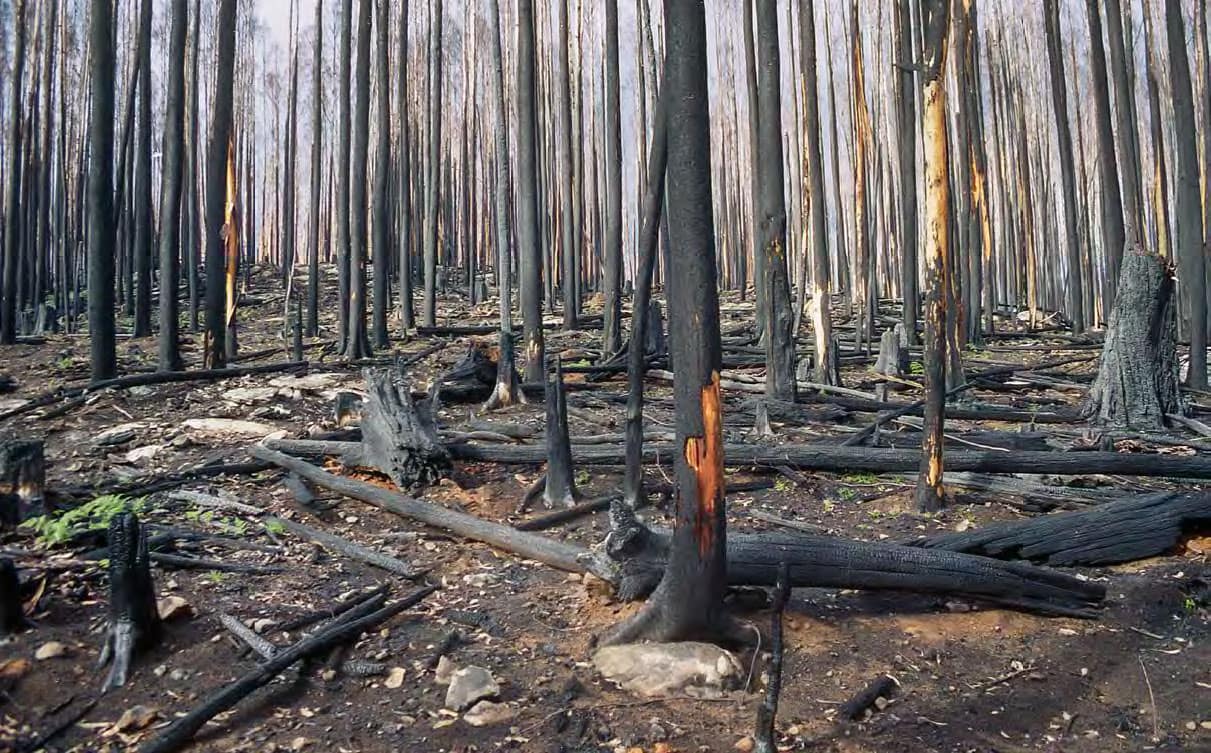
SETA makes an absurd comparison between the flammability of national parks and state forests. The proper scientific comparison is between logged and unlogged state forests, while accounting for forest type, topography, and other factors. When analysed correctly, the results are clear: logged forests always burn at higher severity than intact forests (Lindenmayer et al. 2022).
The economic reality of native forest logging
SETA also makes false claims about the costs of ceasing native forest logging. Repeated economic analyses show that the industry has cost the NSW economy hundreds of millions of dollars and cannot survive without massive ongoing subsidies from government (Frontier Economics and ANU 2021, Frontier Economics 2023). In one year alone, losses have exceeded $245 million in NSW, and cumulative losses exceed $1.5 billion in Victoria and $1.3 billion in Tasmania (Lindenmayer 2024).
Public native forest logging operates at a huge loss, subsidized by taxpayers, and remains economically unviable. It is financially reprehensible to maintain such subsidies and prop up a clearly failing industry, and especially during a cost-of-living crisis.
The myth that native forest logging supports construction
SETA falsely claims that native forest timber is essential for housing construction. The reality is:
- 90 per cent of all sawn timber in Australia already comes from plantations, not native hardwood forests (Department of Agriculture Fisheries and Forestry 2023, Lindenmayer 2024).
- Native forest logging primarily produces low-value, high-volume woodchips, not sawn timber (Department of Agriculture Fisheries and Forestry 2023) – one of the key reasons why it is such a major loss-maker for the people who own the resource – the taxpayer (Frontier Economics 2023).
- A significant portion of Australia’s native hardwood plantation timber is being exported. Instead of logging native forests, we should focus on processing our hardwood plantation timber domestically to create jobs for Australians.
The scientific evidence on fire and logging
New studies now show that logged and regenerated native forests in Australia are four times more likely to burn than plantations. The rate of loss of native forest timber is so high (Cary et al. 2021) that even the least savvy investor would recognise that future investments in native forest logging are very poor economic decisions. Plantations produce more sawn timber, grow faster, and are less fire-prone. Decisions about where we should be sourcing our timber are obvious.
Logging’s impact on biodiversity
SETA incorrectly claims that logging has no impact on biodiversity, citing detections of Leadbeater’s Possum as evidence. But like flawed statements from the former VicForests (Victoria’s now defunct logging agency) it has confused survey effort with changes in populations over time (Lindenmayer 2024). Extensive long-term data collected since 1997 show that site occupancy by Leadbeater’s Possum has declined by 50 per cent over the last 25 years—with logging being a key driver of this decline (Lindenmayer et al. 2020).
Research in both Victoria and NSW has demonstrated that logging has significant negative impacts on a wide range of threatened species (Ward et al. 2024) (Ashman et al. 2025). In Victoria, the cessation of native forest logging has helped better protect the habitats of 34 species (Ashman et al. 2025).
The role of disturbance history in biodiversity decline
SETA fails to understand the importance of disturbance history in shaping biodiversity. Recent studies of the Black Summer wildfires show that biodiversity recovery was severely impaired in areas with a history of repeated prescribed burning and past logging, especially in wetter forest types (Driscoll et al. 2024).
SETA’s article continues to perpetuate decades-old myths that run counter to both scientific and economic evidence. For over 30 years, the native forest logging industry has relied on these misleading claims to justify ongoing forest degradation (Lindenmayer 2024). The evidence is clear:
- Logged forests burn at higher severity than unlogged forests.
- Native forest logging is economically unviable without massive government subsidies.
- 90 per cent of Australia’s sawn timber comes from plantations.
- Plantations are less fire-prone and a better long-term investment.
- Logging significantly threatens biodiversity, including Leadbeater’s Possum.
The debate on native forest logging must be driven by facts—not industry spin. Continuing to log native forests in the face of scientific, ecological, and economic realities is reckless.
References
– Ashman, K., M. Ward, C. Dickman, D. Harley, L. Valentine, J. Woinarski, J. Marsh, C. Jolly, T. Doherty, D. Driscoll, E. Bowd, D. Watchorn, N. Clemann, and D. B. Lindenmayer. 2025. Policy decisions matter: cessation of logging benefits 34 threatened species in Victoria, Australia. PLOS One 20:e0319531.
– Attiwill, P. M., M. F. Ryan, N. Burrows, N. Cheney, L. McCaw, M. Neyland, and S. Read. 2014. Timber harvesting does not increase fire risk and severity in wet eucalypt forests of southern Australia. Conservation Letters 7:341-354.
– Bowman, D., G. J. Williamson, R. Gibson, R. A. Bradstock, and R. J. Keenan. 2021. The severity and extent of the Australia 2019-2020 Eucalyptus forest fires are not the legacy of forest management Logging. Nature Ecology Evolution.
– Bradley, C. M., C. T. Hanson, and D. A. DellaSala. 2016. Does increased forest protection correspond to higher fire severity in frequent- fire forests of the western United States? Ecosphere 7:e01492.
– Cary, G., W. Blanchard, C. N. Foster, and D. B. Lindenmayer. 2021. Effects of altered fire regimes on critical timber production and conservation rotations. International Journal of Wildland Fire 30:322-328.
– Department of Agriculture Fisheries and Forestry. 2023. Australia’s State of the Forests Report. Department of Agriculture Fisheries and Forestry, Canberra, Australia.
– Driscoll, D. A., and e. al. 2024. Biodiversity impacts of the 2019–2020 Australian megafires. Nature.
– Frontier Economics. 2023. Public native forest logging: a large and growing taxpayer burden. Frontier Economics, Melbourne, Victoria.
– Frontier Economics and ANU. 2021. Comparing the value of alternative uses of native forests in southern NSW. Frontier Economics and ANU, Singapore.
– Furlaud, J. M., L. D. Prior , G. J. Williamson , and D. M. J. S. Bowman. 2021. Fire risk and severity decline with stand development in Tasmanian giant Eucalyptus forest. Forest Ecology and Management 502:119724.
– Levine, J. I., B. M. Collins, Z. Steel, P. de Valpine, and S. L. Stephens. 2022. Higher incidence of high-severity fire in and near industrially managed forests. Frontiers in Ecology and Environment 20:398-404.
– Lindenmayer, D., W. Blanchard, D. Blair, L. McBurney, C. Taylor, B. C. Scheele, M. J. Westgate, N. Robinson, and C. Foster. 2020. The response of arboreal marsupials to long-term changes in forest disturbance. Animal Conservation:https://doi.org/10.1111/acv.12634.
– Lindenmayer, D. B. 2024. The Forest Wars. Allen& Unwin, Crows Nest, Sydney, Australia.
– Lindenmayer, D. B., C. Taylor, W. Blanchard, P. Zylstra, and M. J. Evans. 2023. What environmental and climatic factors influence multi-decadal fire frequency? Ecosphere 14.
– Lindenmayer, D. B., P. Zylstra, R. Kooyman, C. Taylor, M. Ward, and J. E. M. Watson. 2022. Logging elevated the probability of high-severity fire in the 2019–20 Australian forest fires. Nature Ecology & Evolution 6:533-535.
– Mackey, B., C. Campbell, P. Norman, S. Hugh, D. A. DellaSala, J. R. Malcolm, M. Desrochers, and P. Drapeau. 2023. Assessing the Cumulative Impacts of Forest Management on Forest Age Structure Development and Woodland Caribou Habitat in Boreal Landscapes: A Case Study from Two Canadian Provinces. Land 13.
– Taylor, C., M. A. McCarthy, and D. B. Lindenmayer. 2014. Non-linear effects of stand age on fire severity. Conservation Letters 7:355-370.
– Ward, M., K. Ashman, D. B. Lindenmayer, S. Legge, G. Kindler, T. Cadman, R. Fletcher, N. Whiterod, M. Lintermans, P. Zylstra, R. Stewart, H. Thomas, S. Blanch, and J. E. Watson. 2024. Shifting baselines clarify the impacts of contemporary logging on forest-dependent threatened species. Conservation Science and Practice 6:e13185.
– Wilson, N., R. Bradstock, and M. Bedward. 2022. Disturbance causes variation in sub-canopy fire weather conditions. Agricultural and Forest Entomology 323:109077.
Story series (in order of publication):
Debunking false claims about bushfire risk and native logging in Australia;
Logging does indeed increase fire risks!: David Lindenmayer;
An alternative perspective to David Lindenmayer: South East Timber Association;
Logging and bushfire risk: Robert Onfray responds to David Lindenmayer;
Bushfire risk and native forest logging: David Lindenmayer responds to South East Timber Association;
Fire severity is always greater in areas that have been logged: David Lindenmayer responds to Robert Onfray;
David Lindenmayer ignores core points and key questions: Robert Onfray’s further response;
Megafires thrive on high per hectare fine fuel loads across the forest landscape, regardless of land tenure: SETA’s further response to David Lindenmayer;
Robert Onfray’s response misses core scientific realities – logging makes forests more flammable for many decades: David Lindenmayer;
SETA’s claims ignore established science and economic realities: David Lindenmayer;
David Lindenmayer fails to engage with real-world fire dynamics: Robert Onfray;
Research outputs – Talk about logging but don’t talk about national parks: SETA.
This debate is closing. Australian Rural & Regional News intends to ask a few questions of each of the participants with a view to rounding out the debate.

