


Robert Onfray, 2 March 2025. This article is in response to Fire severity is always greater in areas that have been logged: David Lindenmayer responds to Robert Onfray. The entire series of articles and interchanges is listed below.
David Lindenmayer’s response to my rebuttal still fails to address the core points I raised in my original blog and overlooks the straightforward questions I posed in my response to his critique.
It is well understood that younger regrowth can experience more intense fires due to its size and dense structure compared to older forests. However, most regrowth results from past fires rather than logging. The fact that regrowth burns with greater intensity does not mean it drives the spread of large fires or makes forests more flammable overall. This is the core claim that Professor Lindenmayer is trying to prove, yet he has not provided empirical evidence to support it.
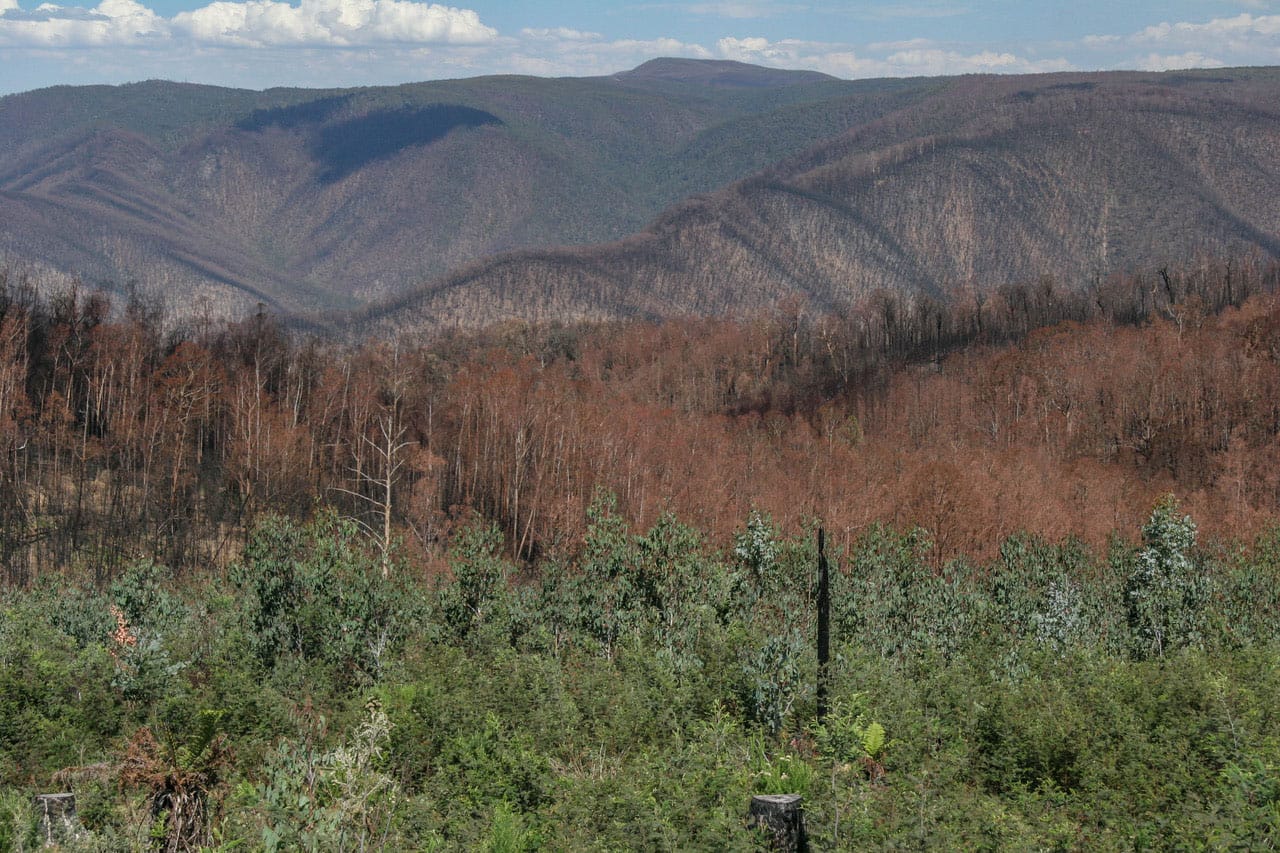
Furthermore, as I demonstrated with data in my initial response, the scale of logging operations is so small that it cannot be considered a driver of large wildfires. If Professor Lindenmayer has empirical evidence proving otherwise, he should present it, as I previously challenged him to do.
Instead of addressing these key points, Professor Lindenmayer focuses on his study of fire severity. However, fire severity is a post-fire measurement, typically based on canopy scorch or mortality, while fire intensity is measured at the flame front. A fire burning at a specific intensity could cause varying levels of severity in dense regrowth compared to mature forests due to differences in tree size and height. Therefore, using severity as the sole measure of fire behaviour is misleading.
While definitions of fire severity can vary based on context, it typically refers to the extent of loss of vegetation or organic matter due to fire. This is often expressed in terms of scorch or defoliation extent. For a specific fuel or vegetation type, it relates to Byram’s fire line intensity, but burn severity cannot be equated across different fuel types. For instance, the burn severity of a fire that completely defoliates a heathland may be described as the same as a fire that completely defoliates a forest. However, the intensities involved could be vastly different.
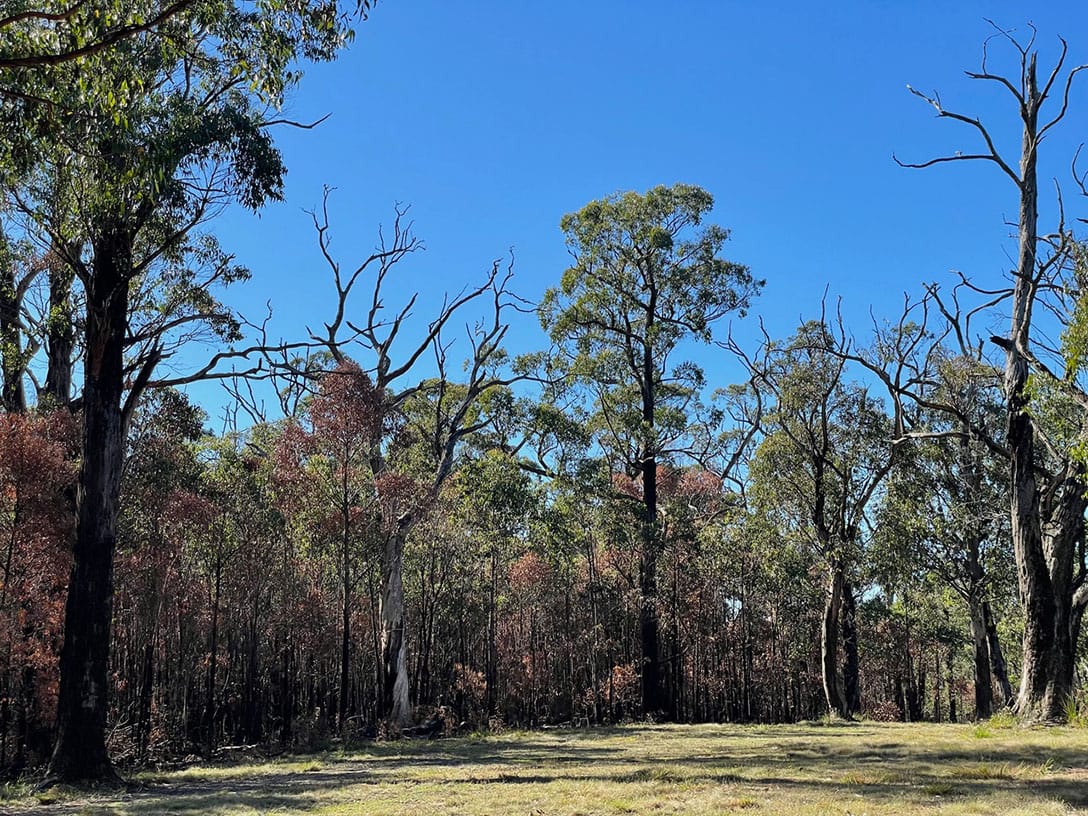
The photo below proves this point. It shows a fuel reduction burn in 2024 at Kinglake off the Kinglake-Whittlesea Road in the water catchment. Substantial eucalypt overstorey mortality from the 2009 fires caused the site to support a dense stand of 15-year-old regrowth. The photo highlights that the measured fire severity does not reflect fire intensity. In this case, a low-intensity fire scorched the 8-10 metre regrowth but did not scorch the mature trees.
The proportional extent and distribution of logging regrowth should be parameters used to assess the impact of logging as a driver of significant bushfires, rather than relying on broad assumptions that fail to account for variations in forest structure, fire history, and land management practices.
Examining the studies David Lindenmayer cites
Professor Lindenmayer insists that “plenty of evidence” supports his hypothesis, yet a closer look at the studies he references in his latest response reveals significant weaknesses.
He relies significantly on Tayler et al. (2014), which he refers to as an “empirical study” following the 2009 Black Saturday fires. The study relies on data on fire severity mapped by the Department of Sustainability and Environment. Attiwill et al (2013) conducted a similar analysis of the 2009 fires. The difference is that Attiwill et al (2013) used the entire area burnt by the two main fires, while Taylor et al (2014) focused on a subset.
Taylor et al (2014) utilised map-based analysis and statistical modelling to identify patterns but did not demonstrate that one factor directly causes another. The authors neither collected nor measured fire severity or intensity on-site nor did they perform controlled experiments to isolate the effects of logging on fire behaviour.
Taylor et al (2014) acknowledged that the dataset they relied on did not allow them to determine whether the stands in the 70-year age class were created by wildfire or past logging. To address this significant deficiency, the authors argued that since most unlogged forests contain multiple age cohorts, the existence of even-aged stands implied logging. However, this does not provide definitive proof that logging—not wildfire—was the cause of the regeneration of those stands. This uncertainty weakens their conclusion that logged forests burn more severely than unlogged forests.
While spatial analysis like this offers valuable insights, it does not identify the causes or demonstrate that logging is the primary driver of fire severity. When evaluating landscape-level fires, assessments of fire intensity are more critical, such as those conducted by Cruz et al. (2012).
Professor Lindenmayer also references Wilson et al. (2022) to support his position. However, this study does not measure actual fire behaviour—such as fire intensity, flame height, or rate of spread—between logged and unlogged forests. Instead, it calculates forest flammability indicators, like fuel moisture content and the Forest Fire Danger Index (FFDI), based on weather data. While these indicators help in understanding microclimates, they serve as proxies for fire risk—not as direct evidence of fire behaviour in logged forests. Additionally, their conclusion that logging increases fire risk is an inference, not an observation supported by real-world fire data.
Does David Lindenmayer rely on literature reviews?
Despite his claims, Professor Lindenmayer does rely on literature reviews. In his latest response, he references a paper he co-authored with Professor Zylstra (Lindenmayer and Zylstra, 2024), stating that “logged forests almost always burn at greater severity than intact forests”.
However, this paper is a literature review and theoretical discussion, not a study based on field data. While it speculates on how disturbances “may” increase flammability, it does not provide new empirical evidence to support this statement. It does not constitute scientific proof that logging increases “fire severity.”
Similarly, his 2022 paper (Lindenmayer et al, 2022) does not present new findings but rather synthesises other studies—again, without offering additional empirical data to support his hypothesis.
Studies that contradict David Lindenmayer’s hypothesis
Notably, Professor Lindenmayer still overlooks studies that contradict or challenge his position. In addition to those I outlined in my original blog, here are further examples:
- Proctor and McCarthy (2015) conducted a study based on field data collection instead of modelling or remote sensing. They demonstrated that thinning reduces fire severity by lowering elevated fine fuels, key drivers of fire spread and intensity. They found that fine fuels from slash decomposed within four years, and thinned forests exhibited a lower overall fuel hazard compared to adjacent unthinned forests. Contrary to Professor Lindenmayer’s claim, thinning reduced the risk of crown fires, making suppression easier—not harder.
- Volkova et al (2017) demonstrated that thinning reduced fire intensity by lowering surface and bark fuel loads. Fire simulations replicating the severe 2006/07 Great Divide Fires showed that thinned forests experienced nearly 30 per cent lower fire line intensity, a 20 per cent reduction in the rate of spread, and shorter spotting distances than unthinned forests.
- Burrows et al (2023) established transects in mature karri forests in Western Australia at 72 sites with varying fuel ages, measuring total fine, surface, near surface, and elevated fuels. This study shows that fuel loads and fire hazards increase over time in long-unburned forests, making them more susceptible to severe wildfires than logged forests. While more aerated fuels are present in younger stands, they constitute a small component of the total fuel load. This field-based, empirical study provides metrics and data-driven conclusions that professional land managers can confidently rely on when making field decisions.
These studies, based on direct field measurements rather than modelling, regression analysis, or literature reviews, provide strong evidence that active forest management, including thinning, can reduce fire intensity, rather than increase fire intensity or “severity”.
Addressing the “lobbyist” smear
Professor Lindenmayer has suggested that those who challenge his conclusions are influenced by industry interests. He writes, “We can manage forests either by listening to forest industry lobbyists, or we can use evidence to guide good decisions. I prefer evidence”.
For the record, I am retired, self-funded, and have no industry affiliations. I approach this issue as an independent professional with 33 years of fire management experience. I care about forests and travel widely, reporting on their mismanagement due to policies shaped by ideology rather than practicality and common sense.
I depend on real-world fire behaviour and field data, rather than assumptions based solely on theoretical models or literature reviews.
A challenge to David Lindenmayer
After 33 years of practical experience in fire management—both controlled burning and wildfire suppression—I understand the responsibility of making decisions impacting forests, biodiversity, assets, and human lives. Fire managers cannot afford to rely solely on theoretical models and disputed assumptions. We engage with real fires, guided by on-the-ground knowledge and field-tested practices. Unlike academics, our decisions are immediately tested by reality, and we are accountable for the outcomes.
If Professor Lindenmayer believes his theories reflect reality, he should test them in the field. I invite him to design a controlled study in recently logged and unlogged areas—such as the jarrah forests of Western Australia or any native forests in Victoria. After all, logging of native forests has ceased in those states. If his claim is correct, we should now observe less severe fires.
Final thoughts
Professor Lindenmayer’s statement that “the science is clear – ignoring it does not make it any less true” is problematic because science is a method of inquiry, not a fixed body of knowledge. Scientific claims require rigorous testing, replication, and openness to contradiction.
Sound fire management decisions, informed by empirical research, are essential for reducing bushfire risks and protecting communities. His hypothesis remains contested, unreplicated, and unproven. Policymakers and the public should recognise it as such and ensure that empirical research, not theoretical assumptions, informs fire management decisions.
Story series (in order of publication):
Debunking false claims about bushfire risk and native logging in Australia;
Logging does indeed increase fire risks!: David Lindenmayer;
An alternative perspective to David Lindenmayer: South East Timber Association;
Logging and bushfire risk: Robert Onfray responds to David Lindenmayer;
Bushfire risk and native forest logging: David Lindenmayer responds to South East Timber Association;
Fire severity is always greater in areas that have been logged: David Lindenmayer responds to Robert Onfray;
David Lindenmayer ignores core points and key questions: Robert Onfray’s further response;
Megafires thrive on high per hectare fine fuel loads across the forest landscape, regardless of land tenure: SETA’s further response to David Lindenmayer;
Robert Onfray’s response misses core scientific realities – logging makes forests more flammable for many decades: David Lindenmayer;
SETA’s claims ignore established science and economic realities: David Lindenmayer;
David Lindenmayer fails to engage with real-world fire dynamics: Robert Onfray;
Research outputs – Talk about logging but don’t talk about national parks: SETA.
This debate is closing. Australian Rural & Regional News intends to ask a few questions of each of the participants with a view to rounding out the debate.


Well said Robert. I think you summed up the philosophy of scientific principal succinctly. Science is not a repository of knowledge, but the means to seek it out by gathering empirical evidence to test a hypothesis.
This is music to my ears. Finally someone has articulated a very sensible and scientifically sound response to the David Lindenmayer rhetoric and laid out the very fair and reasonable challenge. If David continues to dominate the stage with his strong views it is time he also was prepared to back it up with accurate science or perhaps guarantee that we will now see less fire intensity in Victoria given the cessation of timber harvesting.
Thank you Robert!
Thankyou Robert for clarifying that information. The increased fire intensity and decreased biodiversity seems to have corresponded with decreased active forest management in the state forests and increased size of National Park that are largely unmanaged and inaccessible. A huge policy failure if you ask me.
I enjoy the contributions of Robert Onfray. Has he studied philosophy as well as forestry? He seems well aware of the views of Plato and Aristotle on the differences between general chit-chat (doxa), academic learning (episteme), and practical experience (gnosis). Like all the foresters I know he rates practical experience of forests and bushfire above claimed theoretical learning. How refreshing.
P.S. There is a good online essay on the matter… also, if you pass my email address on to him, I will send him a small bushfire philosophy book on the matter.