


Professor David Lindenmayer, Fenner School of Environment and Society, Australian National University, 19 February 2025. This submission is in response to Logging and bushfire risk: Robert Onfray responds to David Lindenmayer. The entire series of articles and interchanges is listed below.
In a recent article in Australian Rural & Regional News, I highlighted the overwhelming body of scientific evidence showing that logging does indeed increase the risk of high-severity wildfire. Mr Onfray wants evidence of this effect of logging on wildfire – and there is plenty of it.
The research demonstrating the link between logging and increased fire severity is not based on opinion. It is derived from multiple empirical studies conducted over decades, across different forest types, and by independent research teams. These studies involve real-world, on-the-ground data, extensive statistical analysis of thousands of sites, and careful control of factors such as fire weather and topography.
I am happy to send Mr Onfray (and anyone else) those peer-reviewed scientific articles and guide him on how to understand the fundamentals of robust experimental design and then to read the results of the statistical interrogation of the data being analysed.
Wildfire and logging
A detailed empirical study following the 2009 Black Saturday wildfires, published in the international journal Conservation Letters, analysed 633 sites to examine the relationship between fire severity and forest age—including forests that had been logged and regenerated (Taylor et al. 2014). The results were clear:
- The risk of high-severity fire jumped from 10% to 70% in logged forests once they reached seven years of age.
- This elevated risk remained high for nearly 40 years, and forests only approached pre-logging fire risk levels when they reached over 80-120 years old.
This work was not a literature review as incorrectly claimed by Mr Onfray. Rather, it was an analysis of the real-world effects of the Black Saturday wildfires. An important innovation in that painstaking work was that it controlled for the fire weather at the time any given part of the forest was burned—using what are called isochrones (Taylor et al. 2014).
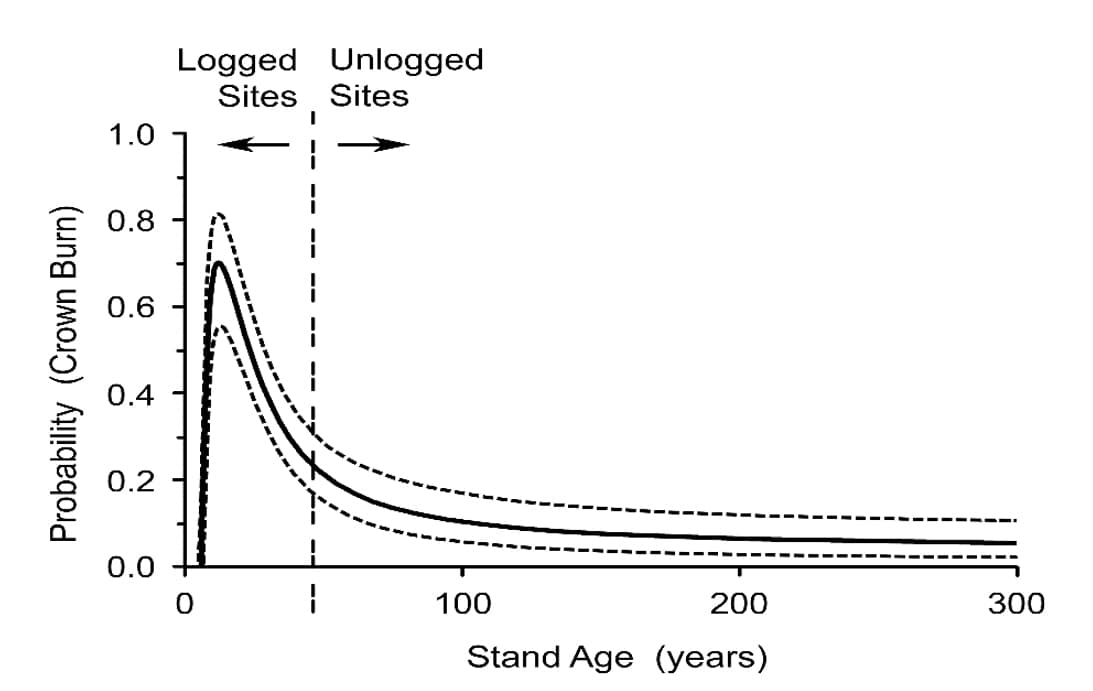
But this study is far from the only one. A separate research team at the University of Wollongong has shown quite clearly that the increased risks of high-severity wildfire last for 70 years after an area has been logged (Wilson et al. 2022). That work states:
“…..fuel was available to burn 1.4 times more often in recently logged sites…..compared to sites that had not been logged for 71 years”.
They go on to state:
“…changes in vegetation associated with logging and to a lesser extent wildfire, increase the risk of fire” (Wilson et al. 2022).
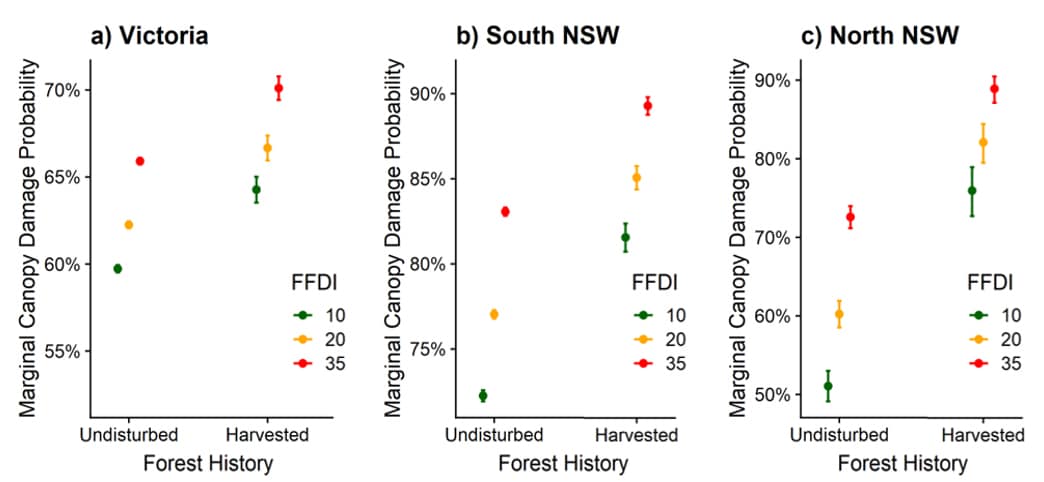
But what about the effects of the biggest wildfires of them all—the Black Summer wildfires of 2019-2020? We completed an extensive analysis of these fires too – right across the entire fire footprint—from north-eastern Victoria to northern New South Wales. That study, published in the international journal Nature Ecology and Evolution, showed that:
- Fire severity was up to 20% higher in logged forests compared to intact forests, even when fire weather conditions were accounted for (Lindenmayer et al. 2022).
- Logged forests were significantly more likely to suffer extensive canopy damage than intact forests (Lindenmayer et al. 2022).
This reinforces the finding that logging contributes significantly to fire severity. That is, logged forests almost always burn at greater severity than intact forests. Increased fire severity that damages the canopies of trees is important because such extreme events are the ones that put people and property at risk (Lindenmayer and Zylstra 2024).
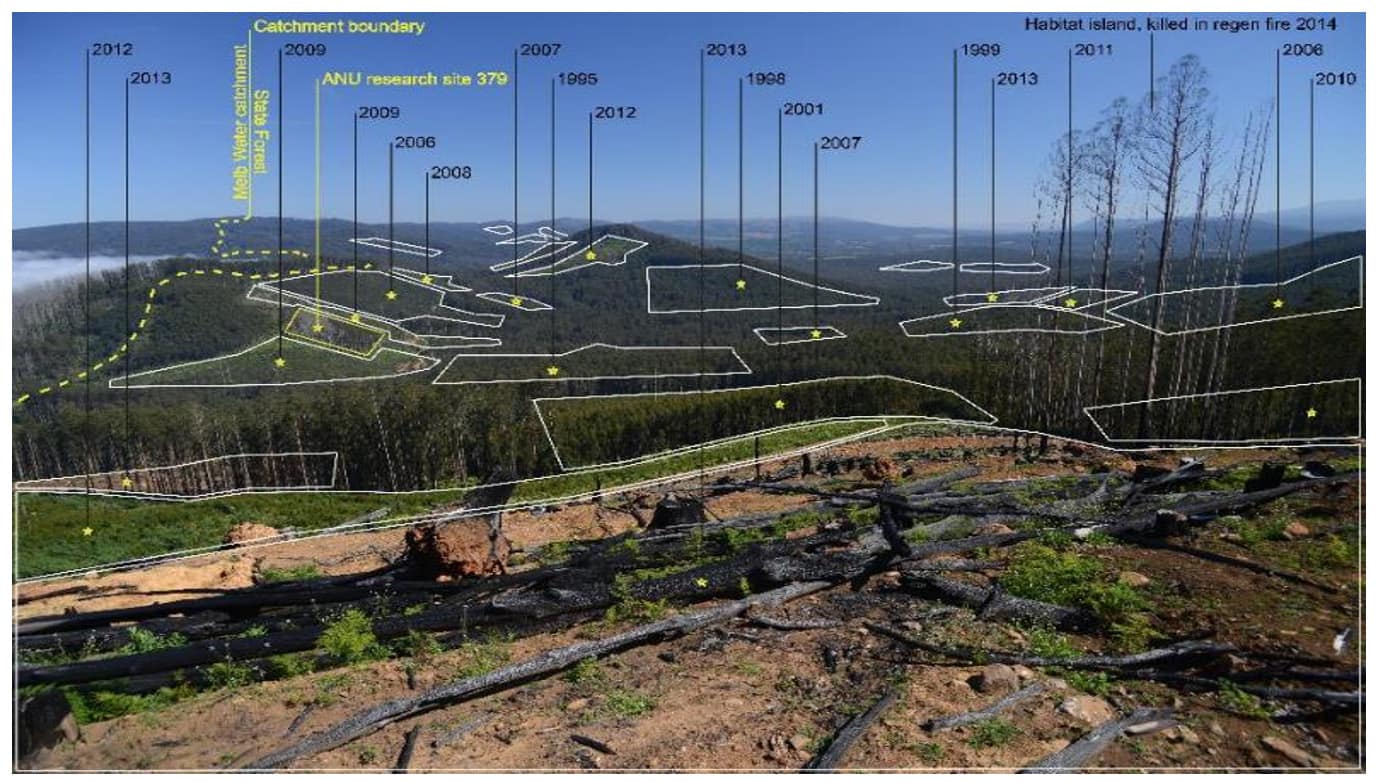
Given that logging clearly increases the risk of high-severity wildfire, there are major risks of fire spreading across those logged landscapes where there are many blocks of cut forest. The figure below shows a typical logged landscape, with the boundaries of a subset of the areas that have been clearfelled highlighted in white. Each area that is regenerated after logging will remain more flammable for up to 40 years (Taylor et al. 2014) and possibly as long as 70 years (Wilson et al. 2022). The risk that fire will spill over from a logged area and spread from one highly flammable site to a nearby one is therefore extremely high.
Wildfire and logging in other parts of the world
The relationships between logging and increased fire severity are not just an Australian issue—it has been empirically documented across multiple regions and ecosystems worldwide. In Australia, studies have confirmed these effects in central Victoria, north-eastern Victoria, south-eastern New South Wales, and northern New South Wales – and in a series of studies from a range of universities (University of Melbourne, The Australian National University, University of Tasmania, and the University of Wollongong).
Beyond Australia, the same pattern has been documented in north-western USA (Thompson et al. 2007) (Levine et al. 2022), central western USA (Bradley et al. 2016) and most recently Canada. These findings reinforce the well-established scientific understanding that logging fundamentally alters forests in ways that make them more flammable. Again, I am more than happy to send Mr Onfray these peer-reviewed studies if he wants to read them. I am also happy to help him understand what the results are showing. The science is clear—ignoring it does not make it any less true.
Wildfire and thinning
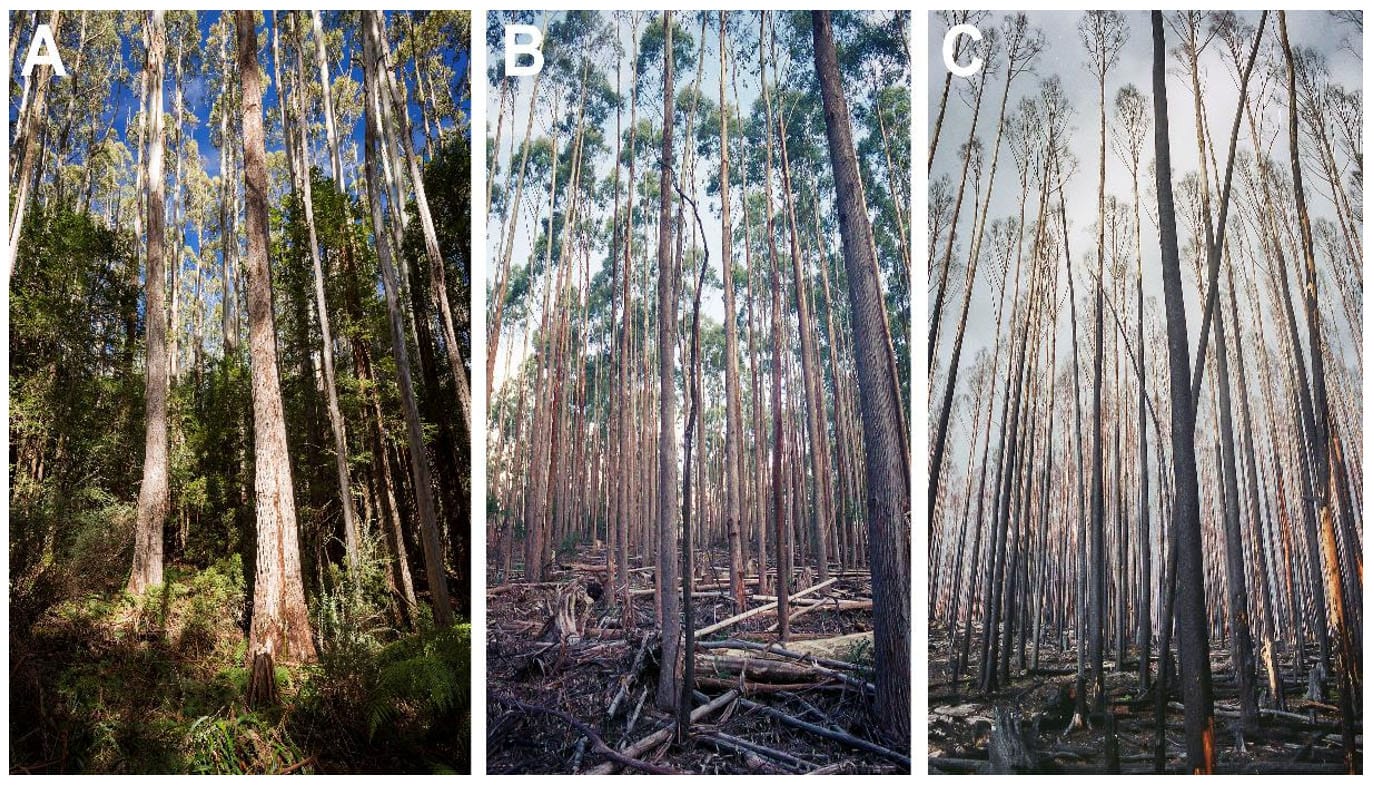
Thinning is a form of logging in which part of the forest is removed, usually by heavy machinery. The history of past thinning operations is well known in places such as Victoria where good records are kept. This makes it possible to compare the severity of wildfire in places that have been thinned with those that have not been thinned. For the comparison to be valid, it is important to control for the type of forest being thinned, fire weather, and other important factors. We did this for the 2009 Black Saturday wildfires in tall, wet forests and drier mixed species forests and found that thinning either had limited effect or increased the risk of high severity wildfire (Taylor et al. 2020). That analysis entailed a comparison of 424 thinned sites and 1687 unthinned sites and was published in the international journal Conservation Letters (Taylor et al. 2020). Many thinned sites burned at very high severity – as shown in the example in Figure 1 below.
An analysis of the 2019-2020 Black Summer wildfires reinforced these findings (Taylor et al. 2021). That work, published in the journal Austral Ecology, examined 1,415 thinned sites and 3,558 unthinned sites across tall wet forests and drier lowland forests. Again, the results showed that thinning either made no difference, or in some cases increased fire severity (Taylor et al. 2021).
Importantly, these findings align with concerns raised by foresters and forestry agencies themselves. As early as the 1990s, reports from Forestry Tasmania (2001) and Buckley and Cornish (1991) acknowledged that thinned forests can accumulate dangerous fuel loads, increasing flammability rather than reducing it. The empirical studies on thinning are large and highly robust and they underscore the statistical validity of our work. They provide the scientific evidence that Mr Onfray is seeking.
Concluding comments
The scientific evidence is overwhelming: Logged forests burn at higher severity than intact forests. These findings are based on decades of research from multiple independent sources.
Of course, wildfire is influenced by many factors, including climate conditions, terrain, and fire weather. However, logging effects can be substantial and sometimes even outweigh the effects of fire weather. Native forest logging is one of the factors that we can control directly—and we must act accordingly by stopping it.
This will reduce the risk of high severity wildfire in many places; something which is vitally important for the safety of people living in rural communities. We can manage forests either by listening to forest industry lobbyists or we can use evidence to guide good decisions. I prefer evidence.
References
– Bradley, C. M., C. T. Hanson, and D. A. DellaSala. 2016. Does increased forest protection correspond to higher fire severity in frequent- fire forests of the western United States? Ecosphere 7:e01492.
– Buckley, A. J., and N. J. Cornish. 1991. Fire hazard and prescribed burning of thinning slash in eucalypt regrowth forest. CSIRO and Department of Conservation and Environment, Melbourne.
– Forestry Tasmania. 2001. Native Forest Silviculture Technical Bulletin 13: Thinning Regrowth Eucalypts. Forestry Tasmania, Hobart.
– Levine, J. I., B. M. Collins, Z. Steel, P. de Valpine, and S. L. Stephens. 2022. Higher incidence of high-severity fire in and near industrially managed forests. Frontiers in Ecology and Environment 20:398-404.
– Lindenmayer, D. B., and P. Zylstra. 2024. Identifying and managing disturbance-stimulated flammability in woody ecosystems. Biological Reviews 99:699–714.
– Lindenmayer, D. B., P. Zylstra, R. Kooyman, C. Taylor, M. Ward, and J. E. M. Watson. 2022. Logging elevated the probability of high-severity fire in the 2019–20 Australian forest fires. Nature Ecology & Evolution 6:533-535.
– Taylor, C., W. Blanchard, and D. B. Lindenmayer. 2020. Does forest thinning reduce fire severity in Australian eucalypt forests? Conservation Letters 14:e12766.
– Taylor, C., W. Blanchard, and D. B. Lindenmayer. 2021. What are the relationships between thinning and fire severity? Austral Ecology.
– Taylor, C., M. A. McCarthy, and D. B. Lindenmayer. 2014. Non-linear effects of stand age on fire severity. Conservation Letters 7:355-370.
– Thompson, J. R., T. A. Spies, and L. M. Ganio. 2007. Reburn severity in managed and unmanaged vegetation in a large wildfire. Proceedings of the National Academy of Sciences 104:10743-10748.
– Wilson, N., R. Bradstock, and M. Bedward. 2022. Disturbance causes variation in sub-canopy fire weather conditions. Agricultural and Forest Entomology 323:109077.
Story series (in order of publication):
Debunking false claims about bushfire risk and native logging in Australia;
Logging does indeed increase fire risks!: David Lindenmayer;
An alternative perspective to David Lindenmayer: South East Timber Association;
Logging and bushfire risk: Robert Onfray responds to David Lindenmayer;
Bushfire risk and native forest logging: David Lindenmayer responds to South East Timber Association;
Fire severity is always greater in areas that have been logged: David Lindenmayer responds to Robert Onfray;
David Lindenmayer ignores core points and key questions: Robert Onfray’s further response;
Megafires thrive on high per hectare fine fuel loads across the forest landscape, regardless of land tenure: SETA’s further response to David Lindenmayer;
Robert Onfray’s response misses core scientific realities – logging makes forests more flammable for many decades: David Lindenmayer;
SETA’s claims ignore established science and economic realities: David Lindenmayer;
David Lindenmayer fails to engage with real-world fire dynamics: Robert Onfray;
Research outputs – Talk about logging but don’t talk about national parks: SETA.
This debate is closing. Australian Rural & Regional News intends to ask a few questions of each of the participants with a view to rounding out the debate.


A major flaw in Lindenmayer’s claims about logged forests being more susceptible to bushfire after 7 years is that the increase in understorey growth after 7 years is caused by the increase in floral diversity as a result of the opening up of the tree canopy and the higher availability of light, nutrients and water. In turn, higher floral diversity then leads on to animal and bird diversity where species are able to exploit the increased floral and related resources created by logging.
In other words, the increased fire risk is a trade-off for our biodiversity. If you want to maximise the number of wildlife species in our forests, then you have to accept a higher risk of bushfire. But Lindenmayer’s research shows that logging provides lower bushfire risk for the first 7 years after logging which is a strong argument for prescribed burning to be conducted at 8 to 12 year intervals.
Academic activists have no skin in the game, meaning they pay no price if their recommendations are implemented and species still go extinct or we still have catastrophic wildfires cause loss of human life etc.