

Professor David Lindenmayer BSc, Dip. Ed, Ph.D, DSC, FAA, FESA, FRZNSW, FAAS, AO
The Australian National University, 14 March 2025.
This article is in response to David Lindenmayer ignores core points and key questions: Robert Onfray’s further response. The entire series of articles and interchanges is listed below.
This debate is drawing to a close. Australian Rural & Regional News intends to ask a few questions of each of the participants with a view to rounding out the debate.
Robert Onfray completely confuses fire intensity (the amount of heat generated) with fire severity (damage to vegetation and soil). He also misunderstands the difference between empirical studies (based on evidence and real-world data) and modelling (theoretical simulations). Additionally, he fails to understand the difference between a literature review and an empirical study.
Many of our studies on fire risk and logging operations are quite clearly empirical studies, based on very large datasets and analysed in partnership with some of the most experienced statistical scientists in Australia and indeed worldwide. Our study in 2014, led by Dr Chris Taylor and based on 633 datapoints, demonstrates a very strong (and highly statistically significant) non-linear relationship between stand age, logging history and fire severity. Interestingly, the paper by Attiwill et al. 2014 mentioned by Robert Onfray lacked formal analysis, but the crude plots they provide actually showed a very similar outcome to the detailed statistical analyses of empirical data completed by Taylor et al. paper.
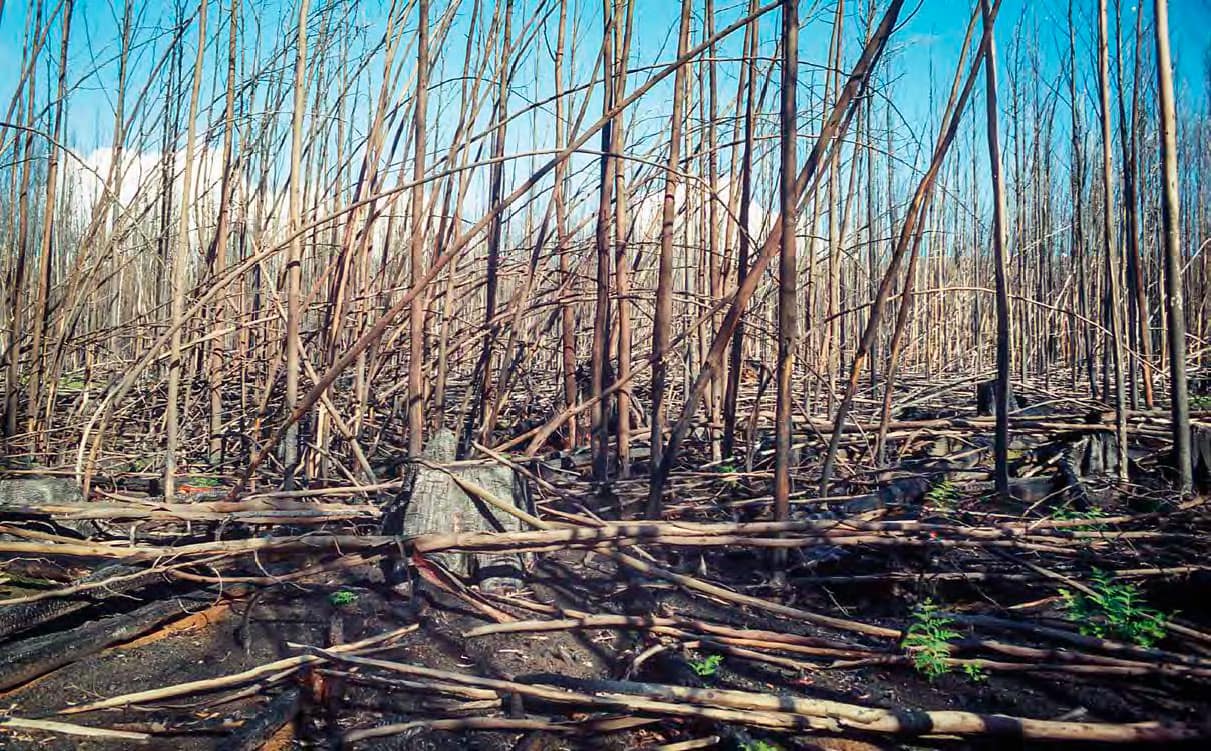
Our 2022 study uses an analysis of millions of points across the entire footprint of the Black Summer 2019-2020 fires. This was not a theoretical study—it was based on analyses of extensive, real-world datasets and showed quite clear, consistent findings: logged forests always burned at higher severity than intact forests. There are several reasons for the extra fire burden created by logging. There are large amounts of logging debris left in logged forests – up to 450 tonnes per hectare – which adds to the amount of fuel. Logged and regenerated forests are drier than intact forests. Logged and regenerated forests are hotter than intact forests. Logged and regenerated forests are windier than intact forests. Logged and regenerated forests are characterised by ladder fuels that can take fire from the understorey to the overstorey, leading to a canopy burn.
Thinning does not help
Our work on thinning encompasses two empirical studies that were based on 424 thinned sites and 1687 unthinned after the 2009 wildfires and 1,415 thinned sites and 3,558 unthinned sites after the 2019-2020 Black Summer fires. In both studies thinning either made no difference to fire severity or made wildfires worse.
Onfray’s misrepresentation of logging’s
impact on fire risk
Robert Onfray claims that logging cannot be responsible for large-scale wildfires because only small areas are logged annually. This argument ignores two critical factors:
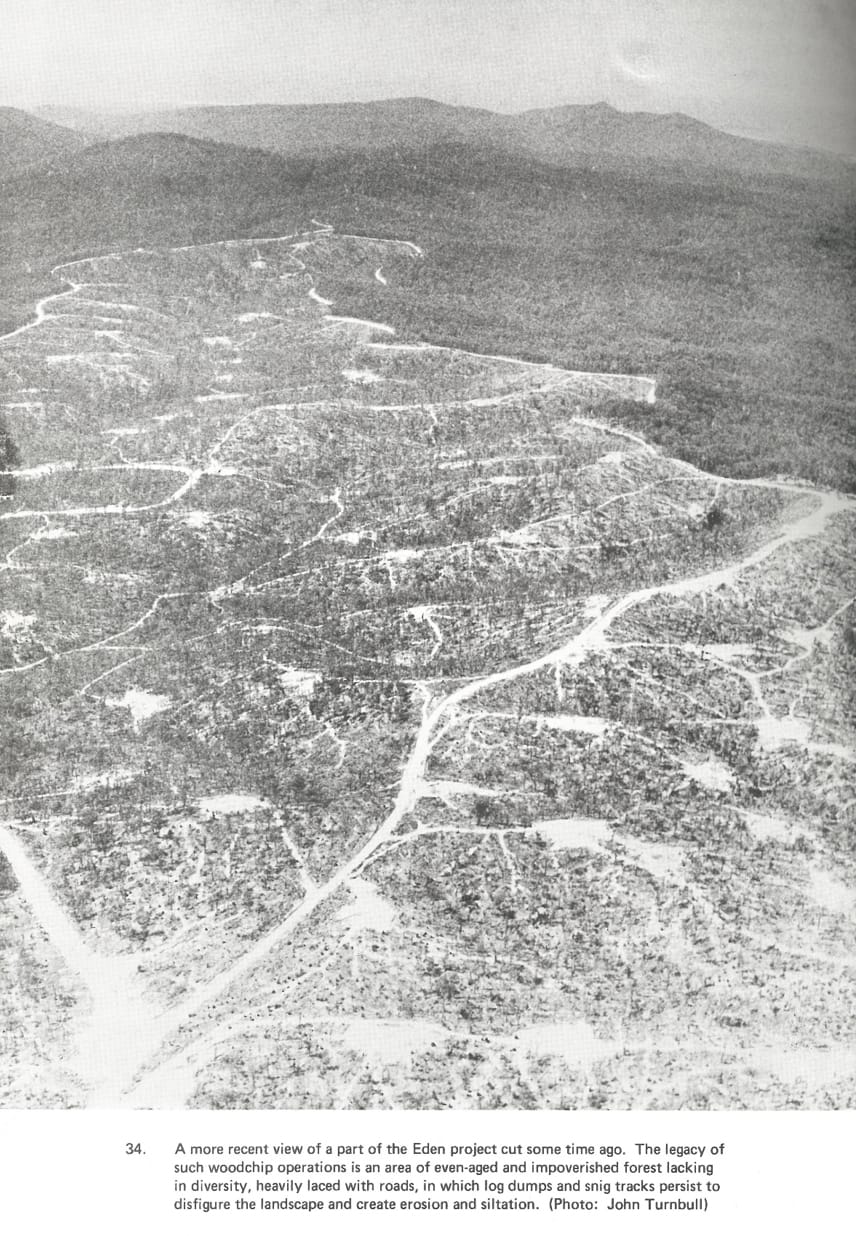
1. Logging is widespread and cumulative – Every year, thousands of hectares are logged, creating many logging coupes (blocks of forest that are cut down) across the landscape. Over time, these logged patches accumulate and create landscapes dominated by extensive areas of regrowth forests that are significantly more fire prone than intact forest.
2. Fire severity in logged and regenerated forests remains elevated for up to 70 years. Everything logged during my entire lifetime (~ 65 years) remains in a more flammable state today. This means that large areas of south-eastern Australia are affected by increased fire severity due to past logging.
Given that logging coupes are cut each year and over many years—and that fire severity remains elevated for up to 70 years—it should be abundantly clear that the impacts of logging on fire risks are substantial and widespread.
Global scientific consensus on logging and fire risk
It is important for readers to recognise that the clear link between logging and fire severity is not just confined to Australia. Major empirical studies (that is not literature reviews nor modelling work) in the USA and Canada have demonstrated the same pattern—logged and regenerated forests burn at higher severity than intact forests. Ignoring this well-documented link poses a serious risk to human safety, particularly for people living in rural Australia. It is important to recognise that any area logged today will carry this extra burden of elevated fire risks until the end of this century—2100. The decisions we make now will impact future generations, leaving our children and grandchildren to deal with consequences of poor forest management decisions.
A fundamental misunderstanding of scientific methodology
Of course, the relationship between fire severity and logging only applies to forests that have been logged—to suggest otherwise is nonsensical, and we have never suggested otherwise.
I have published the results of many true experiments over my 40-year career in science. Robert Onfray’s assertion that controlled experiments are needed to test fire risk in logged areas is absurd. It would be impractical, unethical, and immoral to deliberately light high-severity fires in forests for experimental purposes. Instead, the only responsible way to assess fire risk is through rigorous statistical analyses of large datasets—which is precisely what our research has done.
The evidence is clear—it’s time to act
The science is clear:
1. Logging increases fire severity—over vast areas and for decades.
2. The impact of logging on wildfire risk is not limited to Australia—it has been documented globally.
3. Every native forest logged today increases future fire risks, which will persist for generations.
To continue logging native forests in the face of overwhelming scientific evidence is not just irresponsible—it is reckless. If policymakers are serious about protecting rural communities from increasingly severe wildfires, they must base decisions on science, not industry misinformation.
Story series (in order of publication):
Debunking false claims about bushfire risk and native logging in Australia;
Logging does indeed increase fire risks!: David Lindenmayer;
An alternative perspective to David Lindenmayer: South East Timber Association;
Logging and bushfire risk: Robert Onfray responds to David Lindenmayer;
Bushfire risk and native forest logging: David Lindenmayer responds to South East Timber Association;
Fire severity is always greater in areas that have been logged: David Lindenmayer responds to Robert Onfray;
David Lindenmayer ignores core points and key questions: Robert Onfray’s further response;
Megafires thrive on high per hectare fine fuel loads across the forest landscape, regardless of land tenure: SETA’s further response to David Lindenmayer;
Robert Onfray’s response misses core scientific realities – logging makes forests more flammable for many decades: David Lindenmayer;
SETA’s claims ignore established science and economic realities: David Lindenmayer;
David Lindenmayer fails to engage with real-world fire dynamics: Robert Onfray;
Research outputs – Talk about logging but don’t talk about national parks: SETA.
This debate is closing. Australian Rural & Regional News intends to ask a few questions of each of the participants with a view to rounding out the debate.