


Introduction – fire intensity
South East Timber Association, 7 March 2025. This article is in response to Bushfire risk and native forest logging: David Lindenmayer responds to South East Timber Association. The entire series of articles and interchanges is listed below.
One of the key drivers of fire behaviour that Professor Lindenmayer seems to pay little attention to is the ground fine fuel load across the forest landscape. The key driver of fire intensity, with a given fuel moisture content, wind speed, air temperature and relative humidity, on the day, is fine fuels.
“Fine fuels are the fuels that burn in the continuous flaming zone at the fire’s edge. They contribute the most to the fire’s rate of spread and flame height. Typically, they are dead plant material, such as leaves, grass, bark and twigs thinner than 6mm thick, and live plant material thinner than 3mm thick. Once ignited, these fine fuels generally burn out within two minutes.”1 Understorey shrubs and regrowth, ladder fuels also contribute to both flame height and forest fire rate of spread.
Empirical studies are the collection and analysis of primary data based on direct observation or experiences in the ‘field’. Fine fuel and ladder fuel loads are empirical values, that can be measured in the field. Empirical studies of these values have underpinned bushfire behavioural science in Australia for over 50 years.
Fire severity
Many fire scientists and others with forest science degrees and decades of forest management, fire mitigation and firefighting experience have a number of questions and concerns about Professor Lindenmayer’s opinion on the impacts of native forest harvesting on fire severity.
Papers by Attiwill et al 20142, Bowman et al 20223, among others, provide an alternative scientific context to key drivers of high intensity fires, to those postulated by Professor Lindenmayer and others.
Bowman et al stated: “For instance, a broadscale analysis of fire-severity mapping of forests across land tenures in the state of New South Wales (NSW), Australia burned in 2019–20 (~4.1 Mha) found no clear differences in the proportion of high or extreme fire severities between native forests in National Parks (54.5% of the area burned) and those in public forests available for timber production and privately owned forests (43.2% of the area burned).”3
The Greater Blue Mountains World Heritage Area (GBMWHA), in recent decades, has generally been subject to a minimal human intervention management regime that appears to mirror Professor Lindenmayer’s view of how forested land in Australia should be “managed.”
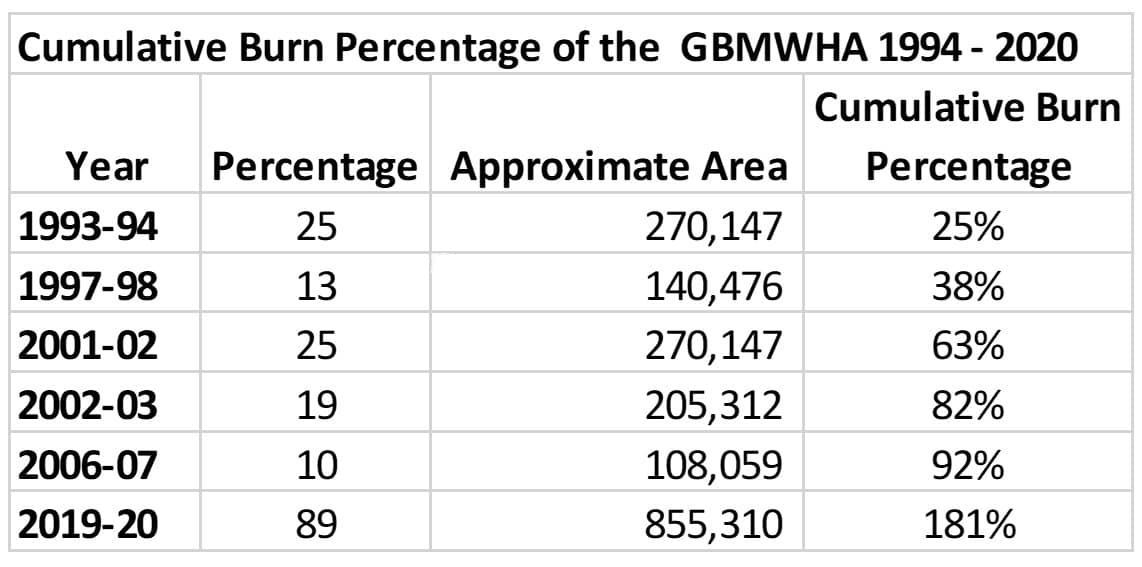
The 2019-20 figures include the Gospers Mountain Fire, the biggest fire from a single ignition source in Australia’s recorded history. The May 2021 summary of the impacts of the GBMWHA fires noted among other things that: “The unprecedented scale of the fires, leaving few unburnt refuges from which to recolonise, makes the recovery of the fauna highly problematic.”
How much of this permanently protected wilderness, other than the Wollemi Pines, had not been subject to multiple high or extreme fire severity impacts between 1994 and 2020? What environmental impact is this repeated high/extreme severity fire regime having on biodiversity and water catchment values?
The issue of repeated high intensity megafires may, in part, explain why the NSW NP&WS September 2021 Zero Extinctions report states: “There is evidence that the overall decline in biodiversity in NSW is occurring even in the national park estate.”4
It is highly unlikely that the cessation of native forest harvesting will change the impacts of fire severity in the 1,080,588 hectare GBMWHA, given the fine and ladder fuel loads across this and most parks and reserves.
Professor Lindmayer claims native forest logging is not economically viable
The two economic reports referenced by Professor Lindenmayer omit several significant costs to government and communities, should the native forest industry close. The cost of alternate land management arrangements don’t come free. The management costs of the NSW National Parks & Wildlife Service have been bundled into the now Climate Change, Energy, the Environment and Water budget. Analysis of the last available cost to government of managing the NSW conservation reserve system was over $50 per hectare above State Forest land management costs.
Shutting down the NSW native forest industry could cost the NSW government an additional $90 million, if the FCNSW balance sheet was to break even. If the 2023-24 FCNSW hardwood operational loss of $29 million was to continue and be funded by government, the additional cost to government of shutting down FCNSW would be a mere $61 million. The cost of lost tax revenue, business adjustment programs and unemployment benefit costs would also be a cost to government.
The loss of $2.9 billion in gross revenue and $1.1 billion in gross value add5 the native forest industry delivers would have major social and economic impacts on affected communities.
The building sector is embracing mass timber construction as a green solution. Mass timber high rise construction is increasing, but where is this timber coming from, as Australia locks more and more native forest into wilderness fire buckets? Timber imports are expected to supply 40 per cent of timber consumption by 2027, because the proposed transition of hardwood demand to more Australian plantations has no factual basis.
Mass timber beams used in the Adelaide aquatic centre have taken an expensive carbon miles journey from Austria, via Belgium to Australia.6 The mass timber beams for the Sydney Fish Markets’ new roof have also taken an expensive carbon miles journey from Northern Italy.7
Professor Lindenmayer claims logging is driving species declines
Professor Lindenmayer states “The science is clear—logging fragments ecosystems, removes critical nesting sites, and pushes species towards extinction.”
Species like the critically endangered Leadbeater’s Possum are on the brink due to habitat loss.”
With regard to the lowland population of Leadbeater’s Possum, Environment Victoria reports: “As the floodplain habitat deteriorates in Yellingbo, the number of colonies has reduced dramatically over the past 20 years. Hydrology is the driving factor in this population decline.”
Increased survey efforts of the highland population of Leadbeater’s Possum (LBP), by VicForests, has revealed many new LBP colonies. In March 2024, Vicforests reported that “between 2014 and 2021 we established well over 1,000 exclusion zones around sightings of Leadbeater’s possums in state forests. This resulted in over 14,000 hectares of a forest being reserved and protected as new Leadbeater’s possum colony reserves.”8
VicForests also noted LBP were more frequently found in 20-40 year old fire or harvesting regrowth with retained hollow bearing trees, than 75 year old forest (1939 regrowth). Unfortunately, most of the survey effort has focussed on state forest subject to timber harvesting. Consequently, reliable comparison of LBP population density, between state forests and national parks is not possible.9
Endangered Southern Brown Bandicoot
Predation by introduced feral cats and foxes is a landscape scale threat to many bird and mammal species, which gets very little attention from most critics of the native forest industry.
In May 2016, the Federal Threatened Scientific Committee (TSCC) reviewed the conservation status of the Southern Brown Bandicoot (SBB). The table below formed part of the advice. The authors of the report alleged that timber harvesting “(i)mpacts are large in south-east NSW.”10
In July 2016, an assessment of the conservation of the SBB in NSW was released. It noted:
- “Within State Forests in the same region (Eden), recent changes from seasonal predator control to permanent predator control programs have seen increases in both southern brown bandicoots and long-nosed potoroos.”
- “Recently a translocation from the Eden region into Jervis Bay (ACT) was performed.”11
This Eden region referred to state forests within the Eden region, managed by FCNSW.
The table seems to clearly explain why Parks Australia and the Taronga Conservation Society came to the Forestry Corporation of NSW to obtain both SBB and Long-nosed Potoroos to repopulate the Booderee National Park, where both species had been long extinct.
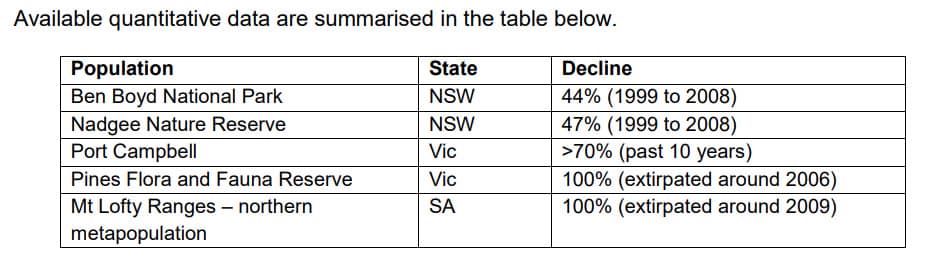
While the SBB data from the conservation reserve system in three states was all bad news, why did the national TSSC choose to ignore the good news from state forests in their assessment of the SBB conservation status? Was there bureaucratic embarrassment that multiple use state forests, managed by FCNSW, had a more comprehensive and effective program of predator control, which was making a real difference to SBB and other mammal species?
Endangered (Federal TSSC listing) Long-footed Potoroo
In November 2015, the NSW Threatened Species Committee noted: “Long-footed Potoroos have never been directly observed in NSW despite extensive surveys for this species within areas predicted by a habitat model based on climate and vegetation.”
Intensive survey for this species in the period 1988-1996 yielded only 17 definite records, comprised of 6 predator scat records and 11 hair tube detections.”
The NSW TSSC listed the NSW Long-footed Potoroo (LFP) as critically endangered in NSW.12
Initially, in southern NSW, a Potoroo Management Zone was created in the early 1990s, and was managed to prevent road building, prescribed burning and logging. As a result of the 1988-96 surveys, additional areas of state forest became part of the South East Forest National Park (SEFNP) in 1997.
No LFP had ever been seen in NSW. Over 12 months in 2016-17, 20 years after the dedication of the SEFNP, the NSW NP&WS undertook 25,120 infrared “trap” nights, across the modelled LFP range, with 43 species being photographed, but NO LFPs.
By 2019, there were still no sightings of LFP. There were uncertainties regarding species identification from hair and scat samples and a number of probable LFP designations in the BioNet LFP database.
Enquiries were made with NP&WS staff regarding the availability of hair and scat samples, as DNA analysis may have been able to resolve the uncertainties. The response was: “No analyses were undertaken by National Parks and Wildlife Service (NPWS), as all samples were sent away for identification. No material has been retained by OEH and NPWS.”
Follow up advice confirmed that the independent contractor who examined the samples had not retained any material either. Why would a conservation agency not retain at least some of the “hard” evidence to show that the never seen LFP had existed in NSW?
Despite Professor Lindenmayer’s gloomy outlook that “logging is driving species declines”, in October 2023, FCNSW published the first photo of a Long-footed Potoroo ever taken in NSW. It was photographed in the multiple use Bondi State Forest.
The way forward: smarter fire management
Professor Lindenmayer’s 19 February response to SETA states: “Victoria’s fire management authorities have already demonstrated in just the last week, the effectiveness of proactive suppression strategies. Forest Fire Management Victoria (FFMVic) has successfully used aerial water-bombing and rapid air attack responses to control recent fire ignitions, particularly those caused by lightning strikes.”
For up to eight weeks before the ignitions Professor Lindenmayer referred to, over 30 fire bombing aircraft had been deployed to western Victoria and all foam and retardant loading systems were fully operational. The impacts of the western Victorian bushfires, over the prior eight weeks, give little comfort that the threats high intensity megafires pose to Australia’s biodiversity will be addressed by Professor Lindenmayer’s ”way forward” opinion.
In the month prior to his statement, the ABC reported on 27 January 2025: “Authorities said the fire in Little Desert National Park travelled more than 40kms over the course of Monday afternoon, burning a long strip through the terrain … Firefighting aircraft have been grounded for the day.”13
On 28 January 2025 the ABC reported: “Bushfire in Victoria’s west burns 65,000 hectares in a day, destroys Little Desert Nature Lodge and homes.” In a few days, the Little Desert fire burnt more than 95,000 hectares of national park and private property.
It was reported that the Wallaby Rocks section of the Grampians fire burnt 59,000 hectares and the Yarram Gap Road section burnt 76,000ha. A total of 135,000 hectares of national park and private property was burnt. Much of the affected area burnt at high to extreme severities.
How has logging contributed to the fire severity of these disasters in the western Victorian conservation reserve system? What is the impact of these fires on endangered species?
Aircraft can be effective in initial attack on fires. However a total reliance on fast initial attack in forests with heavy fuel loads across the landscape has been shown, year after year, to be a recipe for disaster. Aircraft can be very useful in supporting backburning operations.
The broadscale use of aircraft for day to day bombing of active fire fronts distant from control lines can cost tens of millions of dollars. In 2019-20, the NSW aircraft hire bill was $255 million. In relation to the western Victorian fires, “Of a total 22 million litres of water and fire retardant used on the Grampians bushfires, Hamilton has loaded 345 bombers with 1.1million litres.”14
Ecologically and from a risk mitigation to human lives and property perspective, a much greater emphasis on broadscale low intensity burning is the way forward to smarter fire management.
References
1. DSE Overall Fuel hazard Assessment Guide 4th Edition July 2010
2. Attiwill et al: https://conbio.onlinelibrary.wiley.com/doi/abs/10.1111/conl.12062
3. Bowman et: al https://www.forestry.org.au/wp-content/uploads/2022/04/Bowman-et-al.-NEE-2022-response-to-Lindenmayer-et-al-2022.pdf
4. https://www.environment.nsw.gov.au/-/media/OEH/Corporate-Site/Documents/Parks-reserves-and-protected-areas/Parks-management-other/national-parks-wildlife-service-threatened-species-framework-210369.pdf
5. Economic Contribution Study of the NSW Hardwood Timber Industry (NEFH 14 February 2023)
6. https://woodcentral.com.au/australias-largest-timber-beams-paraded-through-downtown-adelaide/
7. https://woodcentral.com.au/sydney-fish-markets-huge-glulam-roof-has-finally-clicked-into-place/ 8. https://archive.vicforests.com.au/publications-media/latest-news/setting-the-record-straight-yet-again
9. https://www.wildlife.vic.gov.au/__data/assets/pdf_file/0032/27896/Targeted-survey-report-2015_final-7Oct15r.pdf
10. Threatened Species Scientific Committee Conservation Advice Isoodon obesulus obesulus 5 May 2016
11. Isoodon obesulus obesulus Southern Brown Bandicoot (eastern) Assessment of conservation status in NSW 4 July 2016
12. NSW Scientific Committee Final Determination Long-footed Potoroo November 2015
13. https://www.abc.net.au/news/2025-01-27/little-desert-bushfire-dimboola-victoria/104865044 14. https://www.abc.net.au/news/2025-02-14/cfa-veterans-too-old-for-fire-trucks-power-water-bombing-fleet/104905450
Story series (in order of publication):
Debunking false claims about bushfire risk and native logging in Australia;
Logging does indeed increase fire risks!: David Lindenmayer;
An alternative perspective to David Lindenmayer: South East Timber Association;
Logging and bushfire risk: Robert Onfray responds to David Lindenmayer;
Bushfire risk and native forest logging: David Lindenmayer responds to South East Timber Association;
Fire severity is always greater in areas that have been logged: David Lindenmayer responds to Robert Onfray;
David Lindenmayer ignores core points and key questions: Robert Onfray’s further response;
Megafires thrive on high per hectare fine fuel loads across the forest landscape, regardless of land tenure: SETA’s further response to David Lindenmayer;
Robert Onfray’s response misses core scientific realities – logging makes forests more flammable for many decades: David Lindenmayer;
SETA’s claims ignore established science and economic realities: David Lindenmayer;
David Lindenmayer fails to engage with real-world fire dynamics: Robert Onfray;
Research outputs – Talk about logging but don’t talk about national parks: SETA.
This debate is closing. Australian Rural & Regional News intends to ask a few questions of each of the participants with a view to rounding out the debate.


Well written piece showing that shaping forest management on the advice of academic ecologists lacking in practical fire management experience, is a recipe for disaster.