


Professor David Lindenmayer AO, 19 February 2025. This submission is in response to the article An alternative perspective to David Lindenmayer: South East Timber Association, published on ARR.News on 14 February 2025. The entire series of articles and interchanges is listed below.
In response to the South East Timber Association’s (SETA) critique, I want to clarify the scientific evidence and address the inaccuracies in their claims.
Logging increases fire risk
– the consequences of ignoring the evidence
SETA disputes the well-documented link between logging and increased fire severity, but the scientific consensus is clear: logging fundamentally alters forests in ways that make them more flammable. The science is clear that logged forests almost always burn at higher severity than intact forest – as seen in the Black Summer wildfires from north-eastern Victoria to north-eastern New South Wales (Lindenmayer et al. 2022b) – an effect that lasts from 40-70 years after a forest has been logged (Taylor et al. 2014) (Wilson et al. 2022).
What’s at stake here isn’t just an academic debate—it’s the safety of rural communities. Fire authorities, including the NSW Rural Fire Service, already recognise this risk. During the catastrophic 2019–2020 wildfires, operational maps flagged recently logged areas as high-risk zones due to excessive debris accumulation. This isn’t just theory; it’s an acknowledged hazard in real-world firefighting.
The reasons for the link between logging and increased fire risk are well understood: logged forests are drier, windier, and littered with hundreds of tonnes of debris, creating ideal conditions for intense and severe wildfires (Lindenmayer and Zylstra 2024). This has been documented not just in Australia, but globally—including both North America and South America (Lindenmayer and Zylstra 2024).
Dismissing scientific findings from detailed empirical studies that show the link between logging and wildfire isn’t just misleading—it’s dangerous. If we ignore what the science and firefighting agencies are telling us, we increase the likelihood of more devastating fires, putting lives, property, and ecosystems at risk. Rather than debating well-established facts, the focus should be on solutions: that is, both preventing future logging-driven fire risks and also investing in smarter fire management strategies that protect both people and the environment (Lindenmayer et al. 2022a).
Native forest logging is not economically viable
The economic case for native forest logging is weak. Time and again, financial analyses have shown that native forest logging operates at a major loss when subsidies and environmental costs are accounted for (Frontier Economics and ANU 2021, Frontier Economics 2023). Public funds continue to prop up a native forest logging industry (Chapman et al. 2025) that degrades water supplies, biodiversity, and carbon stores—all of which economic accounting studies have shown have significantly higher long-term value than native forest logging (Keith et al. 2017). The future lies in plantation-based forestry (Lindenmayer and Taylor 2022), not in the continued destruction of native forests.
Logging is driving species declines
SETA downplays the impact of logging on biodiversity, but the reality is undeniable: native forest logging is a major driver of habitat destruction (Ward et al. 2024). Species like the critically endangered Leadbeater’s Possum are on the brink due to habitat loss. Old-growth forests cannot simply be “replaced” with young regrowth. The science is clear—logging fragments ecosystems, removes critical nesting sites, and pushes species towards extinction. It is also critical to understand that recent studies show that the recovery of biodiversity following wildfires is severely impaired when forests have been subject to repeated previous disturbances, including past logging (Lindenmayer et al. 2019). This was a key result from a recent major analysis of the effects on the 2019-2020 Black Summer wildfires on biodiversity (Driscoll et al. 2024).
The way forward: smarter fire management
Rather than continuing to debate well-established science, efforts should be directed toward solutions that reduce fire risk and protect both people and the environment. Victoria’s fire management authorities have already demonstrated in just the last week, the effectiveness of proactive suppression strategies. Forest Fire Management Victoria (FFMVic) has successfully used aerial water-bombing and rapid air attack responses to control recent fire ignitions, particularly those caused by lightning strikes. These targeted interventions prevent small fires from escalating into large-scale disasters, underscoring the importance of early detection and rapid response. The best time to fight fires is when they are small (Plucinski 2012). Using new technology to help us do that is critical (Lindenmayer et al. 2022a) – something that engineers and scientists at The Australian National University have been working intensively on for several years now (Lindenmayer et al. 2022a).
The next step in strengthening fire management is developing and implementing advanced drone technology. Emerging high-tech drone systems have the potential to revolutionise firefighting by providing real-time fire surveillance, detecting ignitions faster than ever before, and even carrying out autonomous suppression efforts in hazardous conditions (Yebra et al. 2021). For example, new generation drones can carry payloads of 1000kg and hit targets such as recent ignitions with extraordinary precision. Investing in these innovations—rather than continuing a logging regime that makes forests more fire-prone—is the logical path forward. Moreover, developing these technologies offers important business and export opportunities for Australia to help tackle the global problem of increasing fire risk in forests (Bousfield et al. 2023).
Conclusion
The scientific and economic evidence overwhelmingly supports ending native forest logging—not only to protect biodiversity and water supplies but also to reduce bushfire risk and limit economic losses from a failing and highly subsidized industry (Lindenmayer 2024). The ongoing degradation of native forests contradicts both environmental responsibility and public safety. With modern fire management strategies proving their effectiveness and technological advancements offering even greater possibilities, the focus must shift toward smarter, science-driven solutions. The future of Australia’s forests should be built on sound economics, resilience, conservation and innovative fire mitigation—not industry myths that put communities at risk.
References
– Bousfield, C., D. B. Lindenmayer, and D. Edwards. 2023. Major and increasing wildfire-driven losses of timber stocks globally. Nature GeoScience 16:1145–1150.
– Chapman, B., J. Mitchell, and D. B. Lindenmayer. 2025. A Disturbing Example of Inequitable and Expensive Government Subsidies: The Logging of Native Forests in Australia. Australian Quarterly 96:17-25.
– Driscoll, D. A., and e. al. 2024. Biodiversity impacts of the 2019–2020 Australian megafires. Nature.
– Frontier Economics. 2023. Public native forest logging: a large and growing taxpayer burden. Frontier Economics, Melbourne, Victoria.
– Frontier Economics and ANU. 2021. Comparing the value of alternative uses of native forests in southern NSW. Frontier Economics and ANU, Singapore.
– Keith, H., M. Vardon, J. A. R. Stein, J. L. Stein, and D. B. Lindenmayer. 2017. Ecosystem accounts define explicit and spatial trade-offs for managing natural resources. Nature Ecology and Evolution 1:1683-1692.
– Lindenmayer, D., and C. Taylor. 2022. Diversifying forest landscape management – a case study of a shift from native forest logging to plantations in Australian wet forests. Land 11:407.
– Lindenmayer, D., P. Zylstra, and M. Yebra. 2022a. Adaptive wildfire mitigation approaches. Science 377:1163-1164.
– Lindenmayer, D. B. 2024. The Forest Wars. Allen& Unwin, Crows Nest, Sydney, Australia.
– Lindenmayer, D. B., M. J. Westgate, B. C. Scheele, C. N. Foster, and D. P. Blair. 2019. Key perspectives on early successional forests subject to stand-replacing disturbances. Forest Ecology and Management 454:117656.
– Lindenmayer, D. B., and P. Zylstra. 2024. Identifying and managing disturbance-stimulated flammability in woody ecosystems. Biological Reviews 99:699–714.
– Lindenmayer, D. B., P. Zylstra, R. Kooyman, C. Taylor, M. Ward, and J. E. M. Watson. 2022b. Logging elevated the probability of high-severity fire in the 2019–20 Australian forest fires. Nature Ecology & Evolution 6:533-535
– Plucinski, M. 2012. Factors Affecting Containment Area and Time of Australian Forest Fires Featuring Aerial Suppression. Forest Science 58:390-398.
– Taylor, C., M. A. McCarthy, and D. B. Lindenmayer. 2014. Non-linear effects of stand age on fire severity. Conservation Letters 7:355-370.
– Ward, M., K. Ashman, D. B. Lindenmayer, S. Legge, G. Kindler, T. Cadman, R. Fletcher, N. Whiterod, M. Lintermans, P. Zylstra, R. Stewart, H. Thomas, S. Blanch, and J. E. Watson. 2024. Shifting baselines clarify the impacts of contemporary logging on forest-dependent threatened species. Conservation Science and Practice 6:e13185.
– Wilson, N., R. Bradstock, and M. Bedward. 2022. Disturbance causes variation in sub-canopy fire weather conditions. Agricultural and Forest Entomology 323:109077.
– Yebra, M., N. Barnes, C. Bryant, G. C. Cary, S. Durrani, J. U. Lee, D. Lindenmayer, R. Mahony, R. Prinsley, P. Ryan, R. Sharp, M. Stocks, A. Tridgell, and X. Xiangyun Zhou. 2021. An integrated system to protect Australia from catastrophic bushfires. Australian Journal of Emergency Management 76:4.
Story series (in order of publication):
Debunking false claims about bushfire risk and native logging in Australia;
Logging does indeed increase fire risks!: David Lindenmayer;
An alternative perspective to David Lindenmayer: South East Timber Association;
Logging and bushfire risk: Robert Onfray responds to David Lindenmayer;
Bushfire risk and native forest logging: David Lindenmayer responds to South East Timber Association;
Fire severity is always greater in areas that have been logged: David Lindenmayer responds to Robert Onfray;
David Lindenmayer ignores core points and key questions: Robert Onfray’s further response;
Megafires thrive on high per hectare fine fuel loads across the forest landscape, regardless of land tenure: SETA’s further response to David Lindenmayer;
Robert Onfray’s response misses core scientific realities – logging makes forests more flammable for many decades: David Lindenmayer;
SETA’s claims ignore established science and economic realities: David Lindenmayer;
David Lindenmayer fails to engage with real-world fire dynamics: Robert Onfray;
Research outputs – Talk about logging but don’t talk about national parks: SETA.
This debate is closing. Australian Rural & Regional News intends to ask a few questions of each of the participants with a view to rounding out the debate.


Lindenmayer is an acknowledged anti-fire and anti-logging activist but it’s important to understand a few points.
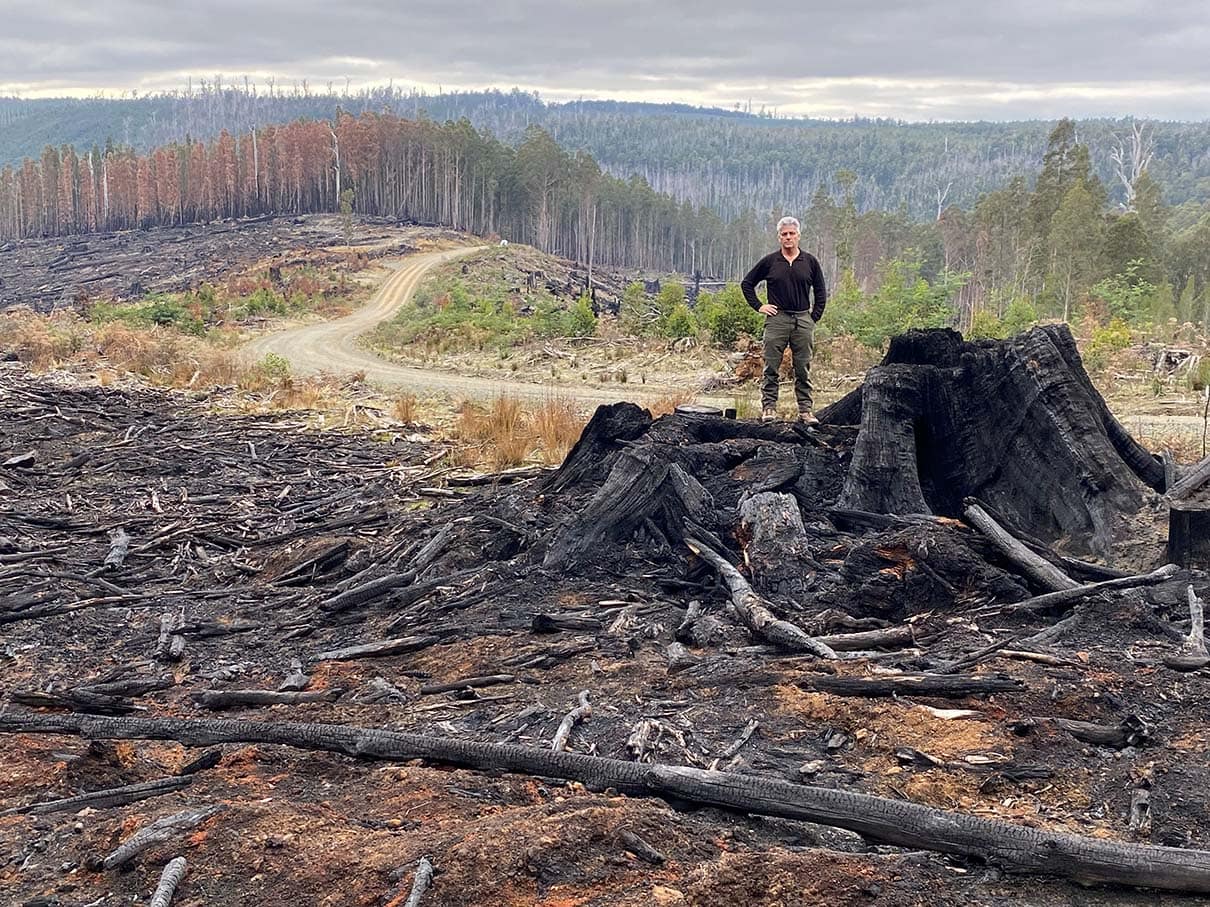
What he refers to as ‘logging’ is in fact clear felling (as shown by the photo in the article) yet the two types of native forest harvesting are hugely different in their environmental impacts. He needs to very carefully differentiate between the two types of harvesting.
Much of his research applies to mountain ash – a forest ecosystem which regenerates only after catastrophic wildfire. His findings on this ecosystem type generally cannot be applied to other forest ecosystems because of the profound differences between them and mountain ash.
His reference to Leadbeater’s Possum being critically endangered (as it may well be) fails to acknowledge that, at the time of European settlement, many species of wildlife were critically endangered either through natural causes or because of Aboriginal hunting and/or use of fire. To now blame timber harvesting for all the conservation problems found in our forests is scientifically dishonest and the sign of a true activist at work!
There’s a claim in the article stating “Old growth forests cannot be replaced with young regrowth”. Fair enough. But perhaps we should confirm what we mean by old growth. According to some it is appears to be any forest of any age. Native timber harvesting is undertaken in regrowth forests, much of which is naturally regenerated. Environmental protections and regulations are in place – the Federal Court in NSW found as much. Surely it is better to have sensible management of a local resource, with proper risk management, mitigation and controls, rather than offshoring our timber needs, supply chains and jobs to other places.
Tim Lester, General Manager, Australian Forest Contractors Association