A 30-year professional fisherman who grew up surfing and spearfishing says he’s too worried about the shark numbers he sees in the ocean every week to paddle out at his favourite break.

Multiple NSW estuary, rock and beach, and deep-sea champion, and 2025 Australian Bass Tournaments champion, Ben Hay spoke to the Clarence Valley Independent about the explosion in shark numbers he has seen during his career, what has contributed to this population increase, and possible remedies to the current problem.
Mr Hay has current ocean trap and line fishing entitlements for the waters off the NSW Central Coast and is out in the ocean every week.
“On top of my commercial fishing history I surfed and spearfished my whole childhood, right through my teens, and I have surfed until recently,” he said.
“Back when we were young and in our teenage years you never saw a shark, it was unheard of and there just wasn’t many attacks back in those days.”
“There was quite a big commercial shark fishery through the 1960s, 70s, and 80s, and all that shark got sold as fish and chips, known as flake,” he said.
“There were boats in the Northern Rivers region, some of them were trawlers, and when the prawn season finished, they used to put big drums on their boats, and they’d shoot hundreds of hooks on a set line and catch sharks.
The were several factors that saw a downturn in commercial shark fishing including the banning of wire traces and protection of species.
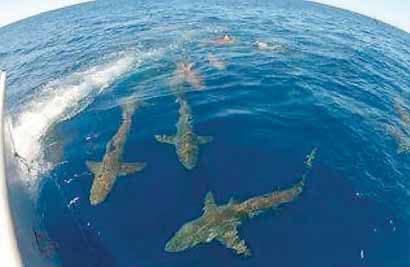
“The DPI clamped down and they imposed a lot of rules and regulation that made it totally unviable for us to even bother targeting sharks,” he said.
“Numbers of Grey Nurse sharks were declining, so they got deemed as a protected species and part of the management plan was that wire traces were banned inside of three miles of the shoreline.
“The rule doesn’t really make sense because if you were to go and set line with heavy monofilament leader, which you’re allowed to do, all the sharks that you’d want to catch would bite you off, and the only ones that wouldn’t bite you off would be Grey Nurses, so to me that management plan was counterproductive.
“The regulations made shark fishing unviable and that pretty much finished shark fishing along the coastline for good.”
Mr Hay said currently, licensed commercial fishermen are permitted to catch 500 kg of shark a week, and six Wobbegong Sharks per day.
But for what they earn for their effort, it is no longer worth focusing on sharks.
“Shark fishing has never been a big part of my business, but at times there’d be an odd month or two where I would go shark fishing to fill in when the fishing wasn’t really good,” he said.
The death of the commercial shark fishing industry coincided with an increase in shark numbers, as certain species weren’t being caught in such numbers.
“A lot of the shark that was sold for flake was whaler sharks, but you caught other species too,” he said.
“For the commercial shark fishery, the bulk of the catch was Whaler sharks, and four species of Whaler used to be caught by the tonnes.
“You commonly caught Bronze Whalers, Dusky Whalers, Black Tip Whalers, and Bull sharks or River Whalers as we used to call them.
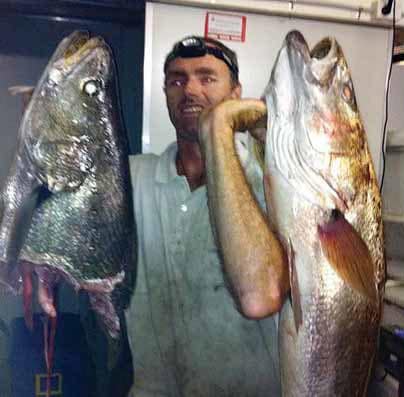
“They were all headed and gutted and sent to market including juvenile Great Whites, small Tiger sharks.
“Even back then, for the big sharks you didn’t get a lot of money, but there was money in the fins and the jaws.
“Changes to the commercial shark fishing industry saw the shark fin market shut down, because across the top end of Australia they were catching sharks, chopping the fins off the body and letting them sink to the bottom.”
When the commercial shark fishing industry was massively reduced, the dynamics of the Australian fish and chip market changed.
“Every fish and chip shop in Australia then relied on shark for flake, fish cocktails and without a ready supply of flake, Australian fish and chip shops had source their fish.
“Rather than the buyers purchasing shark that they have to fillet and process, they now import cheap fish, that is already pre-filleted and frozen in boxes, like Basa from Asia and Hoki from New Zealand,” he said.
“The price for sharks isn’t there either anymore because the buyers just want to buy frozen, pre-filleted.
“Now they have a freezer full of these frozen fillets, and it became convenient for them, they can get it cheap by buying it in bulk, whereas shark was more labour intensive.
“Even if we were able to shark fish again, the market isn’t really there anymore, because it has been replaced by cheap, pre-filleted, frozen imported fish.”
The NSW Department of Primary Industries also introduced shark management plans which, Mr Hay said have contributed to an increase in shark numbers.
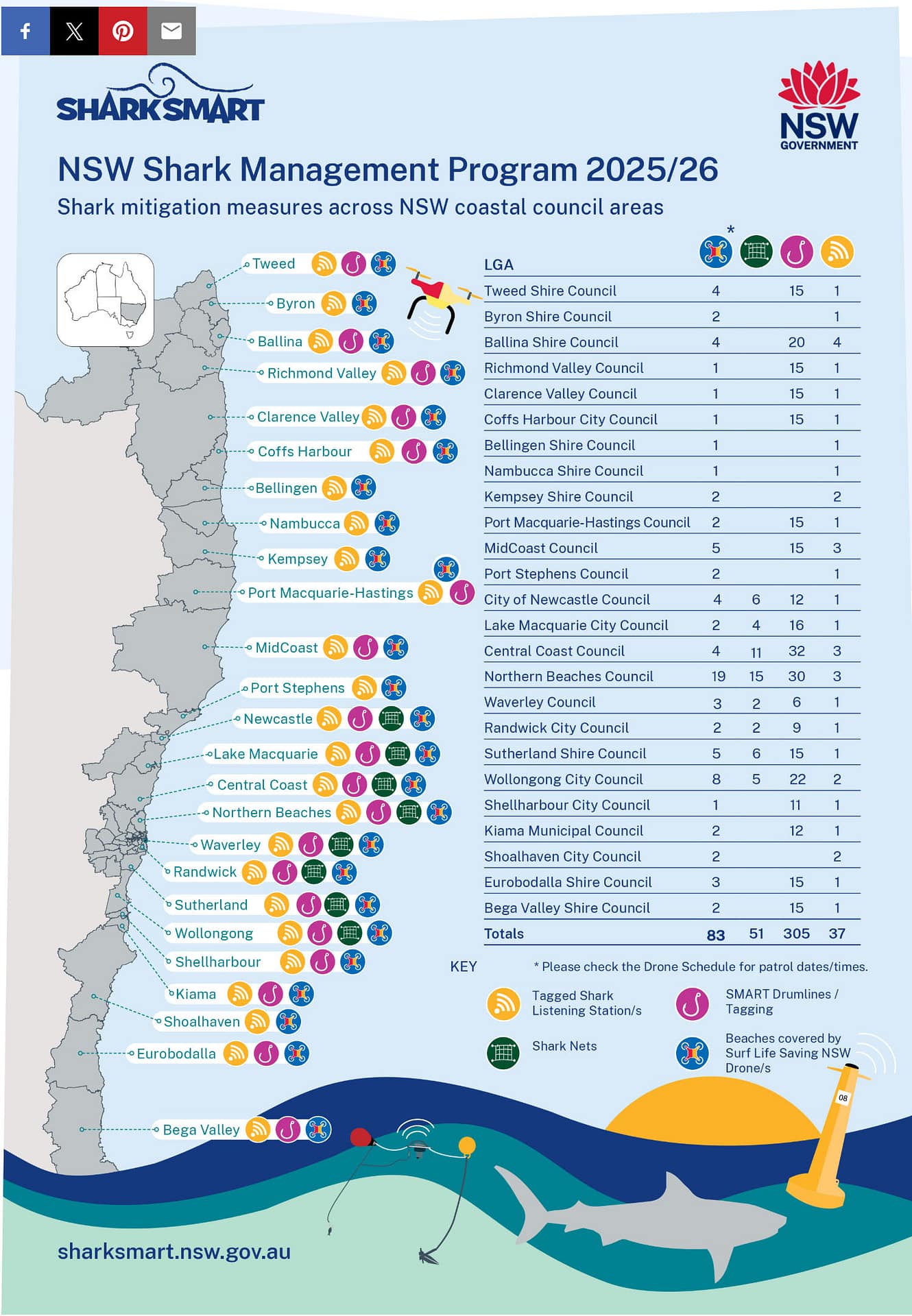
Image: NSW Government
“I’ve never seen sharks in the numbers that they are now,” he said.
“Most of the attacks that are happening now are from Bulls and Whites.
“I’ve seen a few five-metre Great White sharks which would be the biggest I’ve seen.”
The annual whale migration between May and November provides a perfect opportunity for predatory sharks. “You get a migration of Great White sharks up the east coast of Australia every year with the whale migration, and they come from down south,” he said.
“During the whale migration, the Southern Ocean virtually comes to us, so not only do you get the whales, but you also get the seals turn up, and there are lots of salmon schools.
“A big part of what brings Great White sharks close to our beaches during this time are the salmon schools, biomasses of salmon that travel and spawn along the east coast.
“With Bull sharks its almost in reverse, they are a bit more of a warm water species and they actually filter down the east coast with the warmer water each year.”
Technology has also brought sharks to prominence, illustrating a perceived threat to people.
“Drones have played a big part in actually being able to see what is swimming around off our beaches,” he said.
“They are a great tool to monitor the coastline and alert people when a shark is nearby, but they have also revealed how many sharks are out there.”
Not being in the water at dangerous times for sharks would limit opportunities for sharks to attack.
“When it’s low light, or you get a bit of rain or a bit of colour in the water, if you’re out there really early in the morning or late in the afternoon, sharks are in a different mindset then and you are way more likely to get attacked,” he said.
“Great Whites seem to prefer to hunt in those sorts of conditions.”
Despite this, Mr Hay said the most recent attack at Sydney’s Coogee Beach was in crystal clear water at 11am, which illustrates how Great White Sharks are cruising along off our beaches.
“Now you are going to get these attacks in these unlikely scenarios because there are so many sharks around,” he said.
The NSW Government SharkSmart program runs from Tweed Heads to Bega along the NSW coast, with shark listening stations, baited smart drum lines, and drones monitoring shark activity.
“Since the smart drum lines have been positioned all up and down the coastline, we’ve had as many attacks, or more, than we’ve ever had,” he said.
“Smart drum lines can’t be baited with anything other than a frozen mullet and for small sharks, mullet is part of their food source, but you don’t catch a man eater with a mullet.
“Where some of these attacks have taken place there’s bailed drum lines just out past where the attacks have happened.
“Drum lining is only run through the day to protect swimmers, they don’t want to do it at night because people aren’t swimming at night, but at night you are going to catch a lot of sharks.
“If you want to get a lot of tracker tags in a lot of sharks, the way to do that would be to bait at night.”
Mr Hay said he isn’t sure what the solution to the shark situation is.
“I can’t ever see there really being an answer,” he said.
“Personally, I don’t believe culling would do a lot, sharks are in huge numbers.
“I don’t think they would ever allow culling; there would be too much of an outrage if they announced a cull.
“I don’t think a cull would put a mark on the population.
“Our supply chain is where it’s at (with imported frozen fish) and I can’t see how you will be able to turn that around and create demand for sharks again by restructuring everything, so fish and chip shops buy shark again.
“A simple way is to allow commercial fishermen to catch sharks again, but that won’t be successful because sharks aren’t worth much money to the fisherman, so they aren’t worth their time and effort.”

This article appeared in the Clarence Valley Independent, 26 June 2026.
Related story: Increase mitigation or cull?