

The economic impact of the conflict in the Middle East is and will continue to have wide ranging impacts on all facets of Australian society with costs increasing due to the nation’s reliance on trucks and diesel.
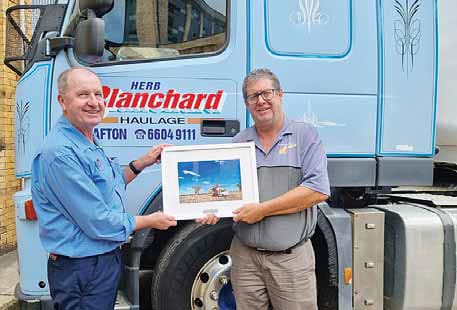
While fuel, and fertiliser costs have skyrocketed due to the choke point of the Strait of Hormuz being closed to shipping traffic, businesses across the nation have begun to pass on the increased costs on many products, while farmers face the uncertainty of whether they will be able to harvest food crops due to the situation and the increasing drought conditions.
In 1955, Herb and Noreen Blanchard started Herb Blanchard Hauling in Grafton.
71 years later, current owner Robert Blanchard said the industry is facing its toughest times in decades and his first diesel delivery since the Middle East crisis erupted was $68,000 more than in early March.
Herb Blanchard Hauling currently runs 19 prime mover semi-trailer combinations and five rigid vehicles that do local deliveries.
“When the conflict started in March the price of fuel just escalated dramatically high, and it’s something you don’t have any control on, so you just have to pay whatever price it is that you have to pay,” Robert said.
To tackle the escalating prices, Mr Blanchard said the business has increased its fuel levy.
Fuel levies are added to the base rate for deliveries to absorb the price increase and in the transport industry, Mr Blanchard said fuel levies range between 25 and 65 per cent.
Since the Middle East conflict caused increases and fluctuations in global oil prices, Mr Blanchard said they are reviewing the fuel levies weekly instead of monthly.
“One of the multinational companies we do work for, their base rate is just over 60 per cent, so whatever the base rate is, they pay us another 60 per cent because of the fuel crisis,” he said.
“The fuel levy has increased a minimum of 25 per cent since early March.
“I think anyone who is a smart business person will have to increase their prices…no one can afford those sorts of increases.
“Our customers don’t like it, but we don’t have any other option other than to pass it on.”
Mr Blanchard said imposing the increased fuel levy slows the economy, because the prices of products rise, as everything gets transported by a truck at some stage, and consumer spending slows due to the increased prices.
He said the industry was performing “ok” before the Middle East crisis, but the slowing of the economy had impacted some customers and deliveries.
The prices paid by the transport industry on diesel are based on the Terminal Gate price and are less than what people pay at the bowser, which Mr Blanchard said is felt by him and others in the industry who do long distance haulage and have to monitor where the cheapest fuel is on the highways.
In response to the escalating fuel prices, on April 2 the Albanese Government halved the fuel excise on unleaded and diesel from 52.6 cents to 20.6 cents, which Mr Blanchard said has had little impact.
“The excise has come off, but the price has gone up at the same time, so you don’t see the impact of the reduction in the excise,” he said.
Local accountant Tim Small, who has clients from a variety of industries said the implications of the crisis are permeating society.
Both Mr Blanchard and Mr Small agreed it isn’t possible to implement a fuel levy during the crisis to absorb price increases on products and services that are inevitable.
Mr Small said when the fuel excise was reduced to 20.6 cents per litre, the government also removed the 32.4 cent per litre Heavy Vehicle Road User Charge for three months – a fee on diesel fuel used by heavy vehicles designed to recover costs for wear and tear on the roads.
He said cutting the Heavy Vehicle Road User Charge did nothing to help farmers or transport companies because the government removed the on road user charge for fuel, which is factored into every litre sold, and the government also removed the fuel tax credit that farmers and transport companies claimed, so effectively, only the general public are seeing the benefits of the government reductions.
“They are no better off…every transport company in Australia is in the same position, every earthmoving company is in the same position, every farmer is in the same position, it hasn’t done anything to help them,” he said.
Most business owners impacted by this situation don’t understand it does nothing to help their bottom line, Mr Small said.
“I don’t even think any of the politicians know this,” he said.
“They took 26 cents a litre of the price at the bowser and they took 26 cents a litre off in the Business Activity Statement of that ABN holder, so they get nothing.”
Across his wide variety of clients, Mr Small said none are immune from the spreading economic fallout.
A large fruit and vegetable wholesaler recently didn’t buy anything at the markets because he was concerned people wouldn’t want to pay the increased prices that had to be passed on to customers due to increased transport costs.
A farmer who supplies to a global company has bought enough fuel to plant and maintain his crop on 15,000 acres, but he doesn’t currently have the fuel to harvest the crop.
A central western NSW mixed crop farming business who grow a variety of grains, who also run sheep and cattle, should be planting in the next few weeks, but due to drought conditions and predicted reduced harvest volumes, and increased fuel and fertiliser costs, they are seriously considering not planting this year, and they will evaluate the situation next year.
Mr Small said large companies like Woolworths, Coles, Aldi, and BHP have had fuel levies as part of their business model for decades, which has worked well and the Woolworths model is promoted by the Australian Institute of Petroleum.
“It’s very fair…it’s very accurate when prices are going up, and it’s very accurate when prices are going down, it’s good for the transport operator, and it’s good for Woolworths,” he said.
He said many transport and logistics companies had adopted a similar model to Woolworths.
“Fuel levies work well, they effectively pass on some of the increase in cost, so for the businesses who work in that model it works well,” Mr Small said.
“But not every operator and not every freight paying customer has a fuel levy mechanism in their contract, and for people who are off contract, what do they do.
The toll of the economic impact on businesses will be felt in years to come, Mr Small said.
“Financial crises take a couple of years, we are only just seeing some of the impacts of Covid playing out,” he said.
Some business owners may borrow money to carry them through challenging times and then they struggle to service the loss, and the business ends up going into receivership after a few years, Mr Small said.
“There are transport companies operating today that in five years’ time are bankrupt because of the decisions they are making today,” he said.

This article appeared in the Clarence Valley Independent, 24 April 2026.

