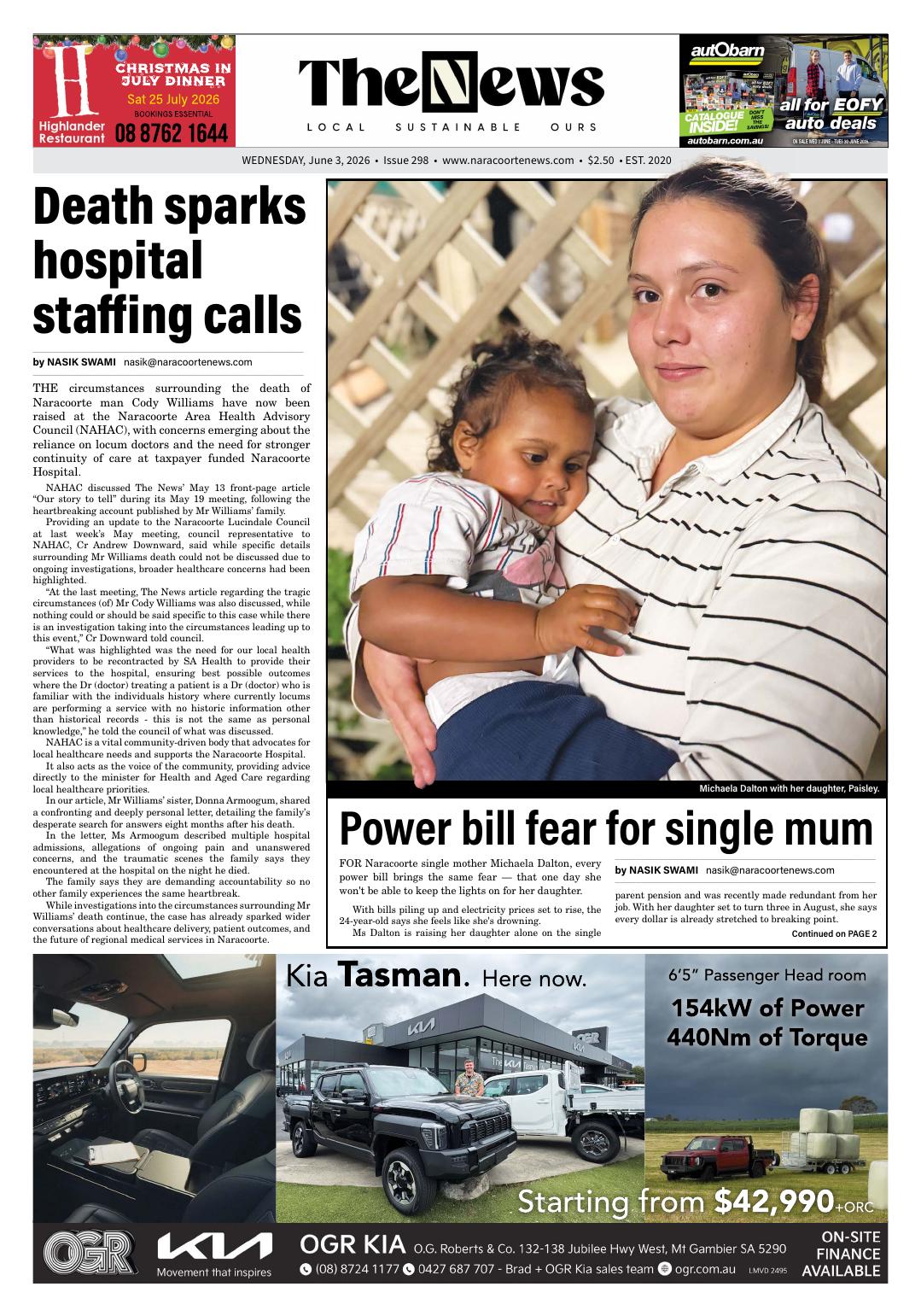
For Naracoorte single mother Michaela Dalton, every power bill brings the same fear – that one day she won’t be able to keep the lights on for her daughter.

With bills piling up and electricity prices set to rise, the 24-year-old says she feels like she’s drowning.
Ms Dalton is raising her daughter alone on the single parent pension and was recently made redundant from her job. With her daughter set to turn three in August, she says every dollar is already stretched to breaking point.
Her concerns come after the Australian Energy Regulator released its final Default Market Offer for 2026-27.
Under the determination, household electricity bills in South Australia are set to increase by 1.4 per cent – around $33 per year – for flat-rate residential customers. Residential customers on time-of-use tariffs are expected to see an average decrease of $25, while small businesses on default market offers are set to receive substantial reductions in power costs.
“My electricity bill is currently $3000 overdue, and more isn’t going to help,” she said.
“Having to choose between childcare, food, internet and electricity, every week while only on single parent pension is hard enough.
“I’m worried with the new power price hikes, I will end up getting the power cut as it’s getting harder to keep up with all the bills needed to keep a household afloat. I spent many weeks crying (over rising costs) because I’m unsure how to handle it all.”
Ms Dalton said paying household bills had become a constant balancing act, often forcing impossible decisions between essential services and feeding her child.
“Many weeks my bills surplus my income and I’m choosing to buy my child food and then ringing the electricity company for financial hardship,” she said.
“I’m worried with the new price hikes that I won’t be able to catch up with the already increasing amount of bills that are overdue. Every time I pay a lot off, more come, (and) I feel like I’m drowning.”
She said unexpected expenses could quickly derail any progress she makes.
“If I get a one-off bill such as rego (vehicle registration) or water, it really pushes me back and I have to choose what I’m going to pay or not going to pay.”
Ms Dalton said life became even more difficult after losing her job.
“Since being made redundant, it’s become harder. The budget is tighter. My fortnightly income is making it harder to provide the right food and food that will last the fortnight,” she said.
“I’m often turning to others to help as my budget for groceries is only $200 a fortnight, which I find it a struggle to be able to keep up with daycare safe food on that budget, which has forced me to dip into payments such as my electricity and internet money.”
With winter arriving, the prospect of rising energy costs weighs heavily on her mind.
“And being winter, and needing to keep heating on scares me even more because my house stays cold and can’t hold heat, but I need to be able to heat the house for my kid, especially when she’s sick,” she said.
The price increase has also drawn concern from member for MacKillop Jason Virgo, who said even modest rises added pressure to households already battling cost-of-living challenges.
“Any increase, regardless of how small impacts families especially in regional communities,” Mr Virgo said.
“For households already struggling with the cost of groceries, fuel, insurance, and mortgage repayments, even an additional $33 a year can make a real difference.
“While the announcement is a move in the right direction for some small businesses and customers on time-of-use tariffs, there is still significant concern for residents who continue to face rising living costs across the board.”
Mr Virgo said regional communities faced unique challenges when electricity prices increased.
“Regional communities like those across the Limestone Coast are particularly vulnerable to higher electricity prices because energy costs affect not only households, but also farmers, manufacturers and small businesses that are vital to our local economy,” he said.
“One Nation believes energy policy should prioritise lower power prices, energy security and reliability, rather than forcing families and businesses to carry the burden of rising costs.
“I will continue advocating strongly for policies that deliver affordable and reliable electricity for regional South Australians.”
South Australian Energy minister Tom Koutsantonis claimed most customers would see power prices move in the right direction.
“It’s heartening to see wholesale prices heading in the right direction, with the majority of residential customers and all small business customers seeing a decrease in their bills under the Australian Energy Regulator’s final Default Market Offer determination for 2026-27,” he said.
“It’s important to emphasise to consumers that the DMO is not the cheapest option on the market the majority of customers are already on better deals, and they should always shop around for the best deal they can find.”
This article appeared in The Naracoorte News, 3 June 2026.