


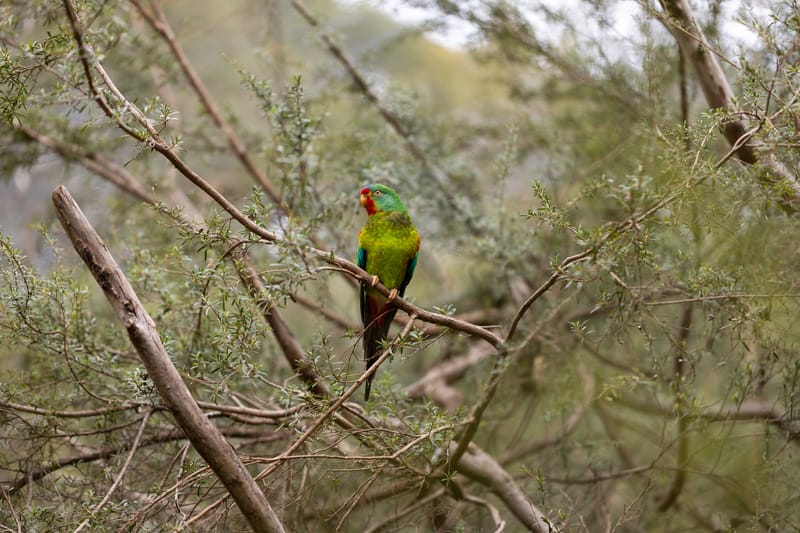
Photo: Sarah Richardson
Timber Towns Victoria (TTV), Media Release, 1 June 2026
A peer-reviewed study concludes that predation by an introduced species is the primary driver of swift parrot decline, and that conservation strategy needs to catch up with that reality.
Timber Towns Victoria (TTV) – the peak body representing local councils whose communities depend on forest industries – says a new peer-reviewed study vindicates what the forestry sector has long argued: that native forest harvesting is not the primary cause of swift parrot decline, and that misdirecting conservation effort toward the forestry sector will not improve the species’ outlook.
Timber Towns Victoria President Cr Karen Stephens says for years, timber workers and their families have carried the economic and emotional burden of decisions that this research now calls into question. “This new scientific research is further evidence that Victorian timber communities were stripped of a vital renewable resource industry, devastating local livelihoods and causing significant mental pain and suffering, due to restrictions that were wrongly justified in part on swift parrot habitat concerns.
“The impact on these communities has been profound — businesses closed, jobs disappeared, and families were left struggling under the weight of uncertainty and stress.” Cr Stephens said.
The study, published in the journal Australian Forestry, was conducted by independent researcher Simon Grove, who reviewed the body of published research to test two competing explanations for the critically endangered species’ collapse. Grove concluded the evidence firmly favours predation — specifically the killing of nesting females and their eggs or broods by sugar gliders, an introduced species — over habitat loss as the primary driver of decline.
The swift parrot breeds in Tasmania and migrates to Victoria and other parts of south-eastern Australia, where it relies on eucalypt woodland and native forest. Nesting birds in both jurisdictions face predation by sugar gliders, whose range has expanded significantly. Grove’s paper sets out two hypotheses — a forest habitat narrative and a predation narrative — and finds that neither the straightforward habitat hypothesis nor a more nuanced version linking sugar glider predation to the effects of forest disturbance is well supported by the available evidence. The predation hypothesis, by contrast, is grounded in empirical observation and supported by what the paper describes as apparently robust statistical modelling.
The implications are direct. A conservation strategy focused solely on protecting existing breeding habitat would, the study concludes, make negligible material difference to the swift parrot’s fate in the short term, doing little more than ensuring remaining birds continue to be predated when nesting. Grove is unequivocal: directing outrage toward the highly regulated forestry sector does nothing to further the species’ chances of surviving into the next decade and is in fact contributing to the problem rather than the solution.
“For too long, swift parrot conservation has been used to partly justify restrictions that crippled Victorian timber towns. This research makes clear it is time to follow the science and end policies that unfairly punish regional communities.” – Cr Karen Stephens, President, Timber Towns Victoria
TTV is calling on the Federal and Victorian governments to update their conservation response to reflect the best available science, prioritise practical predation mitigation at scale, and cease using swift parrot habitat concerns as a basis for restricting the forest management practices that Victoria’s timber towns and their families depend on.
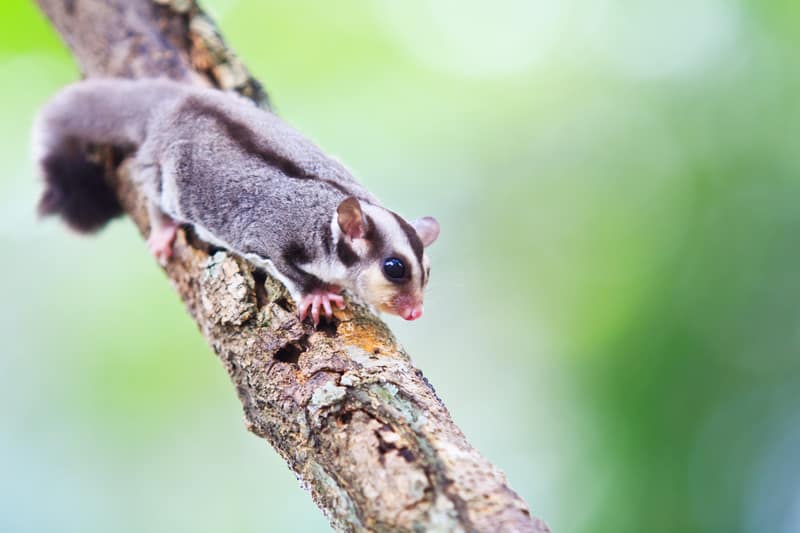
Photo: Riverrail.
About Timber Towns Victoria
Timber Towns Victoria (TTV) is the peak local government body representing councils across Victoria whose communities are sustained by the forest and timber industries. TTV advocates for policy settings that support sustainable forest management, regional employment and the long-term prosperity of the towns and families that depend on working forests.

