


Dr Chris Parker, Cattle Australia, Media Release, 28 July 2025
The threat of lumpy skin disease (LSD) to Australia’s beef cattle industry may have fallen off the front pages, but the current outbreak in Europe proves the risk of this horrid disease remains very real. It is my view that LSD is by far and away the most likely exotic disease of ruminants to enter Australia. Australia needs to heed the hard lessons being learned in Europe and act now to avoid a similar, costly fate.
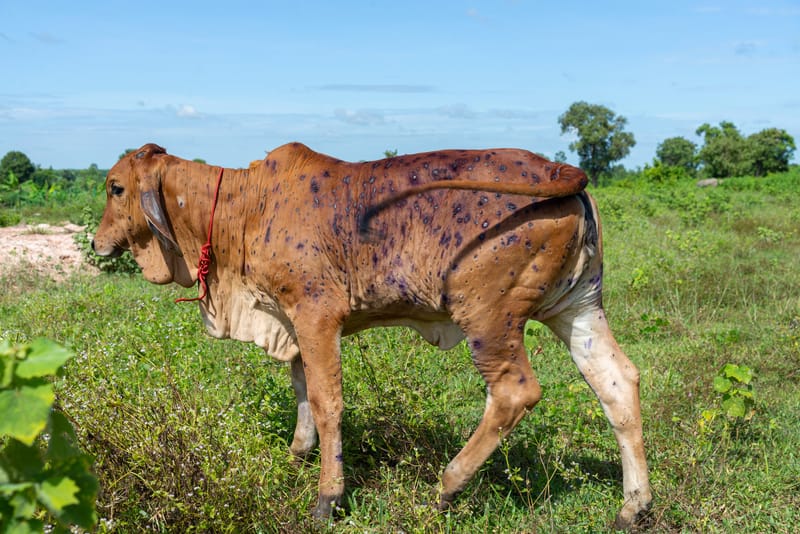
LSD is a viral disease of cattle that is transmitted by biting insects, such as mosquitoes or buffalo fly, that results in hide damage, weight loss, reduced milk production and reproductive impairment and in some cases death of the animal, not to mention the economic damage of international trade restrictions. The disease is endemic in Africa, the Middle East and parts of Asia. It is currently in Indonesia.
So, what do we know about the latest European outbreak?
In mid-June, at the height of the northern summer, disease carrying insects crossed from North Africa and into southern Europe, possibly via one of the countless cargo ships moving across the Mediterranean each day. Possibly they flew on the wind. LSD infected cattle were first detected on June 23 on the island of Sardinia in Italy, before spreading further north in the country. A week later LSD was detected in the Savoie region of France near the Swiss border.
They were the first detections in either country and immediately resulted in restrictions on their ability to export certain bovine products, including dairy, to markets including Australia.
Controlling the outbreak, limiting its spread and eventually removing it from the cattle population requires a major quarantine and livestock vaccination program, which is being monitored and supported by the World Organisation for Animal Health (WOAH). It is highly likely that this will work in the small-scale and more intensive production systems Europe.
So, what does the latest outbreak mean for us?
The Australian beef industry exports more than 70 per cent of its production to more than 80 countries around the world, generating not just economic gain for the nation but contributing to the food security of communities around the world – all of which is contingent on our disease-free status.
The Australia government acknowledges that if LSD were to enter the Australian beef herd it would be incredibly difficult to control, let alone eradicate.
It would require extensive animal movement controls and widespread vaccination programs – a task that would be all the harder if LSD were to spread to feral buffalo populations in the north, where insect life is abundant and much of the extensive landscape is unreachable.
This European outbreak is another wakeup call for us here. It demonstrates yet again that when it comes to biosecurity, prevention is always better than the cure.
So, what is to be done?
The cattle industry is putting its money where its mouth is. Most recently Cattle Australia, with the support of Meat & Livestock Australia’s Donor Company, has collaborated with the Commonwealth Department of Agriculture Fisheries and Forestry and the Australian Centre for Disease Preparedness to initiate new research focussed on the testing of insect vectors for the presence of Lumpy Skin Disease. If successful, this technology could be deployed as a strategic surveillance measure to concentrate our disease response efforts.
Biosecurity is border security, and it needs a boost in the North. We need to see increased surveillance and awareness of LSD risks to ensure, in a worst-case scenario, early detection and rapid response. The vector technologies need to be supported by new investment in Operation LUNAR, which is designed to intercept illegal boat arrivals on Australian shores and are a potential pathway for pests and diseases to take hold on remote grazing properties on our northern coastline.
Biosecurity is a core Government responsibility. These investments need to form part of a shift to a sustainable funding model that provides effective resourcing for Australia’s biosecurity system, including appropriate Government money and user-pays charges on importers.
There are 28 million beef cattle in Australia, and the red meat sector is valued at more than $81 billion and employs 430,000 people along the supply chain across rural, regional and urban areas. Good surveillance tools and strategies will return genuine benefits to Australia’s beef industry and the national economy.


On the Perth Coastal Plain – Biting Fly (Stable fly – stomoxys calcitrans) a “declared pest” breeds unchecked as DPIRD does nothing. Billions of flies breed in waste from vegetable growing or bulk manures – they then descend on every warm blooded animal over a large radius to bite and feed on blood. As they feed multiple times a day on multiple hosts and are a known vector of LSD and other disease – it is here that LSD will become endemic. The WA Govt. know this and still do nothing.