

NSW Department of Primary Industries, Lord Howe Island Marine Park News, The Lord Howe Island Signal
Sharks and rays are among the most endangered groups of animals on the planet, with more than one third of species at risk of extinction. To help address this, the International Union for Conservation of Nature (IUCN) works with experts worldwide to identify places that are critical for their conservation and survival. These are known as Important Shark and Ray Areas (ISRAs).
The marine parks around Lord Howe Island have now been recognised as an ISRA. The waters here support feeding and reproduction for Galapagos sharks (Carcharhinus galapagensis) and provide habitat for at least eleven other shark and ray species. The listing places Lord Howe Island on the global map as a significant place for shark and ray conservation. You can explore the ISRA e-atlas at: https://sharkrayareas. org/e-atlas/.
Galapagos shark research update
In December, 2025, researchers returned to Lord Howe Island to continue testing new shark-deterrent technology designed to reduce unwanted interactions between sharks and fishers.
The work was led by Dr. Jon Mitchell and Dr. Vic Camilieri-Asch (from The University of Western Australia and Shark Ethology Australia) with support from Dr. Vic Peddemors and Ms. Emily Hunt from NSW Department of Primary Industries and Regional Development (DPIRD) and Dr. Shannon Corrigan (Minderoo OceanOmics Centre at The University of Western Australia).
Local charter fishing operators Jack Shick, Brad Wilson and Garry Sexton joined the team to trial a new electrical shark deterrent aimed at reducing shark bycatch (sharks taking bait) and depredation (sharks taking hooked fish).
What the team found
Over eight days of testing, the deterrent showed promising results with 60 per cent reduction in shark depredation and 59 per cent reduction in shark bycatch.
The device also reduced catch rates of target species, with target fish taking 27 per cent longer to catch compared to the control treatment. However, the reduced gear loss and fewer interactions with sharks mean that, overall, the deterrent is likely to benefit local fishers by increasing the number of target fish successfully landed.
Local fishers also shared important feedback for further improving the device’s usability. Suggestions included adjusting rig designs and positioning the deterrent further from the hook to help lift catch rates.
This feedback will be shared with the manufacturer and further testing is planned for 2026.
Tracking local sharks and other marine visitors
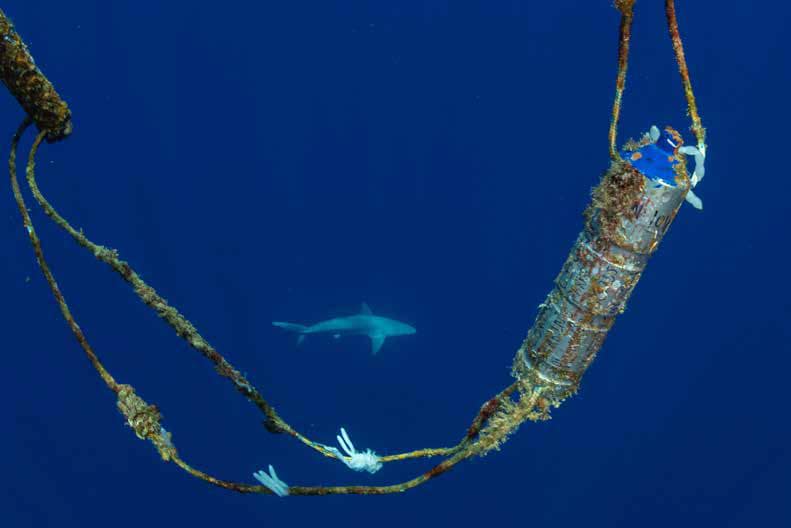
While on the Island, the team serviced the six deep-water listening stations, deployed tags on four additional Galapagos sharks and downloaded updated movement data from the stations. Some of the 34 tagged sharks have been detected in the same areas for over 8 years. The stations also record movements of other species, including Kingfish tagged in 2023 and marine animals tagged elsewhere in Australia and the Tasman Sea, showing connectivity between ocean ecosystems.
The team also collected biological samples (blood, muscle and stomach contents) to support research into Galapagos shark genetics and diet.
About the Project
This research is funded by Parks Australia and the Sea World Foundation.
In-kind support was given from the University of Western Australia (UWA), Sydney Institute of Marine Science (SIMS), NSW DPIRD, the IMOS Animal Tracking Facility and Flinders University. The team thanks the Lord Howe Island community and NSW DPIRD for their ongoing support of this work since 2018.
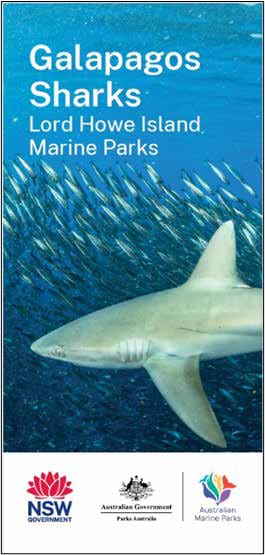
A brochure and poster are also available with further information about Galapagos sharks and the ongoing research.
For copies, please contact Lord Howe Island Marine Park office via phone (02 6563 2359), email (lord.howe@dpird.nsw.gov.au) or visit the office in the main town centre.
This article appeared in The Lord Howe Island Signal, 28 February 2026.

