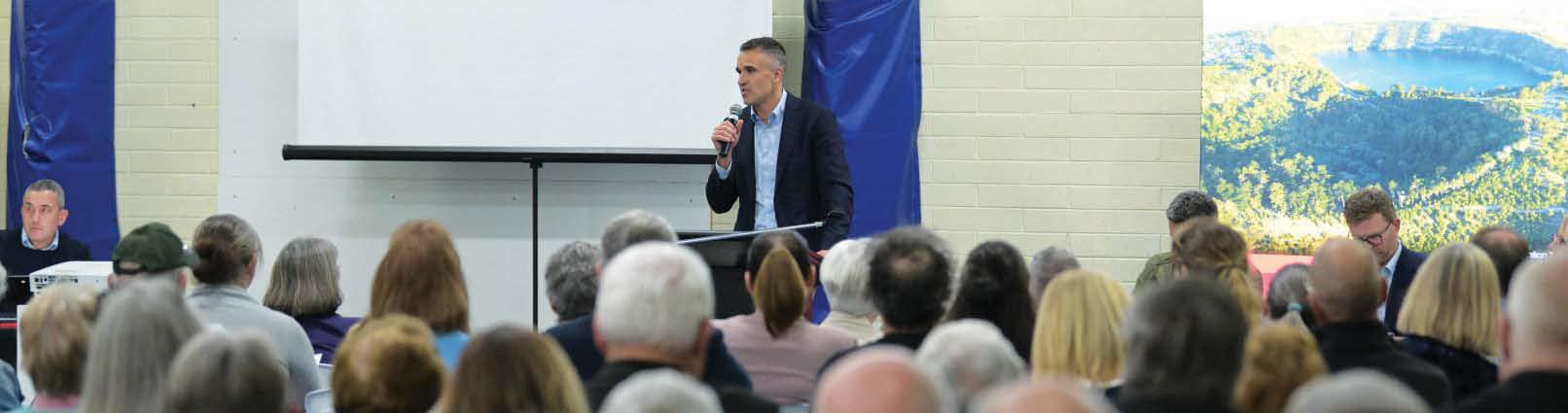
“Frack off” has been the resounding message coming out from the Limestone Coast following the premier’s announcement that the government plans to lift a 10-year moratorium on hydraulic fracturing (fracking) in the region, two years ahead of its 2028 expiry.
A wave of backlash swept across the region last week after premier Peter Malinauskas used the Country Cabinet forum in Mount Gambier to defend the government’s push to bring forward the fracking exploration process, arguing it was necessary to protect South Australia’s future energy security.
Naracoorte Lucindale Council released a strong statement following the announcement, declaring it stood “shoulder-to-shoulder” with the community in opposing any move toward fracking without extensive assessment and consultation.
“Naracoorte Lucindale Council stands shoulder-to-shoulder with our community in calling for protection of the remarkable, productive and globally significant natural assets of our region,” the council said.
“No fracking should take place until a region-wide assessment of the environmental, social and economic impacts is undertaken, and the risks are better understood to inform evidence-based decision making.”
The council said Limestone Coast Local Government Association councils Naracoorte Lucindale, Tatiara, Robe, Kingston, Grant and Mount Gambier were “clear and united” in their opposition.
“The anxiety and concern sparked by yesterday’s (May 14) shock announcement cannot be dismissed,” the statement said.
Speaking at the forum, Mr Malinauskas defended the move, saying he deliberately announced the proposal in Mount Gambier because the issue directly affected the region.
“I announced it very deliberately today (May 14) because I knew that this is a subject matter important to the people of this community and you deserve to hear from the premier of the state first about what we are doing and why,” he said.
“(We are) Not making a decision in Adelaide and then running away from this place. I am making a decision here and running towards it because I feel at ease in my conscience that what we are seeking to do is the right thing to do and I know people will disagree with that, and I am keen to talk about it.”
The premier repeatedly stressed the government would not support any process that threatened the region’s underground water systems.
“We will never allow ourselves to be party to a decision that compromises the aquifers or the water supply here in the Limestone Coast because it is what sustains the productivity, it is what sustains everything that is living here and makes the place so special,” he said.
Mr Malinauskas said the proposal before Parliament was not about immediately starting to frack but instead beginning scientific investigations and consultation earlier.
“What we are seeking to do by legislating the moratorium, which (we) should be clear about, the moratorium finishes in 2028. It’s gone. It’s happening no matter what. It’s over,” he said.
“But what that will do from 2028 onwards is enable the process to start to engage in the science and all the community consultation that puts the steps through, it starts in 2028.
“(But) We have got the opportunity to start that process in 2026.”
He warned South Australia faced potential gas shortages later this decade and said the government needed to act now to avoid future energy crises.
Limestone Coast Local Government Association (LCLGA) president Lynette Martin said councils across the region remained united against fracking proceeding without proper scientific scrutiny.
“The Limestone Coast Local Government Association has a clear and united position,” she said.
“No fracking should take place until a region-wide assessment of the environmental, social and economic impacts is undertaken and the risks are better understood to inform evidence-based decision making.”
Ms Martin said while the region recognised the importance of energy security, the Limestone Coast’s food and fibre industries could not be jeopardised.
“But in the Limestone Coast, any proposal for fracking or rare earth mining must meet community expectations the right scale, the right place, the right oversight, and clear scientific evidence that our land and water resources will not be put at risk.
“This region is built on the strength of its food and fibre industries industries that are established, sustainable and critical to our economy.
“We should be backing those industries with confidence, not creating uncertainty that could undermine future investment,” she said.
Member for MacKillop Jason Virgo also launched a fierce attack on the government’s proposal, accusing Labor of creating division and ignoring community concerns.
“The farming community in the Limestone Coast has fought long and hard against fracking on their prime agricultural land,” he said.
“Ensuring sovereign capabilities does not just mean energy security it also means food security, so we must protect prime agricultural land.”
Mr Virgo claimed there was “plenty of gas in other areas of SA which can be mined without harming prime agricultural land”.
“Labor came down to pick a fight with One Nation, farmers, and the people of the Limestone Coast over fracking when we just wanted them to come and listen to important issues like health, childcare, education and roads,” he said.
“The moratorium expires in two years, and the industry says they themselves can open the Katnook gas plant and run on conventional gas in the short term.”
“The regulator states the shortfall isn’t until 2030 and beyond. There’s no need to rush this through without first seeking community consultation.”
Limestone Coast’s economy:
The Limestone Coast’s economy is deeply tied to agriculture, forestry and fishing, industries which contribute 36.7 per cent of the state’s Gross Regional Product for agriculture, forestry and fishing.
The region is home to six wine regions accounting for 31 per cent of South Australia’s grape crush, nearly half the state’s dairy production by value, about 900,000 sheep and 600,000 cattle, SA’s largest commercial wild-catch fishery by value, and forestry operations producing 37 per cent of Australia’s house frames.
Source: LCLGA
This article appeared in The Naracoorte News, 20 May 2026.