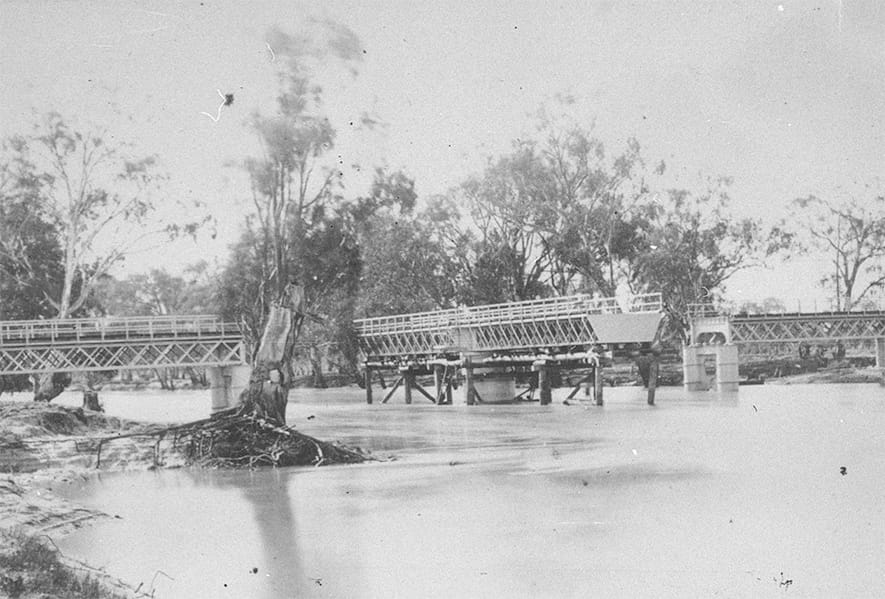
This week’s blast from the past is about Hay’s turntable bridge and the riverboat era it served. It was created using information from various Wikipedia articles.
There’s a piece of industrial archaeology sitting in the river bend just north of where Hay’s bridge crosses the Murrumbidgee.
It looks like debris, like something that should have been cleared away decades ago. But that rusting turntable is actually a remnant of an era when the river was a highway, when paddle steamers were the primary means of moving wool and supplies, and when a bridge had to accommodate both road traffic and river commerce.
The first bridge over the Murrumbidgee River at Hay was built in 1872 at a cost of £20,000.
It was a substantial investment for a town that had only been proclaimed a municipality that same year, but it was essential infrastructure.
Hay sat at the junction of major stock routes and roads, and crossing the Murrumbidgee by punt or ford was slow, unreliable, and dangerous when the river was running high.
But there was a problem, Hay was also a significant river port.
Paddle steamers navigated the Murrumbidgee regularly, carrying wool downstream and supplies upstream, connecting the inland pastoral districts to markets and ports.
A fixed bridge across the river would block that commerce entirely.
The solution was ingenious and, for its time, technologically sophisticated.
The bridge would incorporate a turntable.
The structure included a section that could be swung open to allow the passage of steamers.
The swinging spans turned on a pier in the centre of the river.
The lower portion of that central pier was cast iron, 4.0 metres in diameter, and continued 6.1 metres below the bed of the river for stability.
The drum was a composite of cast and wrought iron carried on the centre pier.
Each of the two swing spans was 18.3 metres in length.
The entire operation was manual. No motors, no hydraulics, just human strength and mechanical advantage.
When a steamer needed to pass, bridge operators would swing open the middle section, allow the vessel through, then swing it closed again for road traffic.
It was slow, labour-intensive, and absolutely necessary.
The bridge was finally opened on August 31, 1874 by Henry Parkes, the Colonial Secretary of New South Wales.
The opening had been delayed while approaches were formed, a reminder that building infrastructure in the Riverina’s difficult soils was never straightforward. But when it opened, it was a genuine achievement; a bridge that served both land and river transport, and acknowledged the economic importance of both modes of travel.
For decades, the turntable bridge was a fixture of Hay life.
Road traffic would wait while steamers passed through.
The rhythms of river commerce dictated the rhythms of land transport.
It was an era when the river was genuinely alive with traffic, when the sound of paddle steamers was as common as the sound of trucks is today.
But river transport was already being superseded even as the bridge opened. Railways were expanding, roads improving, trucks becoming more reliable and more economical. The paddle steamer era, romantic as it was, couldn’t compete with the speed and flexibility of rail and road. Gradually, river traffic declined.
The turntable was last used in 1946. By then, the steamers were mostly gone, the river commerce had dwindled to almost nothing, and the complex operation of swinging the bridge open had become an anachronism. The river that had once been a highway was becoming recreational, a place for fishing and the occasional pleasure boat, not a working transport corridor.
The old bridge itself was eventually replaced by a new one, opened in June 1973. The replacement was a modern six-span reinforced concrete and steel box girder structure, 194 metres long, nine metres between kerbs, with a two-metre-wide footway for pedestrian use. It was everything a modern bridge should be, efficient, reliable, requiring minimal maintenance. But it was also entirely fixed. There was no provision for river traffic, because by 1973, there was no river traffic that needed accommodating.
The old Hay Bridge was subsequently demolished. Its lattice girder design, its timber decking, its innovative turntable mechanism, all were removed. Almost all. The turntable itself, that cast and wrought iron drum that had served for nearly a century, was placed in the river bend just north of where the bridge had stood.
It’s still there today, a curiosity that most people probably walk past at Bushy Bend without a second thought.
If you don’t know what you’re looking at, it just appears to be old industrial junk sitting between the river and Hay Tennis Club.
But if you understand what it represents, it’s a monument to an entire era of Australian commerce and transport.
The turntable reminds us that the Murrumbidgee was once a working river. Paddle steamers like those Captain Francis Cadell pioneered on the Murray ran regularly to Hay and beyond.
The town’s position as a river port wasn’t incidental, it was fundamental to its early prosperity.
Wool from the vast pastoral runs of the western Riverina was moved by steamer. Supplies came upstream the same way.
The river was infrastructure as essential as any road.
The bridge, with its turntable, had to serve both systems simultaneously.
It couldn’t block the river or the road. It had to accommodate paddle steamers and stock routes, river commerce and overland traffic.
For its time, it was an elegant solution to a complex problem.
What’s poignant about the turntable sitting in the river bend is what it represents about technological change and shifting economies. In 1872, when the bridge was built, river transport was absolutely necessary.
By 1946, when the turntable was last used, it was obsolete.
By 1973, when the old bridge was demolished, the idea of river commerce requiring accommodation seemed almost quaint.
That’s three generations, from essential to anachronistic.
From cutting-edge infrastructure to historical curiosity. From daily operation to rusting relic.
But what the turntable also symbolises is Hay’s ability to adapt.
When river transport was king, Hay built infrastructure to support it.
When roads and rail became dominant, Hay adapted to that reality.
The town didn’t cling to the riverboat era out of nostalgia.
It built a new bridge suited to new conditions.
But it also didn’t entirely forget.
The turntable sits there still, a reminder of what was.
Similar bridges existed elsewhere. Carrathool, further up the Murrumbidgee, had a bridge with a bascule-type lift span, completed in 1924.
It too was designed to allow riverboats to pass.
These bridges represented a specific moment in regional development, when infrastructure had to accommodate multiple and sometimes competing transport systems.
The engineering was genuinely sophisticated.
The cast iron central pier sank 6.1 metres into the riverbed. The composite drum.
The manual operation required precise coordination.
The balance between structural strength and moving parts.
This wasn’t crude frontier engineering. This was a skilled, thoughtful design responding to specific local conditions.
Henry Parkes opening the bridge in 1874 was more than a ceremony.
It was recognition that regional infrastructure mattered, that connecting inland communities to markets and each other was essential to the colony’s development.
The bridge wasn’t just about Hay.
It was about the entire western Riverina having reliable access to the rest of New South Wales.
Today, if you want to see the turntable, you can find it in the river bend north of the current bridge.
It’s not signposted, not maintained as a tourist attraction, not part of any official heritage trail.
It’s just there, doing what so much of regional Australia’s history does, surviving through benign neglect, waiting for someone to notice. It’s worth noticing.
That turntable is a remaining reminder of innovation, adaptation, and an entire economic era that shaped the Riverina. It’s a lasting memory of the riverboat captains who navigated the Murrumbidgee, the bridge operators who manually swung those spans open and closed, the wool growers whose product travelled downriver to market, the communities that depended on river transport before roads and rail made it obsolete.
What seems permanent and essential can become obsolete within living memory.
What requires significant investment and sophisticated engineering can be superseded by something simpler and more efficient. What once defined a town’s character and prosperity can fade to become a historical curiosity.
The paddle steamers are gone.
The manual turntable is rusting in the river bend.
But Hay continues, adapting to each new era while carrying forward the history of what came before.
That turntable, sitting there mostly forgotten, is part of that history, a monument to when the river was a highway, when bridges had to move as well as stand, and when Hay was a port as well as a crossroads.
Not bad for a piece of industrial archaeology that most people mistake for junk.
This article appeared in The Riverine Grazier, 11 February 2026.