

Steven Eade is not easy to find in Hay. He moves through town quietly, keeps odd hours, and has spent most of his 11 years here trying to take up as little space as possible. When people do notice him, he says, they are often surprised he is still around.
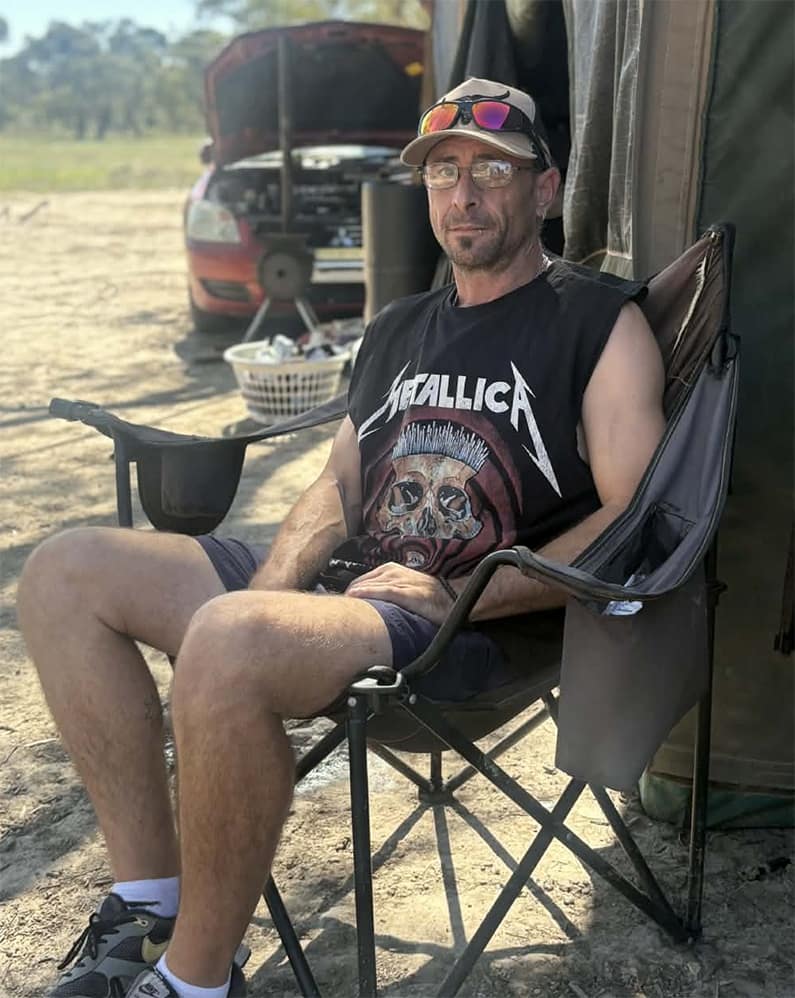
“People say, ‘I didn’t know you were still here. Where have you been?'” he said.
“And I tell them, I’m hiding under a rock where I belong.”
He is not entirely joking. Steven is 42 years old. He does not have a home.
He has set up a tent at a campsite on the edge of town, and when he needs to shower he uses the facilities at the Shell service station on the highway.
He said he has learned to manage these things, because managing is what he has always done.
“I’ve always had to adapt,” he said. “I’ve had to.”
It is a phrase he returns to often, and the reason why becomes clear the longer he talks.
Steven said he was six years old when he first learned what it meant to go without.
His family, he said, made the decision to exclude him from the household for a period of close to two years.
He slept outside. He slept alongside animals. He found his own food.
He was seven, then eight, then nine.
“I found out what homelessness was at the age of six,” he said.
“I’ve spent countless years on the streets since then. I’ve practically got to know it.”
The physical abuse that accompanied his childhood he recalled in detail.
He said he was struck with the handle of a whip, cracked across the head, and that his mother left stab marks on him with a knife.
He says he was never praised, never cherished, never told he was wanted.
“The only good thing my mother ever taught me was independence and respect,” he said. “That’s it. That’s all I got.”
He arrived in Hay a little over 11 years ago, coming from what he describes as an extraordinarily difficult period in his life. Shortly after settling here, he found work at the Caltex, now AMPOL service station on the highway.
By his account, and by the account of the truck drivers who he says still ask after him when they pull through on the Sturt Highway, he was good at it.
“For six years, it was like I practically ran that place,” he said.
“I had more customers coming in for me than for the servo.
“Truckies would come through and ask, ‘Where’s Steve? How come you’re not there anymore?'”
He lost that job and has not been able to return. Steven says he was told that of every worker the station had seen over 10 or 15 years, he was the only one they did not want back.
Finding work elsewhere in Hay has proven equally difficult, Steven said.
He has tried. He says people have made up their minds about him before he walks through the door, and that the accusations that have followed him for close to 20 years are the reason why.
Those accusations were serious.
Steven said the court ended up deeming them baseless. He has been a free man, as he terms it, a single man for the better part of eight months.
But in a small town, he said, the legal outcome and the social outcome are not the same thing.
“Everybody in this town has heard those stories,” he said. “They believe those stories.”
The consequences, Steven says, have been wide-ranging.
He says he was physically removed from shops.
He said a similar situation played out at the service station where he used to work, where he believes an attempt was made to have police issue him a trespass notice on the basis of information he says was falsified.
A best friend of seven years, a man he says he had supported through serious personal difficulties, cut all contact the moment Steven’s own circumstances deteriorated.
“I helped him through his worst times,” Steven said.
“As soon as I had my downfall, he was done. Seven years, gone.”
His family has largely followed suit.
His mother and his sister now live in Griffith, Steven says.
He has not pursued contact, and they have not either.
He says his sister has at times actively made things worse, and that his solicitor has had to intervene on that front as well.
“People look at you when you’re homeless and they think, Oh, look at this one,” he said. “Even your own family.”
He has a daughter who turns 22 this year. He says he raised her with care and attention, and that she never swore or misbehaved because she knew there would be consequences, though he says he never once raised a hand to her.
She lives in Wagga Wagga, and contact is complicated by distance and circumstance.
Steven said he lives on approximately $800 a fortnight.
He said he spends part of his time volunteering to help a local businesswoman, a friend of six years who is also doing it tough financially.
He is not paid for this.
He says it is simply what you do when you recognise need in another person.
“Being a struggler myself, I know what it’s like,” he said.
“When you see someone else struggle, you do what you can.”
Three days before his most recent fortnightly payment came through, Steven says he found himself almost entirely without food and went to a local charity organisation for help.
What he received, he said, was a box of Weet-Bix, a litre of milk and a small tin of coffee.
“What help is that?” he said.
“If you have the means to go to Griffith or Wagga for assistance from charities, you come home with a boot full of shopping. Here you get a box and you’re shown the door.”
He says he can sometimes go extended periods without eating, that it is a habit formed in childhood he has never fully shaken.
Steven said he holds a certificate in car detailing and has experience in gardening and landscaping.
He said he started out washing cars in Moree for $20 a time and worked his way up from there.
He was recently offered work in Deniliquin, which he said gave him genuine motivation to leave Hay.
The obstacle, he said, is his car, which has a blown engine and currently sits immobile. Without it he cannot reach the work, and without the work he cannot afford to fix the car.
“Everything’s always been stacked against me,” he said. “Everything.”
He said he has been diagnosed with bipolar disorder and manages it with medication, a decision he arrived at himself.
He is considerably less positive about the formal mental health system, having cycled through telephone appointments and professional contacts who he said showed little genuine interest in what he had to say.
“I did a test on it,” he said.
“Six months of fortnightly calls. And I found out they only ever want to hear what they want to hear.
“Not what’s actually happening.”
Steven says there have been times when he has considered ending his life, and that his daughter is what has stopped him.
He said the years of accusations, rejection and financial pressure have taken a serious toll on his mental health, and that he reached a point some years ago where he drove his car into a tree. He does not dwell on it.
He said he was recently told that a Hay resident has quietly taken in 17 people with nowhere to go.
He does not know who this person is.
He said the services that might help him are hard to access without money or transport, and that $800 a fortnight does not go far when a person is trying to stabilise a life from scratch.
“What’s $800 a fortnight going to do?” he says.
“Especially when you’ve got nothing behind you.”
He said he thinks homelessness in regional areas will get significantly worse over the next decade, that the rental market has made it impossible for people on low incomes to get a foothold, and that the response available in a town like Hay is not equal to the scale of the problem.
“People believe there’s no homelessness here,” he said. “I’m one of them.”
He has thought about leaving Hay. He said he probably will.
Eleven years is considerably longer than he has stayed anywhere else.
When he goes, he said, he has no particular destination in mind.
“Wherever the tar road leads me,” he said.
For now he is here, at a campsite on the edge of town, moving through his days much as he always has.
He says he is tired of hiding, tired of being defined by accusations which he said the court found to have no basis, and tired of a system that he says has consistently failed to meet people where they are.
“I’m just like everybody else in this town,” he said. “I just have my problems, my issues, my concerns. And everyone else just wants to make them into theirs.
“I try to look forward to every single day,” he said. “I have to.”
This series will continue next week. If you have experienced, or know someone who has experienced any sort of housing instability, and would like to talk, please get in touch with the team at The Riverine Grazier, on (02)69931002 or email kimberly@thegrazier.com.au
We want to hear from you.
If this story has raised concerns for you or someone you know, help is available. You can contact the following national 24/7 support services:
- Lifeline: 13 11 14 or lifeline.org.au
- Beyond Blue: 1300 22 4636 or beyondblue.org.au
- MensLine Australia: 1300 78 99 78
- 13YARN: 13 92 76 (For Aboriginal and Torres Strait Islander people)
- Kids Helpline: 1800 55 1800 (For young people aged 5 to 25)
This article appeared in The Riverine Grazier, 8 April 2026.

