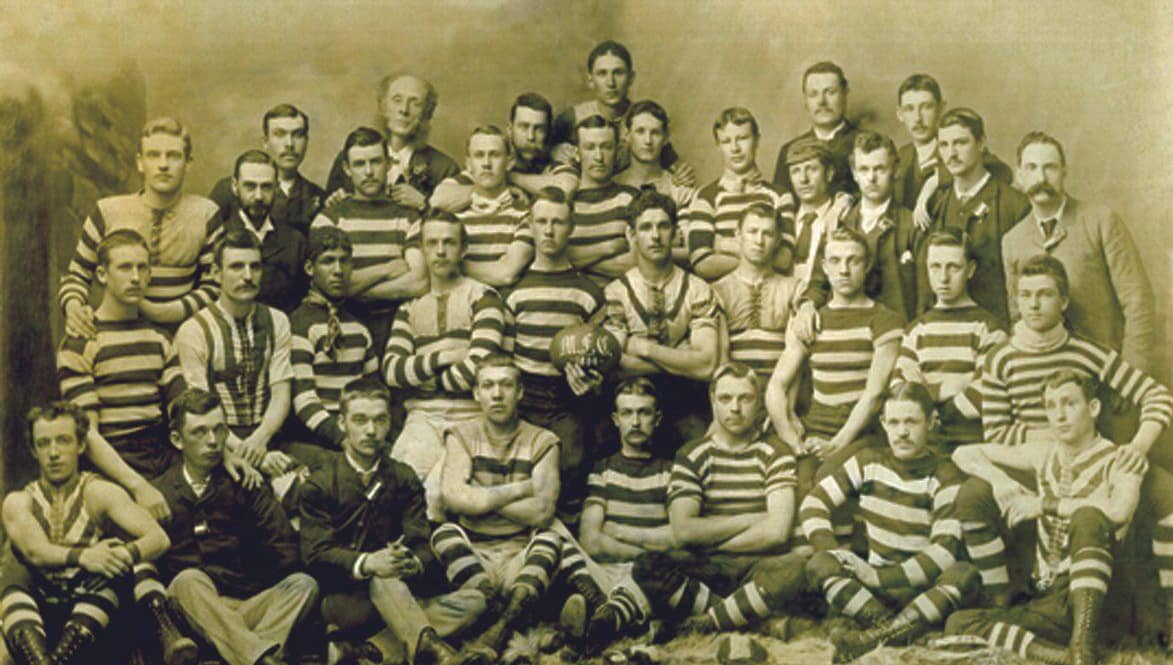
On May 24, 1876, fourteen men sat down together at the Royal Hotel in Hay and formed a football club.
The Riverine Grazier reported it the following week with quiet confidence; the new club had been duly formed, it noted, with “hearty prospects of play this present season.”
One hundred and fifty years later, those hearty prospects have never dimmed.
The Hay Lions Football Club turns 150 in 2026, a milestone that puts it in rare company in New South Wales football.
The club’s journey from that meeting at the Royal Hotel to its current home in the Central Murray Football League is not a straight line.
It is a story of restarts, reinventions, name changes, competitions that folded and competitions that were built from scratch, of a community that simply refused to let its football club die.
Football arrived in Hay the same way it arrived in most of regional Victoria and New South Wales, carried in by settlers from the south who had grown up watching the game and could not imagine a winter without it.
By the 1880s the town had multiple teams competing against each other on Wednesday afternoons, the game falling on what was then a public holiday.
They were called the Federals, the Imperials, the Suburbans and the Gymnasiums.
They drew crowds of two hundred to three hundred people at a time when the town itself was still finding its feet.
The club that would become the Lions was formally founded in 1876.
It spent its early decades playing in and around Hay and the surrounding district, travelling by special train east to Riverina knockouts at Leeton, Whitton, Narrandera and Ganmain.
In 1895 the Hay Football Council was formed to administer the local competition. By 1899 a round-robin tournament against Wagga and Narrandera drew a crowd of seven or eight hundred people.
For the first half of the twentieth century the club played in a rotating cast of local competitions before going looking, after the Second World War, for something more permanent.
That search took it east to the Edward River Football League based around Deniliquin.
Then it was further east again in 1962 to the Barellan and District Football League. The club, by now known as the Rovers, made the grand final in 1969 only to lose to Yanco by 18 points.
When the Barellan league folded in 1971, Hay found itself without a competition.
Approaches to the South West League and the Echuca and District League were both rejected.
For three years, from 1972 to 1975, the club ran its own local competition with four teams, just to keep football alive in the town.
“It kept us going,” said club stalwart Robert ‘Buck’ Howard, who played in that local competition, in a quote recorded by the NSW Football History Society.
It did keep them going. In 1975 Hay joined the Mid Murray Football League, and in 1981 they moved again, this time to the Kerang District Football League, which would later become the Golden Rivers Football League.
It was a move that required another change of identity. Because Quambatook already played in Saints colours, Hay had to find a new name. They became the Lions, and the Lions they have been ever since.
The first season in the Kerang competition ended in a fifth-place finish. The second season ended in a premiership.
In 1982, the newly minted Lions claimed their first ever senior flag, defeating Appin by 13 points in the grand final, 13.16.94 to 11.15.81.
The town of Hay celebrated as only a country town can.
The players carried coach Frank Cranwich into the pub on their shoulders. The party went until Wednesday. Burt Newton and Ernie Sigley rang club president Buck Howard to congratulate him, because the Lions winning their first premiership had made the front page of the Melbourne Sun.
It would be a decade before the next flag, but when it came it came in extraordinary fashion.
The 1992 season is the one that Hay football people speak about in a particular tone of voice, the way you speak about something that still does not quite feel real. Under 21-year-old captain-coach Dennis Dunstan, originally from Balranald, the Lions won the premiership in the seniors, the reserves and the thirds.
All three grades.
In one season. Dunstan had initially declined the Hay coaching role.
Howard and fellow club official Ted Hill persisted and eventually got their man. Dunstan looked around the pub at his first meeting with the playing group and saw, as he later told country football broadcaster Robbie Mackinlay, “all these young blokes, six foot two or three, and I thought to myself there’s some potential here.”
There was. The Lions went through the season unbeaten before claiming the premiership with a 31-point win over Wandella in the grand final, 18.11.119 to 13.10.88.
The celebrations, according to Mackinlay’s podcast about that season, lasted a week.
Howard, by his own account, was worried the players would never go back to work.
Three years later the Lions were premiers again, this time under Des Smith, losing only once all season on their way to a grand final victory over Moulamein.
Then came a long stretch of lean years. The competition was renamed the Golden Rivers Football League in 1998.
For much of the following two decades the Lions struggled to compete consistently and to attract and retain players in sufficient numbers.
Hay is far from anywhere.
It always has been.
The nearest opponent in the competition was 120 kilometres away; the furthest was 299 kilometres away across the Victorian border in the Mallee.
Getting players to training, keeping them in town, finding coaches willing to make the commitment, these are not problems that metropolitan clubs lose sleep over.
The Lions dealt with them every year, the same way they always had, by getting on with it.
The turnaround, when it came, was dramatic.
In 2023 the Lions contested three grand finals and won them all, the seniors, the B Reserves netball and the under 17s netball, in what was described as the club’s most successful season in decades.
In 2025, as reigning premiers, they did it again.
Fielding five teams on grand final day in the final ever Golden Rivers Football and Netball League competition, they won three of them, including the seniors, to become the last premiers the Golden Rivers competition would ever produce.
The league, after 44 years, was disbanded at the end of that season due to declining club numbers.
So the Lions began their 150th year as they have so often begun things; moving on to a new competition, carrying the weight of history lightly, ready to start again.
They are now in the Central Murray Football League, where they recorded a 52-point win over Tyntynder in their first outing as reigning premiers before facing Koondrook-Barham just days ago in their first big test in the new league.
Fourteen men at the Royal Hotel in 1876.
Hearty prospects of play.
Still going.
This article appeared in The Riverine Grazier , 6 May 2026.