


Shelter WA, Media Release, 19 May 2026
There are almost three unhosted Airbnbs for every long-term rental available to rent in Western Australia, with the ratio in regional areas blowing out to 15 to 1, new research has found.
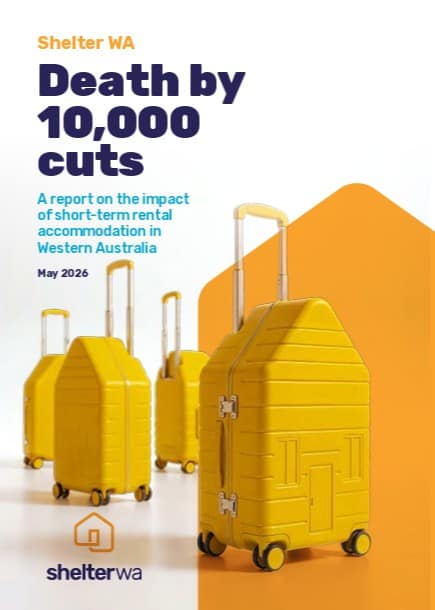
Shelter WA’s ‘Death By 10,000 Cuts’ report analysed 88 localities across the state between March and September 2025, and found more than 10,400 unhosted entire Airbnb properties listed compared with about 3,700 private rental listings.
The report found that returning around one in three unhosted Airbnbs to the long-term rental market would double WA’s available rental supply.
Other key findings of the report:
Short-stay listings are growing and vastly outnumbering long-term rentals
- More than 900 new unhosted Airbnbs were listed across WA in the two years to September 2025, offsetting state government incentives that returned more than 800 homes to the long-term market
- In 15 different local government areas there were hundreds of unhosted Airbnbs listed collectively but no long-term rentals available
Airbnbs have cannibalised smaller rentals and erased affordable suburbs
- More than half (52 per cent) of unhosted short-stay listings are one-and-two bedroom homes which single people, low-income earners and older women rely on
- There were more than 5,400 unhosted one-and two- bedroom short-stay properties listed compared to 840 private rentals
- Just 151 long-term rentals were under $400 per week in WA. In these suburbs, for each affordable rental, there were between 2.5 and 291 Airbnbs listed
Multiple listings by single hosts are now the norm
- Almost three in five (56 per cent) Airbnb hosts have two or more unhosted properties listed
- Just 12 individuals or entities owned or managed 10 per cent of all unhosted Airbnb listings
The report also identifies 45 “Pain Zones” across WA where Airbnbs catastrophically outnumber private rentals.
In Fremantle, there were 22 Airbnb properties for every rental listed, while in Scarborough there were eight to one. Meanwhile, in Mundaring, there were 31 unhosted Airbnb properties but zero private rentals on the market.
The situation is even worse in regional WA. Across 13 regional areas, including Gingin and Dandaragan, there were collectively hundreds of unhosted Airbnb properties and not a single long-term rental available.
| Metro locale | Unhosted Airbnbs | Private rentals | Ratio of Airbnbs to rentals |
| 1. Mundaring | 31 | 0 | 31 to 0 |
| 2. Bassendean | 11 | 0 | 11 to 0 |
| 3. Serpentine-Jarrahdale | 29 | 1 | 29 to 1 |
| 4. Fremantle | 291 | 13 | 22.4 to 1 |
| 5. Scarborough | 272 | 33 | 8.2 to 1 |
| 6. Cottesloe | 117 | 16 | 7.3 to 1 |
| 7. White Gum Valley | 14 | 2 | 7 to 1 |
| 8. Northbridge | 55 | 12 | 4.6 to 1 |
| 9. East Fremantle | 21 | 5 | 4.2 to 1 |
| 10. Hillarys | 23 | 7 | 3.3 to 1 |
| 10. Shenton Park | 23 | 7 | 3.3 to 1 |
Top 10 Perth Metro “Pain Zones” where Airbnbs outnumber rentals from Shelter WA’s ‘Death By 10,000 Cuts’ report.
| Regional locale | Unhosted Airbnbs | Private rentals | Ratio of Airbnbs to rentals |
| 1. Gingin incl Moore River | 201 | 0 | 201 to 0 |
| 2. Dandaragan incl Jurien Bay | 106 | 0 | 106 to 0 |
| 3. Nannup | 90 | 0 | 90 to 0 |
| 4. Lancelin | 85 | 0 | 85 to 0 |
| 5. Jerramungup incl Bremer Bay | 53 | 0 | 53 to 0 |
| 6. Harvey | 49 | 0 | 49 to 0 |
| 7. Irwin | 35 | 0 | 35 to 0 |
| 8. Plantagenet | 28 | 0 | 28 to 0 |
| 9. Shark Bay | 19 | 0 | 19 to 0 |
| 10. Dardanup | 18 | 0 | 18 to 0 |
Top 10 Regional “Pain Zones” where Airbnbs outnumber rentals from Shelter WA’s ‘Death By 10,000 Cuts’ report.
“These findings expose the short-term rental market’s toll on WA’s severe rental crisis,” Shelter WA CEO Kath Snell said.
“While people desperately search for a place to live, more than 10,000 properties are being used for holidays and short stays instead of safe, long-term homes.
“We can’t fix the rental emergency without addressing the short-stay accommodation boom. The state government has helped return hundreds of short-stay properties to the rental market through incentives, but those gains have effectively been cancelled out by the number of new Airbnb listings in the same period.
“Affordable one- and two-bedroom homes have been hollowed out of the long-term rental market. These are the homes most critical for single people, low-income earners and the growing number of older women at risk of homelessness. Single person households are the fastest growing demographic but the homes they need are rapidly being turned into tourist accommodation.
“If around one in three of all unhosted Airbnbs were brought back into the market this would double our available long-term rental supply in WA. We need the state government, working with local government, to act with real urgency and restrict short-term rentals including by introducing a moratorium on new listings in areas with low vacancy rates, a levy for unhosted short-stay properties, and a WA affordable housing scheme that guarantees long-term supply.
“Cities and regions around the world have taken action on short-stay accommodation – now is the time for WA to do the same. We recognise the state government has made a start but stronger intervention is needed and more solutions must be on the table to fix this housing emergency.”

