

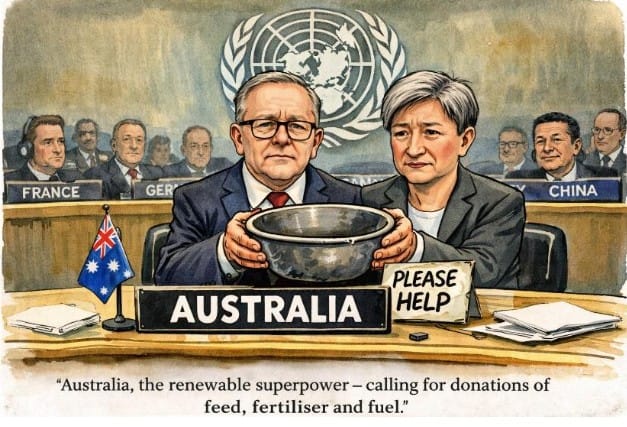
Australia has just signed up to a free trade agreement with the European Union, which is being sold—predictably—as a great leap forward for the inner city consumer. Cheaper European cars. Cheaper French wine. One can almost hear the champagne corks popping in the homes of the Teals.
Out in the paddock, however, the mood is less celebratory.
Because the small print tells a more familiar story. Australia once again signed a deal where farmers pay the costs. Beef and lamb remain carefully corralled behind European quotas, while European farmers continue to enjoy the full protective embrace of their governments. Free trade, it seems, is a concept best applied to other people.
This curious asymmetry does not stop at the Australia EU deal. It extends—rather more consequentially—to the sanctions around the Russian Ukraine war. Faced with a war on their doorstep, the Europeans have signed up to global sanctions on Russia but refuse to impose costs on their farmers.
Australia, by contrast, has decided that our farmers can bear the cost of not having access to cheap Russian fuel and fertiliser while refusing to give Ukraine helicopters and other defence equipment that we were dumping. Go figure.
Despite the rhetoric of sanctions, Europe has kept supply lines open where it matters. Australia has not. The result is entirely predictable: a self-imposed cost disadvantage dressed up as moral clarity.
Consider fertiliser. Russia remains the world’s second-largest producer, turning out roughly 65 million tonnes a year, most of it exported. That is not a marginal supplier. That is the supplier that sets the marginal price.
Europe understands this. It has kept the door ajar—sometimes discreetly, sometimes creatively—but open nonetheless. Australia, with a certain earnest enthusiasm, has slammed it shut and congratulated itself on the sound.
When it comes to backing their farmers, the Europeans provide support. When it comes to backing ours, our government prefers to ride on their back.
While Australia has chosen to wall itself off from Russian supply entirely—banning import, financing and transport of Russian-origin fertilisers under its sanctions regime—Europe has taken a rather more adult approach.
In 2025, the EU imported around 2 million tonnes of Russian urea, accounting for roughly 30 per cent of its imports. France, Germany and Poland—serious agricultural economies, not hobby farms—were among the largest buyers. At the same time, around 20 per cent of the EU’s gas demand continued to be met by Russian supply, whether directly or via the sort of logistical creativity that tends to emerge when necessity intervenes. Some of that gas, inevitably, found its way into fertiliser production.
Even crude oil continues to flow. The Druzhba pipeline still feeds Hungary and Slovakia under exemptions with no obvious expiry date. War or not, the Europeans have made a straightforward calculation: food security and industrial competitiveness come first; everything else is commentary.
Australia, by contrast, has opted for moral clarity accompanied by economic self-harm. We have banned Russian-origin products outright, imposed a 35 per cent tariff on imports from Russia and Belarus, and prohibited financing and transport support. All of this, it should be noted, despite Russia accounting for only around 4 per cent of our direct fertiliser imports—but playing an outsized role in setting the global price.
Which is rather the point. You do not need to buy large volumes from a supplier for that supplier to determine what you pay. In globally traded commodities, the marginal tonne sets the market. Remove Russian supply from the equation and every tonne Australia sources elsewhere becomes more expensive.
And just to complete the exercise in timing, we have managed to do this precisely as fertiliser supply from the Middle East and China dried up. The door closes in one direction, and we make certain it remains firmly shut in the other.
So while Europe continues to access Russian inputs—directly or otherwise—Australian farmers are left bidding into a tighter, more expensive global fuel and fertiliser market. Or at least, one assumes they are bidding. There is a lingering suspicion our fertiliser buyers are waiting for the dust to settle from recent force majeure calls before re-entering with fresh prices and cleaner balance sheets. But you will have to read my two articles Summit’s Force Majeure Gamble: A Pattern Emerges and CSBP’s Force Majeure Gamble: Contracts, Conflict and Consequence on mylinked in page or ARR.News.
The same logic applies to fuel. Australia has effectively locked itself out of Russian crude and refined products. Europe has not. It has rerouted, rebadged and, where necessary, quietly ignored the obvious. The supply continues. The system functions.
Australia, meanwhile, remains an island continent with vast distances, a freight task that would alarm most European policymakers, and fuel reserves that could best be described as optimistic. Layered on top is a just-in-time supply chain that works beautifully—right up until the moment it doesn’t.
And when that moment arrives, as it inevitably does in global commodity markets, Canberra reaches for its most reliable instrument.
A roundtable.
There is a certain consistency to it. Faced with tightening supply, rising prices and clear evidence of how others are managing the same problem, the instinct is not to act, but to assemble.
Meanwhile, our federal Agriculture Minister assures the sector there is “enough fertiliser” for winter seeding. Which may well be true—if one assumes price is irrelevant, timing is optional, and inputs are distributed with the calm efficiency of a centrally planned system.
It is a comforting idea. It is also not how agriculture works.
The difficulty with declaring there is “enough fertiliser” is that it confuses physical presence with economic reality. In a market system, availability is not measured by tonnes that might exist over east, or even those that eventually arrive—it is measured by what can be secured, delivered and paid for when it is needed.
This points to a deeper problem: a habit of closing doors when they should be opening.
The decision to shut down live sheep exports—made to satisfy a domestic audience—directly contributed to a contraction in the Western Australian flock. That has real consequences. Fewer sheep mean fewer pasture paddocks, fewer pasture legumes, and less nitrogen being fixed naturally in the system.
Translated into plain English for a clueless government: it means more reliance on synthetic fertiliser.
So at precisely the moment fertiliser is becoming more expensive and less accessible, policy has increased dependence on it. It is an elegant piece of circular reasoning—constrain supply, remove alternatives, then express confidence that the system will adjust.
Add to that soft grain prices and decile 10 fuel and fertiliser prices, and the adjustment becomes less a matter of efficiency and more a matter of farm survival.
Against this backdrop, the contrast with Europe sharpens. They have a war on their doorstep and have chosen to prioritise their farmers access to critical inputs and maintain production. Australia, comfortably distant from the conflict, has chosen to do the opposite.
One begins to suspect the policy objective is not outcome, but appearance.
There is, however, nothing inevitable about this position. The solutions are not complex. They are simply unfashionable.
In the short term, the government could remove the settings that add cost without adding resilience. It could facilitate access to global supply—starting with Russian— urea and diesel by underwriting the insurance risk of moving fuel and fertiliser through contested shipping routes.
In the medium term, it could take fuel security seriously. Strategic reserves measured in months, not weeks. A target of 200 days of diesel by 2030 would do more for national resilience than 100 roundtables.
And in the longer term, it could follow Trump’s policy of ‘Drill Baby Drill’ and rebuild our oil industry along with tax holidays for building new refineries and fertiliser plants. In effect accept that energy security is not an optional extra.
None of this requires another roundtable. It requires a government that understands the difference between policy and performance.
The Europeans have mastered this distinction. They issue the statements, attend the summits, sign the agreements and then quietly ensure their farmers keep farming.
Australia has chosen a different path. We have perfected the statement and misplaced the supply.
At this rate, it won’t just be fuel security we are short of. It may well be food security too.