

“Never was so much owed by so many to so few.”
— Winston Churchill
“All that is necessary for the triumph of evil is for good men to do nothing.”
—Edmund Burke
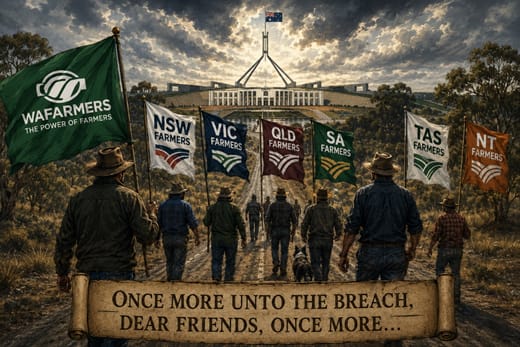
“Once more unto the breach, dear friends, once more.”
— Shakespeare, Henry V
I’ve just returned from a two-day National Farmers’ Federation members meeting in Canberra and the mood is dark. It is increasingly clear this Government has little affection for the productive capitalist class and is hunting for revenue, regulation and control from wherever it can extract it.
The recent Federal Budget fight over discretionary trusts should have been a wake-up call for every family farm in Australia.
The Government originally proposed a broad 30 per cent minimum tax regime on all discretionary trusts from 1 July 2028 — a move that would have struck at the heart of how many family farms structure succession, asset protection and intergenerational ownership.
Fortunately, the NFF spent months deep in negotiations with the Treasurer’s office and Treasury and managed to secure several critical carve-outs for agriculture.
These concessions did not emerge because Treasury suddenly developed affection for family farming. They were extracted because the NFF had the access, relationships and institutional credibility to force government to recognise that family farms are fundamentally different from passive urban investment vehicles.
Nor was this the first major win for the NFF. Last year, together with other national peak bodies, it helped hold off the proposed $50 million biosecurity tax, and every year it fights to preserve the diesel fuel rebate — a policy absolutely critical to the economics of regional Australia.
They fight a constant battle against an increasingly activist-minded bureaucracy and political class in Canberra. Farmers are increasingly frustrated with environmental laws, carbon agendas, industrial relations creep, heritage lockups, wind farms, biodiversity schemes and governments that increasingly view productive, asset-rich family farms as little more than future revenue streams waiting to be taxed, regulated, carved up or absorbed into environmental and carbon markets.
Every one of these policy ideas is the political child of some activist-minded minister, adviser or departmental empire-builder in Canberra. Every one will make life harder, more expensive and more uncertain for family farms.
Yet very few farmers stop to ask the harder question:
Who is actually funding the fight to hold back the tide?
Because when Treasury starts circling family trusts, fuel rebates, succession structures, environmental approvals or carbon reporting, there is only one organisation in Canberra with the institutional gravitas, relationships and door-opening ability to get direct access to the Treasurer, Prime Minister and senior Cabinet ministers when it matters.
That organisation is the National Farmers’ Federation.
It is fashionable in some circles to criticise the NFF, but without it agriculture is left relying on individual MPs shouting from the backbench while deals are stitched together between Labor, the Greens and the Teals long before legislation reaches Parliament.
That is why the NFF matters.
Political commentators like me can bang the drum and rally the troops, but when push comes to shove the only people who can materially shift policy are the handful who can get into the bunker rooms of Parliament House, sit across from key ministers and force government to reconsider.
Without the NFF, agriculture becomes easy pickings for progressive activists and bureaucrats who see productive farmland as an underutilised environmental asset waiting to be regulated, carved up or monetised.
When push comes to shove, the NFF is the only organisation consistently on the front line in Canberra. No single state farming organisation or commodity group carries sufficient weight individually to shift Treasury, Cabinet or the Prime Minister’s office on its own.
The difference is that state farming organisations and commodity groups collectively fund and empower the NFF so agriculture has somebody inside the room while policy is still being shaped — not after the press release is written and the legislation already drafted.
But that system only survives because a relatively small number of farmers across Australia are prepared to financially support it through membership of peak advocacy organisations that in turn support the NFF.
And the numbers behind who is carrying the load are staggeringly small.
Australia likes to talk about having around 80,000 farm businesses. Technically that may be correct under ABS definitions, but it is economically misleading.
The real economic weight of Australian agriculture now sits overwhelmingly within the broadacre grain and livestock sectors. Together, those sectors generate roughly $50 billion of Australia’s more than $100 billion in annual farm gate production. Once the focus shifts from headline ABS farm numbers to commercially significant broadacre agriculture, the pool immediately narrows to perhaps 40,000 grain and livestock farm businesses nationally.
The numbers shrink further again once duplicate, smaller and part-time operations are removed. ABARES data and industry turnover estimates suggest there may only be around 20,000 commercially significant grain and livestock farm businesses nationally turning over more than $1 million annually.
Yet these grain, sheep and cattle businesses are now producing well over half of Australia’s agricultural output, paying the overwhelming share of the roughly half a billion dollars raised annually through RDC levies such as GRDC, MLA, AWI and Dairy Australia, and controlling the vast majority of Australia’s broadacre freehold agricultural land asset base — roughly 100 million hectares nationally and collectively worth around a trillion dollars.
And yet only a fraction of this family farm and asset base is paying for frontline political representation.
A review of the annual reports of the various peak bodies that publish membership numbers suggests only around one in four of Australia’s 80,000 farm businesses voluntarily belongs to a peak advocacy organisation. That suggests perhaps 20,000 producers nationally are contributing directly to organised agricultural representation.
Collectively, these memberships generate perhaps only around $10 million annually in direct advocacy funding nationwide to cover everything from chicken to cotton and rice to red meat. Of that, only around $2.5 million ultimately flows through to support the National Farmers’ Federation in Canberra.
The concentration becomes even more stark within the broadacre grain and livestock sectors. Of the roughly 40,000 broadacre grain and livestock farm businesses nationally, perhaps only 10,000 are carrying a substantial share of the direct advocacy burden for state farming organisations, commodity groups and the NFF itself.
In other words, a remarkably small number of commercial farming families are effectively helping fund the political defence structure of a $100 billion national industry.
Set against more than $50 billion in annual broadacre grain and livestock turnover, direct advocacy funding equates to only around:
- $1 in every $10,000 of farm gate revenue.
By comparison, RDC levies operate much closer to:
- $1 in every $100 of production value.
In simple terms, Australian farmers collectively spend around one hundred times more funding compulsory research levies than they do funding political representation.
That imbalance matters.
Because the existential threats to agriculture over the next twenty years will not simply be agronomic. They will be political.
Think about what you willingly pay your lawyer and accountant each year to protect the farm business. Think about what you spend insuring machinery, crops and livestock against risk. Then ask yourself whether it is reasonable to simply lean on the neighbour to give up their time attending meetings — or merely doing their bit by paying to fight political battles on your behalf.
There are people in Canberra who would quite happily see family farming slowly consolidated into larger corporate ownership structures. It is easier to regulate, easier to tax and easier to integrate into centralised carbon and environmental markets.
Farmers ignore politics at their own peril.
If farmers are serious about protecting their assets, their land, their succession structures and their freedom to farm, they will eventually need to do more than complain about government and lean on the neighbour.
Because right now, only a small and shrinking number are carrying the load.
On that note, I thank the thousands of farmers across Australia who continue to fund the fight while so many others free-ride on the outcomes.
If producers are serious about protecting the future of the family farm, then more need to join and support their peak advocacy organisations, strengthen the NFF and perhaps finally recognise that agriculture’s long-term future may depend on speaking with a far more powerful national voice.