

The launch of Caught in the Current, The Dire Consequences of Politics Driving the Murray-Darling Basin Plan in Barham, celebrated a long-awaited, community-driven historical and factual resource on Australian Water Policy. Sophie Baldwin, CEO of Southern Riverina Irrigators and a 20-year dairy farmer, opened the event by recounting the Basin Plan’s devastating personal and regional impacts. She described buying her first dairy farm in 2002 with 570 ML of water for $2 million total; today the water alone costs $4.4 million, pricing young farmers out entirely. Irrigation use in her zone plummeted from 420 GL (2012) to 160 GL, while environmental deliveries rose from 16 GL to 100 GL. She linked the Plan to local town decline, food-security risks, and the erosion of Australia’s productive heartland.
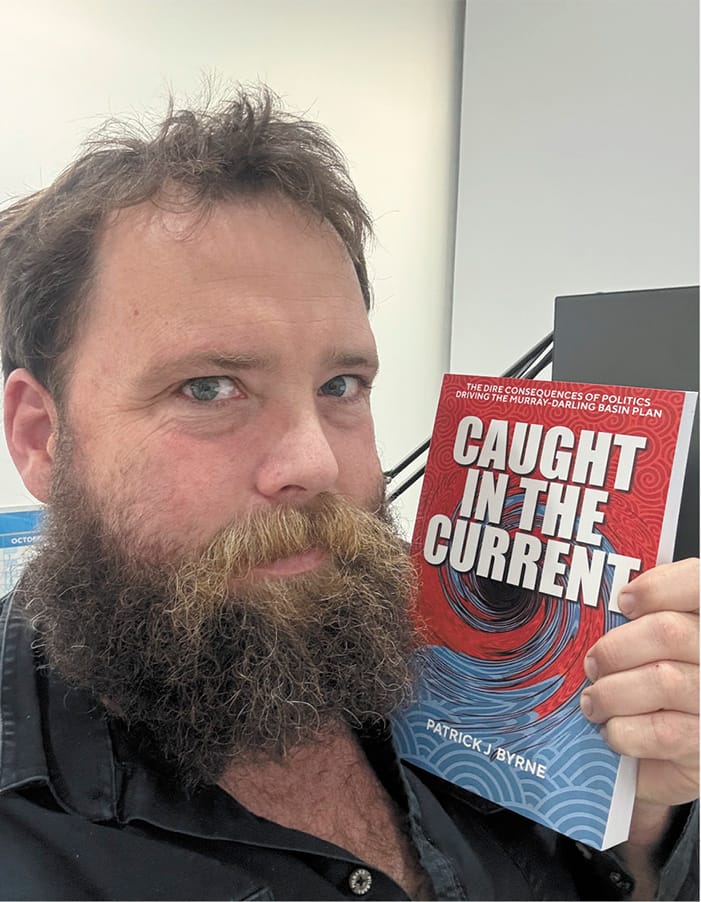
John Lolicato, a key contributor, explained that the book originated with the late Neil Eagle AM and Peter Millington (former Director-General of NSW Water and MDBC commissioner). It counters the one-sided “environment-first” narrative that has dominated since the 2007 Water Act replaced the cooperative Murray-Darling Basin Commission (MDBC) with the more authoritarian Murray-Darling Basin Authority (MDBA). Lolicato detailed how politics overrode balanced social-economic-environmental objectives, citing MDBA’s refusal to correct public misconceptions on the Southern Coorong (geographically impossible to flush with Murray water), the Lower Lakes (estuarine, not historically fresh), and misleading constraint and buyback data. The book is heavily footnoted for use as a verifiable reference by students, researchers, and communities challenging official accounts.
Patrick Byrne, the editor and public-policy writer (co-author of earlier works like High and Dry), delivered the keynote. He described the book as a 125-year history of basin development, politics, and economics, restoring the record of world-best-practice management under the MDBC—praised globally by World Bank expert Professor John Briscoe—before it was discarded in months for the 2007 Act. Byrne praised grassroots efforts and endorsements from demographer Bob Birrell and agricultural economists. He positioned the book as ammunition to win the “ideological argument” coinciding with the Basin Plan review and rural political revolt. Significant findings in the book highlighted food production collapse, flawed narratives and the omission of key data.
Highlighted food-production collapse: Australian agricultural output per head of population rose 38 per cent (1975–2002) but fell 31 per cent by 2020 (projected ~50 per cent drop). Basin irrigation production dropped 29 per cent in just six years—3.5 times faster than the national decline. Australia risks becoming a net food importer within 5–11 years as imports outpace exports.
Environmental water takeover: Pre-1997 Cap, flows were roughly 50 per cent environment / 50 per cent consumptive. Today, held environmental water averages 4,572 GL (far above the 2,750–3,200 GL legislated). When combined with river flows, 71 per cent of water now serves the environment and 29 per cent productive use—reversing the historic balance.
Lower Lakes and Coorong myths: The Lakes are estuarine, varying salinity, not permanently fresh as the Water Act claims using Ramsar Convention powers. The same powers the Commonwealth used to usurp the state’s constitutional powers over water. The Southern Coorong problems stem from South Australian drainage cuts since the 1800s, not insufficient Murray flows. MDBA perpetuates these misconceptions.
Flawed climate narrative: Bureau of Meteorology data (ignored by MDBA) shows basin rainfall up ~45 mm on long-term average; evaporation rates falling. Low inflows result partly from 650,000 new on-farm dams holding ~10 per cent of rainfall, not “drier climate.”
The book also highlights solution like amending the Water Act to recognise the Lower Lakes as estuarine; automate barrages and redirect southeast drainage to restore natural flushing; build new dams; sell back a proportion of held environmental water to irrigators; restore MDBC-style community-cooperative governance.
The book is explicitly designed as a factual counter-narrative and practical tool for inquiries, libraries, and policy debate.
It’s time to bring the best available science back, along with truth and commonsense!
The book is available in local newsagencies.
This article appeared in The Koondrook and Barham Bridge Newspaper, 28 May 2026.

