

Four years on from one of the biggest floods in living memory across the Northern Rivers region that was also Australia’s biggest natural disaster, people, homes and businesses are still feeling the impact.
Deloitte Access Economics were commissioned by the NSW Government to prepare the Northern Rivers Economic Profile and Natural Hazard Impact report in 2025, which states the economic impacts of natural disasters across the region, including the 2022 floods, estimated at more than $3.7 billion.
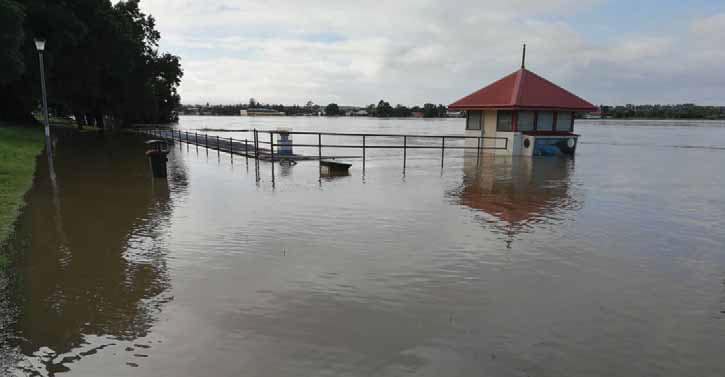
Hundreds of millimetres of rain fell across the region from February 23 to March 1, with some locations breaking daily rainfall records, and six people tragically lost their lives in the extreme event.
Over just two days, February 28 and March 1, 532.6 mm of rain fell at Yamba, and the Clarence River at Maclean reached 3.36 m AHD, threatening the levee.
Roads and homes that had never been previously inundated were flooded with stormwater, followed by river flooding two days later.
Yamba was isolated for a week, and the Coles supermarket ran short of food.
The flood peak also isolated the town of Iluka for many days when Iluka Road was cut near the Esk River.
The Clarence River at Grafton peaked at 7.67 m AHD, below the 2013 flood level of 8.09 m AHD, and did not breach the levee, but it still swallowed the then Grafton Rowing Club.
The majority of the Lismore region received 800 mm or more of rain in February 2022, 600 mm over the same period.
On the four-year anniversary of the floods, Deputy Leader of the Federal Nationals, Member for Page Kevin Hogan slammed what had been done to help Lismore recover and rebuild.
“I can’t help but think if this disaster had been in Sydney, things would be happening much quicker,” Mr Hogan said.
“There are three areas where the State and Federal Labor Governments are failing us.”
Mr Hogan said the Resilient Lands Program was established to unlock land and build new homes.
“Not one home has been built, and it is still years away before the first family will move into one,” he said.
“The Reconstruction Authority was established to speed up this process.
“If this is considered a quick process, then something is clearly wrong.”
Mr Hogan said the buyback scheme has also failed as it was not fully funded.
“It’s moved half a street and left the other half there.
“Over 1,000 homes identified to be bought back won’t be.
“How does that make the community any safer.
Flood mitigation is the only strategy that will deliver long-term safety and certainty for our region.
“Yet to date there has been no meaningful engineering work done to reduce the level of the next flood.”
Mr Hogan said recovery has been driven overwhelmingly by local families, farmers and businesses who have poured their savings into rebuilding homes, reopening shops, restoring farms and getting people back to work.
“We await the CSIRO Flood Mitigation Report in June. Governments must commit to funding and delivering recommendations to take two metres off the next flood,” he said.
“The federal and state Labor governments need to do better, in ensuring this region has a safer and prosperous future.”
Despite Mr Hogan being critical of the recovery process, the NSW Reconstruction Authority (RA) says it is working hard on recovery in the Northern Rivers region.
In the four years since the 2022 floods, the NSW Government through the RA has committed more than $1.3billion in regional recovery.
This includes the Resilient Homes Program, and the Resilient Lands Program, small business recovery grants and support packages, and demolition programs.
More than $1.5 billion has been committed to Northern Rivers Councils and $537 million has been delivered so far.
There are more than 2,500 infrastructure projects underway across local and state networks across the region restoring roads, bridges, community facilities, repairing landslips and essential services.
So far, more than 779 homes have been bought back by the RA, with an additional 119 approved offers working through to settlement, the aim of which is to relocate families from the highest risk flood areas in the Northern Rivers.
By the end of 2026 these homes will be removed from the floodplain, ensuring communities can plan for their renewal of these vacated areas, under the largest program of its kind in Australia.
Across the Northern Rivers, 848 Resilient Measures home assessments have been completed by the RA, with 253 grants approved, and 111 homeowners are in the process of getting quotes for work.
The regions flood mitigation is being strengthen through 36 projects, including major flood pump station upgrades, town drainage, raising bridges and roads, and widening flood channels, through the Northern Rivers Recovery and Resilience Program.
So far 22 projects have been completed, and the remainder are set to be completed in 2026 and 2027.
Safer, flood free land at Mount Pleasant in Goonellabah will go on sale in the coming months, the first safe land to go on sale, which will be followed by land releases at East and North Lismore.
This article appeared in the Clarence Valley Independent, 6 March 2026.
Related story: Deluge in the Clarence Valley

