

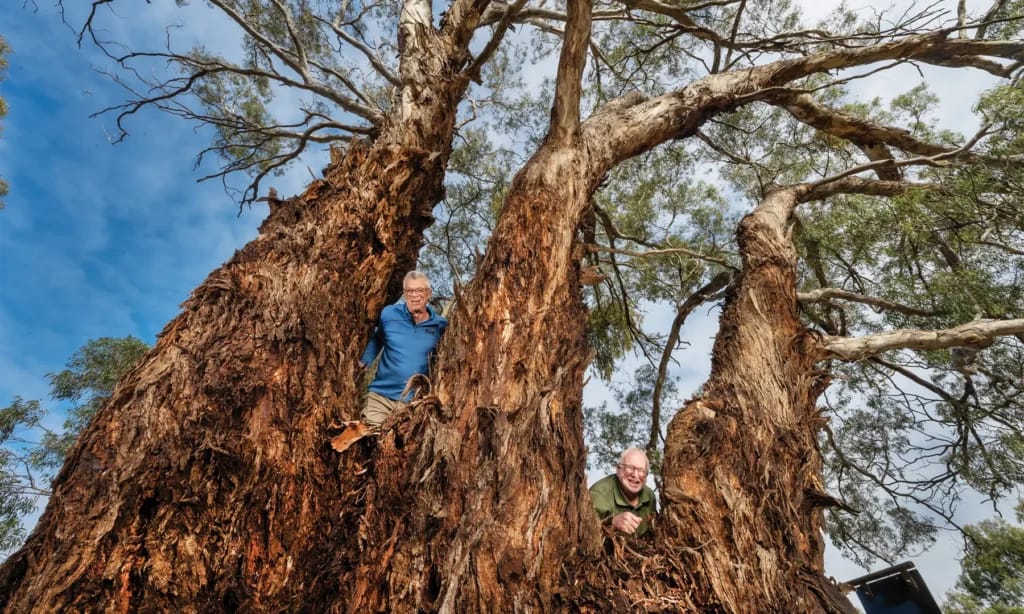
How does a tree survive hundreds of years? The three Ls of Luck, Location and a Little bit of help from friends?
In Victoria, old-growth forests and trees are at risk of fire, and since colonisation most have also faced logging and other human interventions. But occasionally human activity seems to be a protective factor – check out the intact native grassland of regional significance at the historic Woodend Racecourse, for example (attributed to its protected location within the interior of the racing circuit, which was not subject to grazing or exposed to invasive weeds).
And the three Ls might also be the case for a few large pre-colonial trees that have recently been identified at Maldon Golf Course by Bev Phillips of the Maldon Urban Landcare Group (MULGA).
The tree survey at the golf course in October and November 2025 was part of an ongoing project started in 2009 by MULGA, an organisation that cares for and preserves the natural environment in the Maldon area. MULGA has been undertaking a detailed survey of Pre-1852 Eucalypts in Maldon with a circumference of at least 1,815mm at a height of 1.3m, using a calculation based on average growth rate to estimate the age of the trees. Previously surveyed areas include public land such as Maldon Primary School, Maldon Hospital and Bill Woodfull Reserve, as well as roadsides, parts of the Maldon Historic Reserve and some private land.
Maldon Golf Club Secretary Bob Briggs told the TT [Tarrangower Times] that MULGA approached the club about the project. “Bev contacted the golf club and said she was doing a survey of the very oldest of trees in the Maldon area and suspected that there might be some on the golf club,” he said, indicating that the club was very pleased to learn that there were nine pre-1852 trees on the course. “It supports all of our understanding about the historical values, not only of Maldon but also the golf club, so it’s good to know we’ve got a lot of history even beyond the town.”
Bob explained that while the club was formed in 1908, it moved to its current location in the 1920s and the configuration has not changed much since then. “The layout of the golf course is fairly unchanged for the last hundred years in terms of where trees were retained, as in this case, or planted,” he said, noting that the old trees were safely ensconced in the course. “We wouldn’t have had any thoughts at all about cutting them down.”
Bev Phillips said she was first inspired to survey the old trees of Maldon after reading a brochure from the Information Centre called Living Treasures, which was created in honour of a MULGA founding member (and initiator of the Pre-1852 Eucalypts project), Wendy French.
“I became Secretary of MULGA in 2015 and I inherited Wendy’s folder,” Bev explained. Speaking with passion and extensive knowledge, Bev lists numerous “remnant Eucalypts” around town, including an estimated 305-year-old Red Box at the corner of Harker, Reef and Hornsby Street (that was protected by Council after MULGA advocacy) and a Grey Box near Pond Drive that is estimated to be 650 years old.
But the tree project really came to life in response to plans by the Catholic Church to build units on land at St Brigid’s.
“They wanted to move the pétanque piste under the Red Box tree there,” Bev said. The tree is estimated to be 435 years old, and so MULGA rallied to have a root protection zone put in place, which meant no shifting pétanque and no units.
Bev doesn’t believe that being located on the golf course was necessarily a safeguard for the magnificent trees, like the one in our photo. “I think they were just in the right place to not be cut down between fairways,” she said.
However, she did say that a huge Yellow Box (estimated 540 years old) situated between the oval and the netball courts at Bill Woodfull reserve may have been lucky in a similar way when most trees were routinely cut down in the 19th century for fuel and building material.
“We reckon that they left some trees to provide shade for horses and maybe some for people. These trees have a very big canopy; they’re tall, but they’re very wide,” Bev said. “They weren’t in the way of the football. I think it’s probably the same for the golf course; they were not in the way.”
Bob and the Golf Club certainly see much more value in the trees. “Trees are the greatest asset that golf courses have because not only do they provide a canopy for the layout of a golf course, but they provide the challenge for golfers as obstacles,” Bob said.
For Bev and MULGA, identifying these remnant Eucalypts is a big deal. “It has been a major project over a number of years now, and we value the trees in town; they’re precious trees.” MULGA has nominated 14 remnant eucalypts for the National Trust Victoria Significant Tree Register, and there are plans to invite interested local people for a walk to observe Maldon’s oldest trees later in the year. Stay tuned if you are a friend of the trees.
This article appeared in the Tarrangower Times, 6 March 2026.

