

Haydays retirement hostel is facing an imminent crisis, due to the building’s ageing infrastructure.
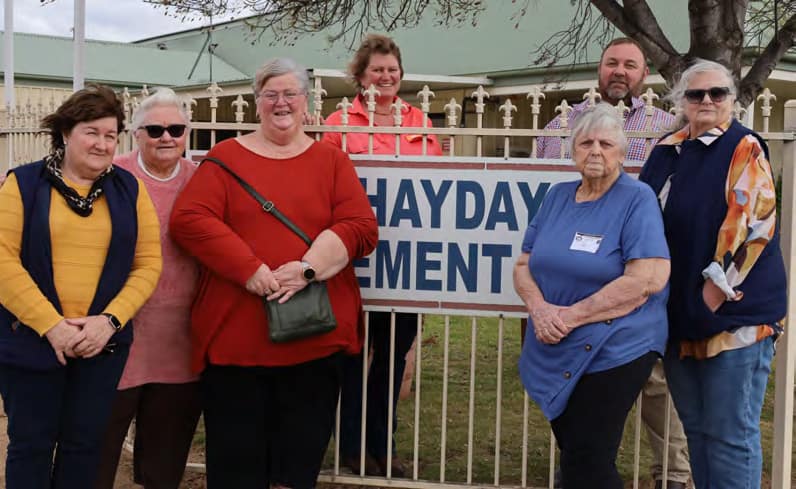
The centre, which first opened in 1968, is just two or three years away from closing, unless vital refurbishments can be undertaken, to ensure the facility is compliant with all Aged Care Commission regulations, according to the Haydays Management Board.
Lisa Bowen, Chair of the Board, expressed her deep concern, stating that ageing in Hay is ‘flying under the radar’ and has been a neglected area.
“It is extremely difficult to care for elderly people in a building that was built in the ‘60s, that isn’t purpose built.
“We need to look after our aged people, because of all they contributed to Hay.
“They made Hay what it is.”
Sharon Weymouth, a registered nurse with more than 47 years’ experience, said Haydays care staff are constantly battling to provide the highest care.
“The staff improvise constantly to care for people, that are beyond the capacity of what the building was built for,” she said.
One example is the narrow width of doorways, which block access to modern ambulance stretchers.
“We have had to move residents out from the bathrooms, out onto a verandah before we could get them onto an ambulance,” Ms Weymouth said.
“It’s degrading and humiliating process for them to have to go through.” The 1960s plumbing frequently requires repairs, and the antiquated buzzer system for staff alerts is inefficient and difficult to use.
The building’s layout is not set up for the required level of infection control, and even basic equipment like a bedpan steriliser cannot be properly installed without major renovations.
Verandas, which have been covered in as part of past minimal renovations, are like “hot boxes in summer” and “freezing cold in winter,” with uneven walkways, posing risks for unstable residents.
Haydays currently offers basic dementia care, but it is not specialised, meaning as residents deteriorate, they often must be moved to facilities like the McFarland wing at Hay Hospital, which has a waiting list.
For those with behavioural problems, the only options are often facilities in Sydney or Newcastle, leading to devastating separations for local families.
“It’s a wrench,” Ms Bowen stated.
“We’ve already got people living away in other towns, and the families have to travel to visit.
“The lack of local respite care for dementia patients also puts immense stress on home carers.”
Haydays is desperately seeking a $5 million federal grant for vital renovations, and is anxiously awaiting the outcome of a submission to the Aged Care Capital Assistance Program.
This crucial funding is not for expansion or luxury, but to simply bring the existing facility up to compliance standards with the Aged Care Commission.
“If we don’t do stage one, we’ll close,” Ms Bowen said. “We’re in trouble.”
A previous Commonwealth grant application was rejected last year, however a facility in Bowral in the marginal seat of Whitlam received $27.5 million out of a total $250 million. Smaller regional areas like Hay missed out.
Beyond the renovations needed to stay open, the board has plans for a ‘phase two’ that would involve building 16 new units, four separate units, and crucially, dedicated dementia care units.
There are also hopes to expand existing rooms by combining three into two, allowing residents more space to bring personal belongings.
These ambitious plans, however, hinge on the success of the initial funding.
Ms Bowen highlighted the contrast in community awareness surrounding developments in Hay.
“There’s people supporting this motel application (Outback Quarter), but no one says anything about the aged care or services in Hay.”
Ms Bowen said there is a desperate need for “personal, public and political awareness” about Haydays’ dire situation.
Haydays “There is no plan B”
“The dedicated staff at Haydays are doing their utmost under challenging circumstances, improvising to provide the best possible care,” Ms Bowen said.
The board, a dedicated volunteer group, is working tirelessly, recognising their significant responsibility in the wake of the Royal Commission into aged care.
“There’s no plan B. We are banking on this,” Ms Bowen concluded.
“If we can’t meet the standard for an aged care facility, what does Hay do? Where do the people go?”
The Riverine Grazier contacted NSW and federal members of parliament, to better understand where responsibility lies.
NSW Minister for Health Ryan Park said the future of Haydays should lie in the lands of the Australian Government, especially when it affects state-run hospitals.
“Aged care facilities are the responsibility of the Commonwealth,” Mr Park said.
“However, state governments – which manage hospitals – are seeing a significant escalation in the number of people waiting for aged care placements in hospitals.
“The notion that patients waiting over seven weeks in a hospital bed longer than they need to be is deeply concerning, and to say it’s not good for patient outcomes is an understatement.
“Long periods of immobility in hospital leads to deconditioning, loss of mobility and cognitive impairment.
“Our hospital system was not designed for this.”
Federal Health Minister Mark Butler, Members for Farrer Sussan Ley and Member for Murray Helen Dalton were contacted for comment, but did not respond.
This article appeared in The Riverine Grazier, 3 September 2024.

