Picture this: you’re 80 metres below the surface of the Pacific Ocean, breathing compressed air while most people would need full helmets and helium-oxygen mixtures.
Your heart, which doctors say is failing, actually slows and calms in the crushing depths. Around you, seven-metre tiger sharks glide through the water, waiting for you to hand-feed them without the protection of a cage.
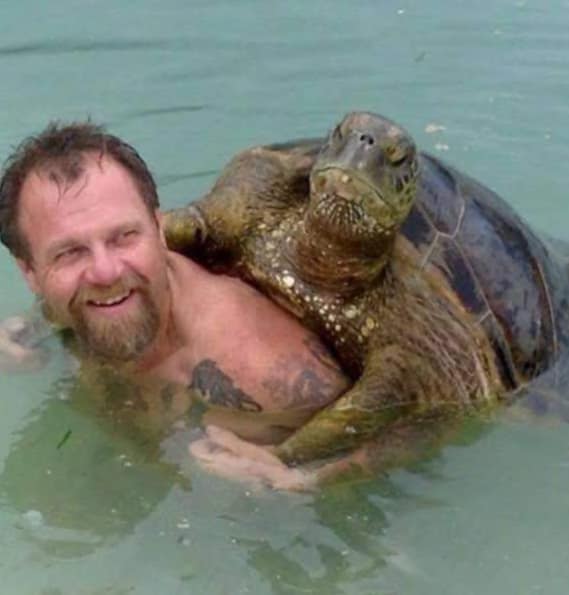
For most people, this would be a death wish. For a former Hay boy, Sean Griffiths, who once weighed 207 kilograms and has been through more battles than most people face in several lifetimes, it’s his sanctuary.
“My heart races most of the time, but when I dive, it actually calms down and slows,” he said.
“My heart rate drops to about 40 a minute. My cardiologist tells me to keep diving.”
It’s an unlikely prescription for someone with severe heart failure, but then again, nothing about this story follows the usual script.
The journey began in 1970s Hay, where a 10-year-old boy moved to Mungadal Station and started Year Seven at Hay War Memorial High School.
His family had deep roots in the area – his ancestors had settled on Mutherumbung and Bullock in 1856, and his grandmother and great aunts were Turner girls, born and raised on the land.
“I had a terrible nickname in Hay. It stuck, and when I moved to Bathurst, I thought I’d never lose it,” he recalls with a laugh.
“I thought, ‘Beauty, now’s the time,’ but I walked into a pub one night, and all these ex-classmates were there, and they yelled it out.”
Those school years were marked by promising talent cut short.
Playing for the Hay Magpies between 1981 and 1986, he and his best mate Darren Mitchell were automatic selections for group and state teams.
“Our Under 14s, Under 13s, and Under 15s teams were unbeatable,” he remembers. “I remember games where I scored nine or ten tries, and we were flogging teams like 60 to 0.”
Then came the game that changed everything. Both boys smashed their knees in the same match when they were about 14.
“We both required surgery; mine was a little bit worse than Darren’s.
“That ended everything. It was a bit crushing.”
The injury was more than just the end of football dreams.
“I was overweight, always a big chubby kid. Losing that ability, because I was in plaster for about six months.
“I should have had reconstruction, but they said it probably wasn’t going to be worth it being so young.”
What followed were decades of struggling with weight, pain, and increasingly poor choices.
Surgery on his leg every five years became routine. His weight climbed to a dangerous 207 kilograms.
Then came the choices that led him into the criminal justice system.
“I was charged with drugs. I took a plea bargain,” he says matter-of-factly. “I was only caught with about one ounce of powder.
“I didn’t know they loaded me up and changed my charge from supply to trafficking of nine kilos.”
The plea deal that was supposed to get him out in a couple of years turned into five years inside, followed by three years on parole.
“I was only out for about seven months and said, ‘That’s it, I’ve had enough, I can’t do it. Put me back in.'”
It was during his second stint, at Junee Correctional Centre, that the first seeds of change were planted.
“I did a four-year university course in two years. When I got out that time, my father was coming to pick me up and had a heart attack at Central Station.
“So, the day I got out, I made a promise to myself that I was going to change everything, and I did.”
The promise wasn’t easy to keep.
“I got out with nothing; I was homeless. I’d lost everything.”
When he met his future wife in 2009, he was sleeping under a bridge in Bathurst.
“I used to meet her in town for coffee and get her to drop me off at different places.
“She ended up asking, ‘Why don’t you take me to where you live?’ I had to tell her, ‘I haven’t got a place to live.'”
But something had fundamentally changed.
Starting from nothing, he began building again.
By 2014, he owned nine investment properties with a combined value of about five million dollars.
“I started from scratch, built up again,” he says simply.
The turning point came during their honeymoon in Fiji.
“I came to Fiji for my honeymoon and kept coming back every year for our anniversary. One thing led to another, and now I own four dive shops.”
The business success came with a price. The years of poor health choices, the damaged knees, the excess weight – they all caught up with him.
“At my maximum, I weighed 207 kilos. I am now 94 kilos.”
The dramatic weight loss wasn’t by choice. “I was going into surgery, and they said if I didn’t lose weight, because it was impacting my legs so badly, they couldn’t guarantee I’d wake up with my legs still.”
Then came the heart failure diagnosis.
“A normal person’s heart volume is 55 per cent at the top of the scale. I was down around 14 per cent.”
Doctors wanted open heart surgery. His response was typical.
“I said, ‘No, I’m going to beat it.'”
Against all medical expectations, he did.
“Over four years, I actually came back up to 67 per cent last August.”
When it dropped again to 12 per cent before Christmas, he fought back once more.
“Before I left to come here this time, which has only been three weeks, I was already back to 35 per cent.”
The diving that doctors initially feared might kill him became his salvation.
“I’m a rescue diver, a certified rescue diver and deep diver. I’m one step under instructor. I do a lot of deep dives, which put a lot of pressure on your heart.”
His 80-metre dive on compressed air puts him under 9 Gs of pressure – more than a fighter pilot experiences.
“To put it in perspective, a jet fighter pilot goes through 5Gs, sometimes up to seven Gs, and that’s pretty extreme.
“An 80-meter dive is 9 Gs.”
The medical establishment is baffled.
“I record it all for the governing bodies because I’m the only person who has ever dived with heart failure. So far, so good, fingers crossed.”
His dive operation in Fiji has become world-renowned.
“We got the top three soft coral dive destinations in the world. In the Tripadvisor Travelers’ Choice Awards, we actually won it worldwide, not just for the Pacific Islands.”
Last year brought another major challenge when his marriage of 15 years ended.
“She told me on Sunday, and by Wednesday, the removalists had packed the house, and they were gone. She left Thursday.”
True to his word about looking after her, he kept his promise.
“This February, I paid her out in cash. I gave up driving, I gave up work; I’m semi-retired now.”
The end of the marriage opened a new chapter.
His financial manager, who had helped him through two decades of business dealings, had also recently separated from her husband of 30 years.
“There was no intention by either of us to want a relationship, but now we’re seeing each other.”
Success in Fiji has meant more than just business achievements.
Living in a village where he’s treated like a chief, Sean has witnessed poverty that puts his own struggles in perspective.
“If you don’t have a farm and you don’t work, you don’t eat. It’s pretty simple.”
His response has been practical generosity. “I purchased a 20-foot container and filled it full of donations and brought it out for the kids and the villages.
“We dropped donations at five villages and two schools that year. To me, it was nothing; it cost me about 10 grand. But to see the smiles smiles on the kids’ faces and the lives we changed, it’s worth the 10 grand in return.”
He’s built houses for families living in tents, provided furniture for those sleeping on ?oors, and ensured school children have the supplies they need.
“None of the school kids are allowed to go to school unless they have their own supplies, like their own books.
“So, at Christmas time when the school holidays are on and O?ce Works have sales, I buy probably $300 worth of pens and pencils for like 20 cents.”
The health battles are far from over.
“I’ve had 27 surgeries in the last two years. I have plates and screws and all sorts of stu? everywhere.”
A motorbike accident broke nearly every bone in his body. The heart failure remains a constant threat.
But he’s learned something about resilience that can’t be taught in any textbook.
“You just have this resounding belief in yourself: you’re ?ne, you’re good. You’ve been down and up and down and up.”
When doctors told him he might lose his legs, his response was practical.
“I straight away went home, got on the internet, and started looking for ?ns so I could dive with one leg. I started converting my bike and my car so I could drive and ride them. I had everything in place, ready to go.”
When the cardiologist warns him about the risks, his response is philosophical.
“He wants me to stop diving. He doesn’t know when I’m going to have a heart attack. “I said to him, ‘Is that how I’m going to die?’
He said, ‘If you don’t do these things, yes, you’ll have a heart attack.’
“And I said, ‘Well, it doesn’t matter then.'”
These days, he splits his time between Bathurst and F?i, where he’s gradually handing over the dive business to his F?ian partner.
“The original plan was that the little F?ian who was my instructor, like my brother from another mother, would own it. I told him, ‘When it’s all said and done, this business will be yours.’
“Last year, I gave it to him.”
The boy who left Hay all those years ago has travelled further than most people could imagine – not just geographically, but through depths of human experience that would break many people.
Prison, poverty, illness, broken relationships and battles with his own body have all been overcome through sheer bloody-minded determination.
“We all veer o? into di?erent paths in life, but the smart ones get back on track,” he re?ects.
“I made the most of my time.”
At 80 metres below the surface, hand-feeding apex predators with a failing heart, he’s found something that eluded him for decades; peace.
It’s not the ending anyone would have predicted for a chubby kid from Hay who once scored ten tries in a game, but it’s authentically his own.
“When they told me I might lose my leg, it wasn’t about losing the leg; it was about what I wanted to do and if I was going to do it,” he says.
“I have legs at the moment.”
And a heart that, against all medical advice and expectation, keeps beating strongest when he’s surrounded by sharks in the deep blue waters o? F?i – as far from the ?at plains of Hay as you can get, but somehow exactly where he needs to be.
This article appeared in The Riverine Grazier, 16 July 2025.