

The silent heroes of a town are the ones who put their hands up to volunteer.
“If you want something done, ask a busy person,” as the old cliché says.
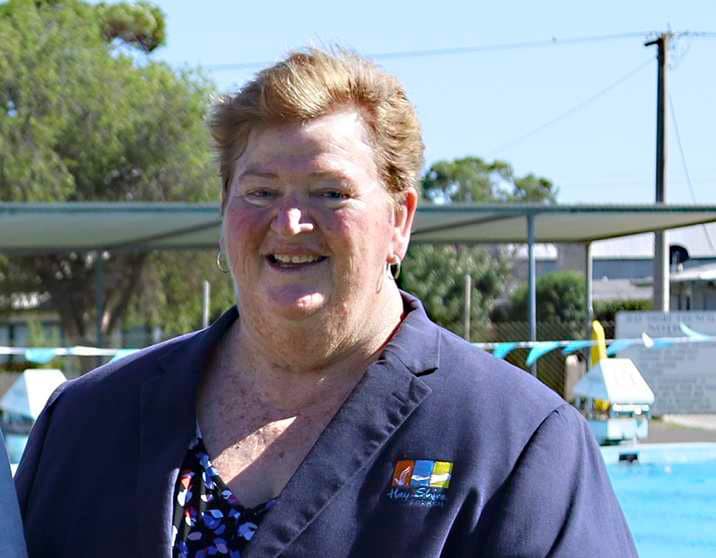
So, as we celebrate National Volunteer Week, let’s look into the many undertakings of our Mayor, Carol Oataway.
Carol embodies the spirit of community dedication in Hay. Described as a wealth of goodness and information, she is a phenomenal volunteer involved in numerous organisations.
While her plate feels full, her commitment to helping others and contributing to the greater good is unwavering.
“My cup is very full and I have no more space,” Carol admits with a smile when asked about her extensive volunteer work.
Yet despite this, her passion for service continues to drive her forward.
Can Assist: A labour of love
Can Assist holds a particularly important place in Carol’s heart, something she describes as “nothing more important”.
This organisation provides essential support to local people diagnosed with cancer who face expensive travel for treatment and appointments.
“We’ve got people who are given the awful diagnosis of cancer. Then they’re facing the fact they can’t get any treatment in Hay – appointments, surgery, whatever – they have to travel to do that. It becomes very expensive,” Carol explains.
Can Assist helps alleviate the financial burden by assisting with costs like accommodation, travel, medical fees, and even utility bills.
“So often, cancer patients are unable to work, due to treatments and just being too sick,” she said.
“We try to take the pain away by helping them with their expenses.
“If you can at least give them a little bit of relief from the awful diagnosis that they’re facing and the fact that they’ve got all these bills piling up.
“Some people can’t work and they’ve run out of sick leave, and that is an awful thing.”
Crucially, money raised locally by Can Assist in Hay is spent directly on people in the Hay community. No wages are paid. Approximately 99 per cent of funds go directly to assisting local individuals with their costs.
“Hay is a very generous community, providing substantial support,” she emphasises. “We are so very lucky in Hay, and in particular, for Can Assist. There was a dedicated group of volunteers years ago who helped set the organisation up for a successful future, with funds held in term deposits to continue providing help.”
Carol notes that in the last year, Can Assist paid out $55,000 to assist people. They have over 30 people on their books.
“Can Assist relies on people asking for help. We cannot proactively offer assistance,” Carol explains. “Anyone experiencing need can pick up the phone to seek support.”
Carol passionately urges those who are struggling to ask for help, aware that some may not access available support due to pride, thinking others need it more. She confirmed Can Assist has enough funds for everyone, dispelling this concern.
“When they say, ‘give that to somebody else,’ well, we’ve got more than enough. We’re a very generous community. We’ve got a good amount of money in the bank to help people.”
A life of service
Beyond Can Assist, Carol’s volunteer efforts are extensive. She volunteers and is an organiser at the Shear Outback bookshop, managing volunteers, banking, and stocking.
“I volunteer at the bookshop once a week, plus I organise the bookshop, the volunteers and I do the banking. I make sure the shelves are stocked.”
She is also President of the Hay Show Committee and serves on the Haydays Board. She’s taken on a new role teaching recorder to Hay Guides, plays the organ at Church on Saturday evenings, and manages the church books.
Her skill and love for accounting figures come from her mother, who was also a treasurer who loved maths. Carol finds joy in looking at figure and doing books.
“Accounting was my second love. If I wasn’t going to be a teacher, I was going to be an accountant,” she reveals. “I got that from my mother. She was the treasurer of everything when I grew up and she loved her maths. I love looking at a set of figures – income in, income out, what profit did we make?”
Between all her commitments, she also cares for her mother and husband. “If anyone misses out, it’s my husband. He doesn’t see a lot of me, and my dogs.”
A game-changer for Hay
A project Carol is particularly proud of achieving as a council member is the Country University Centre (CUC). Having held a successful career as a teacher, and later a principal of Hay Public School, education is her passion.
She believes the CUC is a game-changer for the community. Located at Pine and Cadell Streets, the CUC allows people – young or mature age – to pursue university education and degrees through online learning without needing to leave Hay.
“This overcomes the significant financial and logistical barriers of studying away from home,” Carol explains. “People don’t have to leave Hay anymore now. They can be educated at the Country University Centre. They can get their degree.”
She hopes the community utilises this opportunity, especially given her own experience of relying on a teacher scholarship to afford her education.
“The only reason I was able to go away is because I got a teacher scholarship. They paid my three years of living away from home. My parents couldn’t afford to do that.”
The seeds of service
Carol’s drive to volunteer is also influenced by her upbringing. Growing up in a Housing Commission family, she developed an interest in understanding people’s backgrounds.
She believes her supportive home environment and seeing her parents volunteer fostered her own community involvement. She feels she is giving back to the community that supported her growing up through volunteer-run activities like swimming and tennis clubs.
“I’m giving back to the community that gave so much to me,” she explains. “As a kid, I was in everything. I was in a swimming club – there were volunteers running that. Tennis – there were volunteers running that.”
“I wouldn’t have been able to swim if it wasn’t for volunteers. Because there were volunteer swim teachers back then.”
A different era
Reflecting on her childhood in Hay, Carol describes a different era marked by more freedom for children. Parents encouraged them to play outside and amuse themselves, leading to days spent wandering the neighbourhood, visiting friends, and playing outdoors.
“We kind of were raised by parents who loved us being outside,” she recalls. “They would always say, ‘get outside and amuse yourself’. And you would. You’d wander the neighbourhood, be going to your friends’ houses, spending time with them.”
Unlike today with prevalent technology, children had to make their own fun and invented games. She contrasts this with modern times, noting the excessive use of technology and its potential negative impacts.
“I think what’s missing a little bit is just that creative play, that outdoors time,” Carol observes. “Kids are not as fit as they used to be because they’re not out running, riding their bikes, swimming.”
Hay has a free pool, but it doesn’t see as many children as it did in her youth when it was the primary way to keep cool before air conditioning was common.
“In our day, we didn’t have air conditioning. We might have had a fan in the house. We had temperatures soaring, so the only way to keep cool was to go to the pool. We’d be there for the day.”
River days
Sport was a signficant part of her childhood, with Carol participating in various school teams and spending considerable time at the pool and the Murrumbidgee River.
“I was a swimmer. I loved swimming,” she says. “And then when I turned about 12 or so, I started to play tennis and that was my passion for a long time, even into my adulthood. I only gave it up about 10 years ago.”
When she was younger, the river was off limits. “My mother always said, ‘you’re not to go to the river, I’ll know if you’ve been down to the river’. The river was a big no-no when we were young.”
But as they became stronger swimmers, they were trusted to visit the river. “So we spent a lot of time at that river, and that was like the teenage hangout.”
Carol recalls Madman’s Beach with fondness.
“There were great beaches back in the day in Hay, all gone now due to the weir. There was a really good beach called Madman’s Beach, and it had this big log called The Drake that we would be all over, jumping off it, diving under it, playing charades as we’re sitting up on top of it.”
One of their favourite activities was floating down the river on lilos (air mattresses). “We’d all get on our lilos and we’d start at Cemetery Beach, and we would float down to Madman’s. And then the next time we’d go, ‘Oh, we’re going a bit further’. So we’d go from Cemetery and we’d float around to Sandy. And even once we went right all the way out to Soaps.”
A different economy
Her family, like many back then, grew a lot of their own food to help make ends meet during financially challenging times.
“We grew all our own veggies and we grew our own fruit. We had oranges, lemons, we had peaches, nectarines, grapes, everything. And we also had chooks and we had eggs,” Carol recalls. “I guess that’s how we survived. It was hard to make ends meet back then.”
Carol remembers childhood prices well: 10 cents for a big serve of hot chips at Eric’s Fish Shop, 29 cents for a loaf of bread from the local bakery, and 11 cents for a pint of milk delivered daily.
“Some of my favourite cafes were Panaretos, who had this wonderful iced orange drink,” she reminisces. “The lady kept it in a big stainless-steel container, and then she would ladle it out; it was the best remedy on a hot day. Paragon Café, now Foodie Friends, always had the best milkshakes.”
Carol bought her first car, a 1979 Holden Gemini, in 1982 with cash saved from casual teaching. Before landing her teaching position, which paid $18,000 a year, she worked at Social Security (now Centrelink) in Griffith, earning $13,000 annually.
“I thought I was so rich when I got the job at social security, and then I thought I was even richer when I got my first full-time teaching role,” she laughs.
Words of wisdom
Carol encourages others to volunteer, highlighting how good it makes you feel. “Even small actions, like playing piano for seniors at Haydays, can significantly brighten someone’s day and make them feel cared for and connected,” she says.
However, she acknowledges a significant challenge: volunteer fatigue. “We do have the same people who are putting their hand up. It’s the old adage, ‘If you want something done, ask a busy person’. I think there’s a little bit of volunteer fatigue happening. We’re seeing dwindling numbers of volunteers.”
She urges more people to contribute, even a little, to share the load. “If more people can put their hand up to share the load a little bit, that would be really beneficial because we need to keep volunteers, we need to have volunteers to keep our community functioning.”
For young people, Carol offers practical financial advice. She suggests saving money by staying at home longer if possible, and strongly advises avoiding credit cards for everyday expenses.
“Don’t ever get a credit card,” she warns. “I just believe if you can pay cash for it, you’re better off. There are things you can borrow money for, like your house and your mortgage. But not for things just like TVs or toasters or living expenses. You should be able to afford that.”
A full cup, a full heart
Her incredibly busy schedule means Carol doesn’t get a lot of time for herself. “My sleep is sometimes my ‘me’ time,” she jokes. However, she doesn’t miss having more free time; she loves being busy.
“I don’t get a lot of time for me. But I love being busy. I’ve always loved working.”
Carol is passionate about the Hay community, describing it as close-knit, where people rally around and support each other during tough times.
“If something happens to somebody and there’s a fundraiser, people just rally around and donate what they could,” she says. “Hay’s like that. They don’t mind putting their hand in their pocket and helping out when people need it. They’re not selfish people; they’re constantly thinking of others.”
This, perhaps, is the true spirit of Hay – a community that Carol Oataway both embodies and tirelessly works to preserve and strengthen, one volunteer hour at a time.

This article appeared in The Riverine Grazier, 21 May 2025.

