

Former senior local wine figure Andrew Weeks has provided the following opinion piece regarding debate on the potential introduction of a Wine Industry Code of Conduct.
Andrew Weeks, Murray Pioneer
I write in response to the commentary about the recent Senate Committee hearing, and the impact that a mandatory code for winegrape purchases will have on the Riverland wine sector.
It is not surprising there is a strong voice among growers calling for a mandatory code. Since the inception of the Voluntary Code of Conduct the uptake by many wine grape buyers has been sluggish, despite the strong support by some wine companies. The sale and purchase of wine grapes should be subject to sound and fair commercial practices, and this should be consistent across the wine sector.
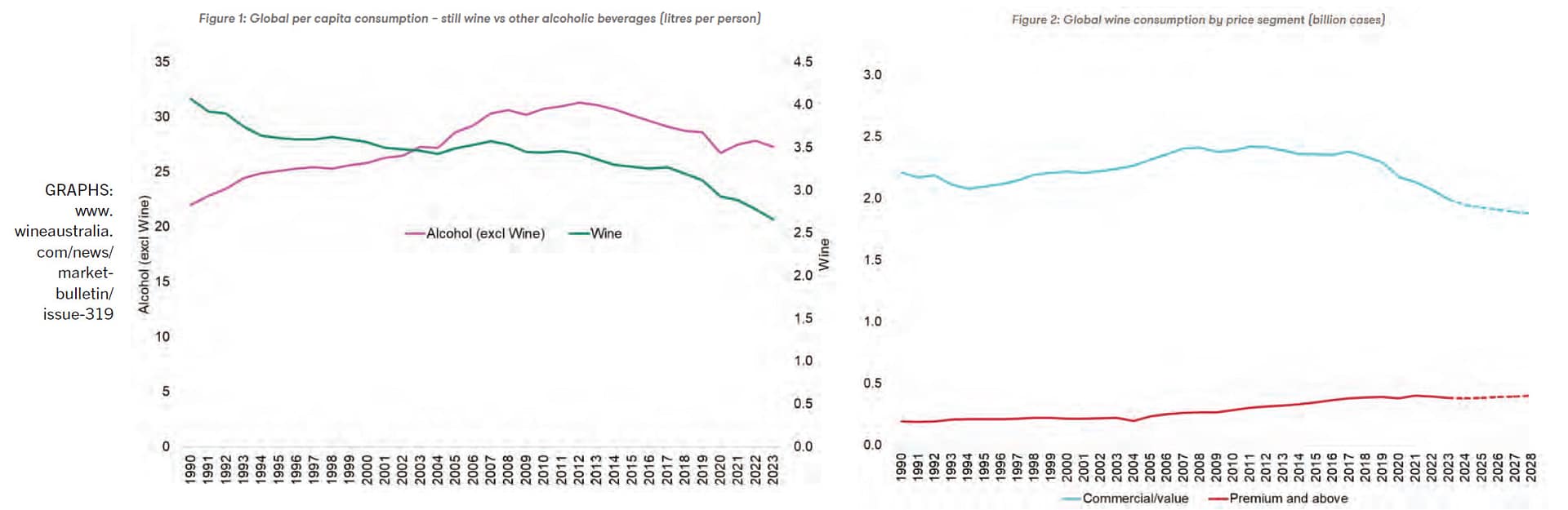
However, it is misleading to suggest that installing a mandatory code of conduct will be the answer to all problems, nor is it guaranteed to only have positive impacts. I have read commentary in these pages to that effect, which infers that wine companies are greedily sitting on massive profits while holding out on growers. This view ignores the facts about the current state of the global wine sector. Anyone in touch with news about the wine industry would have read about staff redundancies, mergers, wine companies going into receivership, and wine companies selling off stock at a loss to generate cashflow.
Sales of all alcoholic beverages have been declining since 2013. More relevant is that wine sales are declining faster and losing market share to other alcoholic beverages.
Of greater relevance to the Riverland and other inland wine regions is the decline in consumption of commercial wine, the product segment where almost all Riverland wine fits, which is declining in consumption relative to premium wine.
Domestic consumption of wine in Australia sees an even more stark trend, with commercial wine falling from annual sales of around 46 million cases in 2013, to around 35 million cases at present, or a reduction of 24 per cent. Premium wine sales have increased slightly over the same period by around 0.5 million cases. The large contraction in commercial sales cannot be offset the relatively small volume increase in premium sales.
This global trend is why significant vineyard area is being removed in wine regions around the world. The contributing factors are addressed in the report by Professor Kym Anderson that was referenced by the Senate Committee, ‘Australia’s Wine Industry Crisis and Ways Forward: An Independent Review’.
As an overarching position, growers should be paid a return that reflects the value of the wine that can be made from that fruit. If a grower produces fruit that can be used to make a higher value wine, they should receive commensurate reward, or in other works, receive a fair market price. This should be a self-evident principle to underpin fair trading that will best suit both parties. However, some of the suggestions being discussed for the mandatory code may have unintended consequences.
The first is a requirement for indicative prices on 30 September, and for all dispute resolution to be completed by 3 October. There is value in providing an early indication to growers about the grape price, but there is likely to be a downside. The earlier a grape buyer must issue a price, the less certain that price can be, and the greater likelihood it will be conservative. If an early price notification must be binding, it will be a very conservative price to avoid the buyer suffering a loss. If it is not binding, the value of that offer to growers is questionable.
The suggestions that price disputes must be concluded by 31 October means that the price must will be finalised before grapes have even been formed on the vine. How can a grower be accurately rewarded for the value of their fruit before the fruit quality is known?
The result is likely to be a ‘commoditisation’ of wine grapes, where price is issued based on the variety, and with little if any regard for quality attributes of that fruit. Such a system may be workable for growers under long-term contractual arrangements, but might have the potential to remove the potential to encourage or reward the production of higher-value wine grapes.
The likely outcome if such measures are implemented is to see less fruit being purchased under the security of a multi-year contract, greater emphasis on the purchase of fruit on the annual or ‘spot’ market, and wine grapes being treated more like a homogeneous commodity. With sales of commercial fruit declining, in a high-cost country such as Australia, our wine industry should be moving toward increasing value, rather than imposing measures that may limit value or reducing contractual security for grape growers.
I have read some very inaccurate and unfair comments about grape grower representation. As someone who has served at regional and national level representing grape growers, I have experienced first hand the time and commitment that this entails, without being paid for the time that it takes. Those being critical of the people who are spending their time and effort on peak bod-ies should be asked the question: “what have you done to represent growers?” Have these people offered input to the representative bodies so that their voice is heard? Have they offered to serve on grower committees? Have they removed unprofitable vineyards, or are they waiting for other growers to do so? Do they pay industry levies to the opera-tion of their representative organisations before criticising them? Do they take on the responsibility of monitoring the wine grape and bulk wine market to guide their business decisions? Or are they just complaining and asking others to solve their problems for them?
Ultimately the value paid for wine grapes is going to be set by the market. There is no argument that commercial trades should be underpinned by legal protection if needed to ensure fair trading terms.
There are growers and winemakers who are showing that it is not only possible, but economical to produce good-quality grapes and wine. The challenge is to transition the Riverland wine industry to transition to a lower volume, higher-value model so that all stakeholders are sustainable in every sense.
However, it is unlikely that bringing in a mandatory code of conduct will make a big enough difference to return profitability to the sector. I agree with the comments made by Tony Pasin that claims that a mandatory code of conduct will on its own return the industry to profit risks giving people false hope and removes the recognition that difficult decisions need to be made and delay the change that could eventually benefit everyone. These are issues that demand informed and pragmatic decisions, not just emotive and divisive rhetoric.

This article appeared in the Murray Pioneer, 19 March 2025.

