

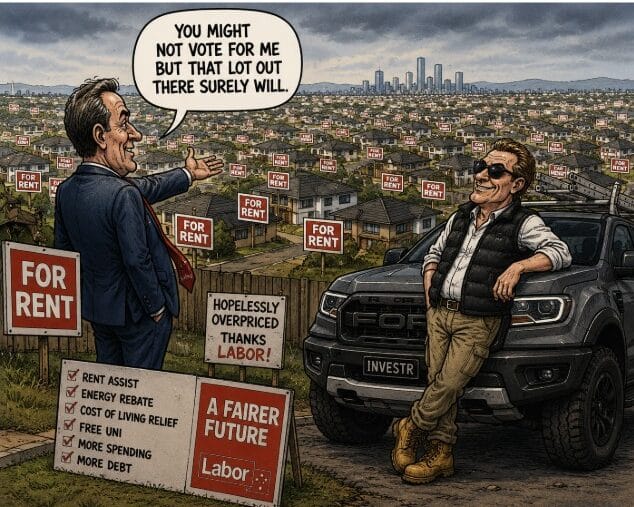
This federal Budget reveals something far more significant than another round of tax fights over capital gains, family trusts and negative gearing.
It reveals who modern Labor now governs for.
For most of the twentieth century, Labor’s political formula was simple: represent the worker. The party’s natural constituency was the blue-collar tradesman, the factory worker, the union member and, at the margins, the unemployed battler trying to get ahead. Labor’s identity was built around class politics — specifically the industrial working class.
Then John Howard changed Australian politics forever.
Howard understood something Labor elites never truly grasped. Australians did not aspire to remain part of a permanent underclass. They wanted to own things. A home. A small business. A work ute in the driveway. Maybe even an investment property.
Howard’s great political achievement was not merely economic. It was psychological.
He transformed Labor battlers into aspirational conservatives.
By driving down debt, confronting union power in the private sector and presiding over an era of low unemployment, lower interest rates and rising real wages, Howard helped push hundreds of thousands of blue-collar Australians into the middle class.
Plumbers, sparkies and boilermakers suddenly earned more than university graduates. They bought homes. Then investment homes. Their super balances swelled. They stopped thinking like workers and started thinking like owners.
And once voters own assets — particularly property — they vote differently.
They worry about inflation, tax, interest rates and protecting wealth rather than redistribution.
Labor eventually confronted a brutal political reality: much of its old working-class base had defected economically to the conservative side of politics.
The fitter and turner from Rockingham had become a small businessman. The FIFO worker from Mandurah now owned two investment properties. The boilermaker Labor once imagined marching beneath union banners was now arguing with his accountant about depreciation schedules on the Hilux and whether to fix the mortgage for three years or five.
Meanwhile, much of the white-collar cultural elite — entrenched in universities, government departments, publicly funded NGOs and the taxpayer-protected corners of the inner-city professional class — looked on with horror as the old working class began behaving like capitalists.
The people Labor once spoke for had stopped talking the language of class struggle and started talking the language of asset protection.
The old industrial worker had not become more progressive. He had become more prosperous.
So Labor needed a new electoral foundation.
First it chased the environmental vote, only to discover the Greens could always outflank it from the Left. Then came the inner-city progressive professionals — the quinoa-and-activism class clustered around the ABC, universities and taxpayer-funded NGOs — only for large sections of that constituency to drift towards the Teals and boutique climate politics.
Then Labor flirted with identity politics, convinced Australia could be remodelled around grievance, race and symbolic division. But Australians, by instinct and culture, proved far less interested in imported American-style racial politics than the activist class expected.
So Labor kept searching.
And eventually it found three rapidly expanding constituencies perfectly suited to the political economy of modern progressive government: mass migration, the welfare economy and the over educated permanent renters.
Since 2000 Australia’s population has surged from about 19 million to almost 28 million, with migration driving the overwhelming share of that growth. Entire suburban corridors of Sydney and Melbourne have been transformed in little more than a generation to look like another country.
But while governments imported people at record rates, they failed to build the housing, infrastructure and social cohesion needed to absorb them successfully.
Critically, Australia did not import enough bricklayers, concreters, roof carpenters and plumbers to expand affordable housing supply at the speed population growth demanded. Instead, governments buried new developments beneath planning restrictions, environmental approvals and layers of bureaucratic red and green tape.
The result was entirely predictable.
House prices exploded.
Rents surged.
Home ownership collapsed for younger Australians.
And Labor discovered something politically valuable: a growing class of voters economically locked out of ownership.
At the same time another dependency class emerged.
Julia Gillard’s NDIS, conceived as a compassionate safety net, rapidly evolved into something much larger — an entire taxpayer-funded economic ecosystem. Not just recipients, but armies of administrators, providers, consultants, carers and support workers whose livelihoods increasingly depended on continued government expansion.
Modern Labor was no longer simply building a welfare state.
It was building entire voting constituencies structurally dependent upon it.
Then came the university generation.
For decades Australia told young people that success meant avoiding manual trades and “not getting their hands dirty”. Hundreds of thousands were funnelled into universities and handed degrees in sociology, media studies and political science on the promise of professional-class lifestyles.
Then reality arrived.
They graduated into a housing market they could not afford, burdened with HECS debts and staring at million-dollar entry-level homes in the very inner-city suburbs they had been culturally conditioned to aspire towards.
Meanwhile, the electrician they once looked down upon was earning twice their salary in a mining camp while negatively gearing his second investment property.
Resentment was inevitable.
And politically useful.
Alongside them sat rapidly growing migrant communities concentrated in outer suburban Sydney and Melbourne — communities often more economically precarious, more dependent on government services and increasingly disconnected from the older symbols of Australian identity and aspiration.
The great irony is that both groups — indebted graduates and migrants packed into the outer suburbs — were sold the same promise: that Australia was a land of prosperity, affordable housing and endless opportunity.
Instead, many got off the plane or out of university to discover an economy geared for those with real skills, not broken English and a degree in women’s studies. Both groups thought they were going to live in quality housing, inner city with good job prospects.
The reality is they have been left struggling to afford to pay the power bill, pay the rent and with no hope of buying into he Australian dream. They are now life long renters and life long Labor voters.
Which is why this Budget matters.
This Budget is not simply about tax changes or housing policy.
It is about replacing Labor’s old working-class base with a permanent aggrieved dependency class — voters locked out of ownership and increasingly reliant on government support to make ends meet. Think this Budget is bad? Wait for the what’s coming if Chalmers ever takes over from Albanese.