


Meat & Livestock Australia (MLA), Media Release, 10 March 2025
Australia’s national cattle herd and sheep flock are both expected to decline slightly as record production, slaughter and exports meet demand, according to Meat & Livestock Australia’s (MLA) 2025 Cattle and Sheep Industry Projections.
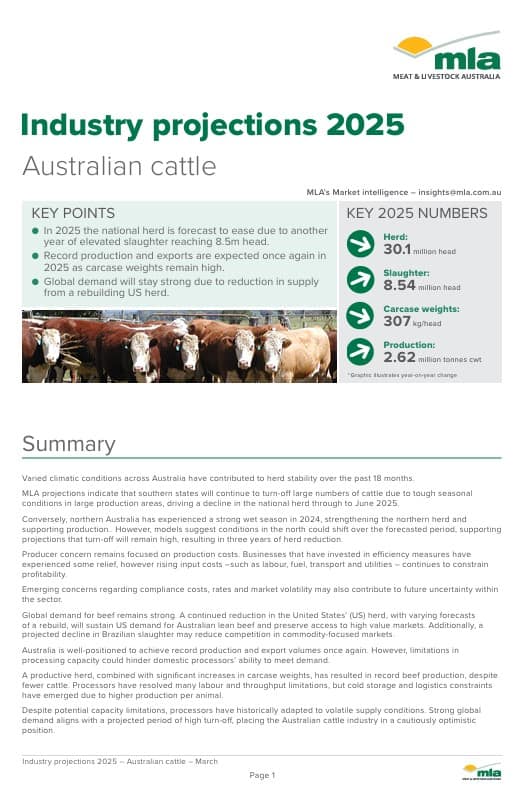
The cattle herd is projected to fall by 1.4 per cent to 30.1 million head in 2025 due to increased turn-off of older breeding cows and dry conditions in Southern Australia.
The sheep flock will fall 7.4 per cent to 73.2 million head due to the increased turn-off of older breeding ewes and tough seasonal conditions across key sheep producing areas.
According to MLA Managing Director, Michael Crowley, the Cattle and Sheep Industry Projections show that the red meat industry is ready to respond to global demand in 2025.
“Record production and elevated slaughter rates are being met with strong demand from well-established relationships with customers throughout the global supply chain,” Mr Crowley said.
The Cattle and Sheep Industry Projections are an important tool for the industry to understand the forecast conditions facing the industry.
“By consulting with producers, processors, agents, and government, MLA creates a clear forecast of the national herd and flock, slaughter, production and carcase weights for the cattle and sheep industries,” Mr Crowley said.
Cattle
Australia produced more beef than ever in 2024, despite slaughter volumes being 7 per cent below the previous record in 2014. This was due to higher carcase weights, primarily due to increased grainfed production.
“Producers are growing more efficient and productive cattle compared to 10 years ago. This is important considering the significant global demand for beef will continue this year, leading to another record production year,” Mr Crowley said.
“Australia is currently in an opposite supply cycle to major beef-producing competitors such as the United States and Brazil. As the US begins its long-overdue herd rebuild and drought conditions in Brazil ease, global beef supply is expected to tighten.
As record production continues into 2025, efficient logistics and supply chain management will become increasingly important.
“Australia is well-positioned to achieve record production and export volumes once again,” Mr Crowley said.
“With increasing carcase weights, storage space has become more valuable, and efficient logistics are now essential to maintaining processing flow and preventing bottlenecks in the supply chain.
“Looking ahead, Australia’s investments in domestic production, processing capacity, and global trade relationships have positioned the cattle sector well for the next few years.”
Sheep
Older breeding ewes retained from the 2020–22 rebuild will finally exit the system in 2025, contributing to the decline in the national flock.
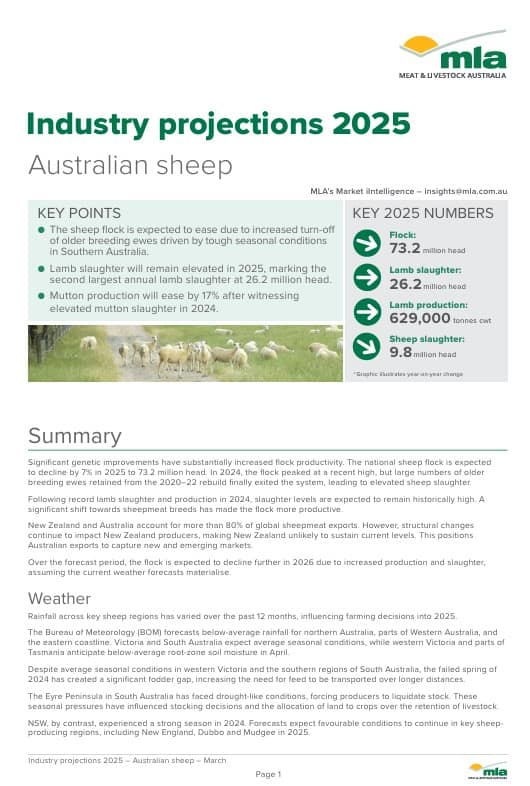
Sheep slaughter is forecast to decline 17 per cent to 9.8 million head in 2025, following the record rates of sheep turn-off at the conclusion of 2024.
Lamb slaughter is forecast to reach 26.2 million head, which is a slight 0.5 per cent decline from 2024.
However, this still represents the second-largest slaughter year on record behind 2024.
Despite the decline in the national sheep flock, lamb production continues to operate at historically high levels reaching 628,648 tonnes in 2025.
This is in part driven by genetic changes in the flock with a focus on improving weight gain and yield in lamb carcases.
“Given the elevated levels of sheep slaughter at the end of 2024, it is expected that lambs not processed last year will be processed in the first months of 2025,” Mr Crowley said.
“In addition, Australia and New Zealand account for more than 80 per cent of global sheepmeat exports. However, the long-standing decline of the New Zealand sheep flock provides an opportunity for Australian sheepmeat exporters to continue their global dominance in 2025.”
Sign up to MLA’s Projections Webinars below:
- Cattle Projections Webinar – Tuesday, 11 March at 11am (AEDT)
- Sheep Projections Webinar – Wednesday, 12 March at 11am (AEDT)
- To view the full Cattle Industry projections: Cattle Industry Projections 2025.
- To view the full Sheep Industry projections: Sheep Industry Projections 2025.

