

Bruce Stewart, The Buloke Times
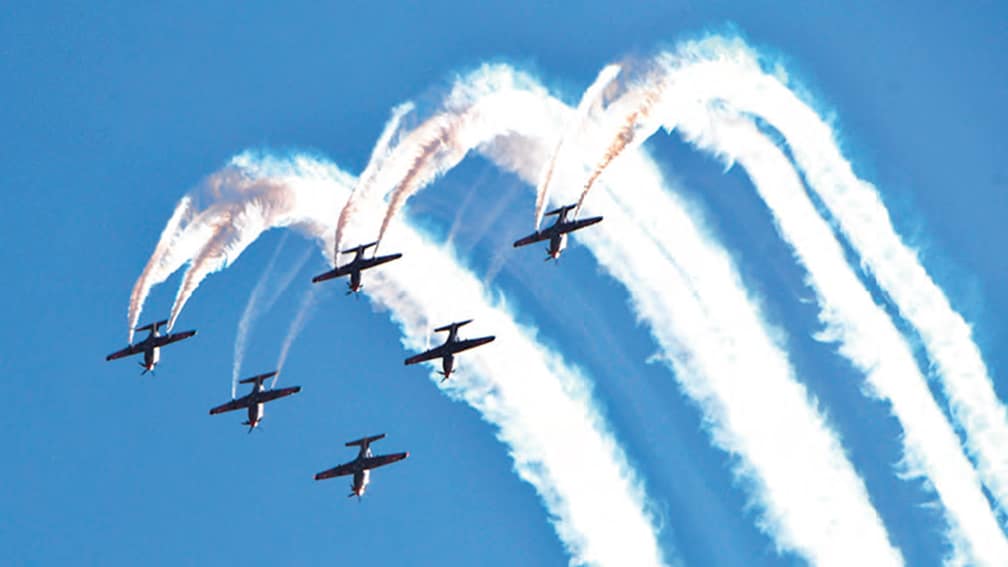
Many hundreds of people gathered the other day at the Epsom/Huntly showgrounds on the outskirts of Bendigo in anticipation of a visit from the Roulettes – the Royal Australian Air Force’s formation aerobatic display team.
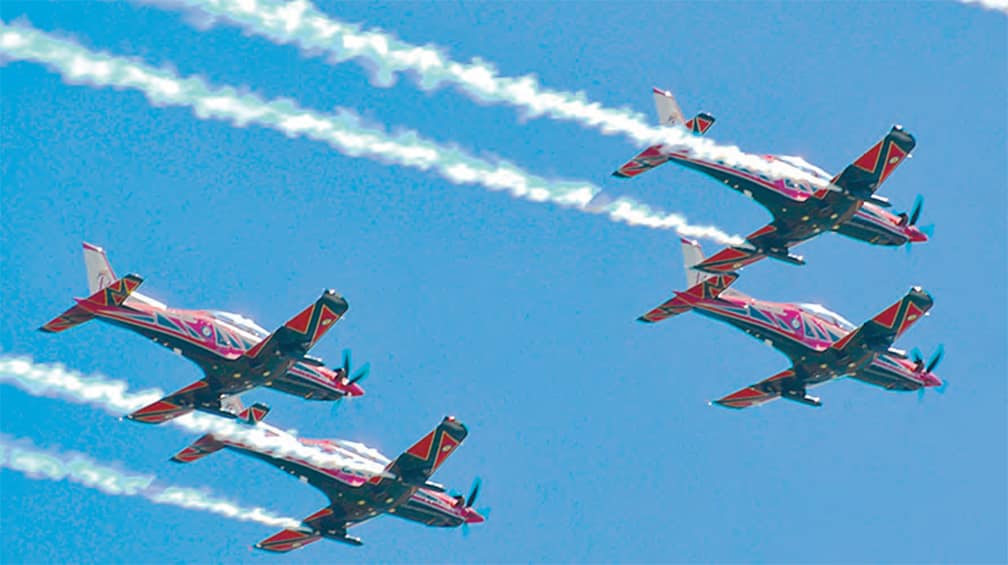
Our patience was rewarded as right on schedule I spied six rapidly moving black dots coming in from the north east. The black dots soon materialised into Pilatus PC-21 aircraft which are currently operated by the Roulettes. The cruising speed of the P- 21 aircraft powered by a Pratt & Whitney turboprop engine generating 1,600 shaft horse power is 600 kilometres per hour so they soon were buzzing right overhead in tight formation.
For the next 15 minutes we were given flying demonstrations equal to the best in the world with aircraft in formation sometimes only 3 metres apart performing all sorts of manoeuvres with pilots sometimes pulling 4-5 g’s in tight turns. At times smoke exuded from the rear of the aircraft leaving stunning visual patterns in the sky. All too soon the demonstration was over and the planes moved to the south east and landed at the local airport topping up with fuel before heading to Adelaide for another presentation.
As I saw these aircraft speeding over our heads and hearing the buzz of the powerful gas turbine engines I couldn’t help but reflect back to the world’s first powered airplane flight by pioneers Wilbur and Orville Wright which took place at 10.35am on December 17th 1903, 121 years ago now! Wilbur and Orville had a meagre 12 hp (8.9 kw) to power their aircraft and flew at 50 kph on that first flight. The Wright plane flew at just 1/12th the speed of the modern PC-21 aircraft! The first flight of the Wright aircraft was just 37 metres in length – just over half of the 65 metre wingspan of a modern commercial jet plane like the Airbus A350 – 900.
We who live in the 21st century owe a debt of gratitude to people of earlier generations who contributed so much to our benefit – including the ability to travel large distances quickly in modern aircraft. Historians tell us that Wilbur and Orville as boys loved playing with anything mechanical and investigating how it worked. They began to make kites, fly them and sell them. By the year 1899 they began to more seriously study aeronautics. The Wright brothers built a glider in 1900 which successfully supported a person’s weight but it was difficult to control. Wilbur and Orville learned to more and more look at birds flying in the sky to see how they controlled their flight. The Wright brothers designed a system of pulleys and cables to change the shape of the gliders wings in a similar way to the bird wing. By doing this they achieved manoeuvability during their 1901 experiments. Eventually they were ready for the final step, a powered flight, but there were no suitable engines, so they designed and built their own, using an aluminium block, way ahead of their time!
After years of trials, frustrations and experimenting they achieved their goal on December 17th 1903. Writer, Ann Lamont, tells us that Wilbur and Orville Wright became followers of Jesus Christ from an early age. They learned to look to God’s creation, especially birds in flight to observe wing shape to help them design and develop flying their flying machine. They set up a wind tunnel in their bicycle shop and experimented with different shaped curved surfaces.
The next time you observe an aircraft or fly in one be reminded of the determination, skills and faith of earlier people, especially pioneers like Wilbur and Orville Wright. We have much to be thankful for.
This article appeared in The Buloke Times, 22 November 2024.

