


Regional Australia Institute (RAI), Media Release, 21 November 2024
New research commissioned by the Regional Australia Institute (RAI) shows the number of city-dwellers looking to relocate to the regions has doubled over the past 18 months, demonstrating an urgent need for solutions to regional pressure points.
The results of a nationwide survey shows 40 per cent of capital city residents are considering a move to regional Australia – up from 20 per cent in May 2023.
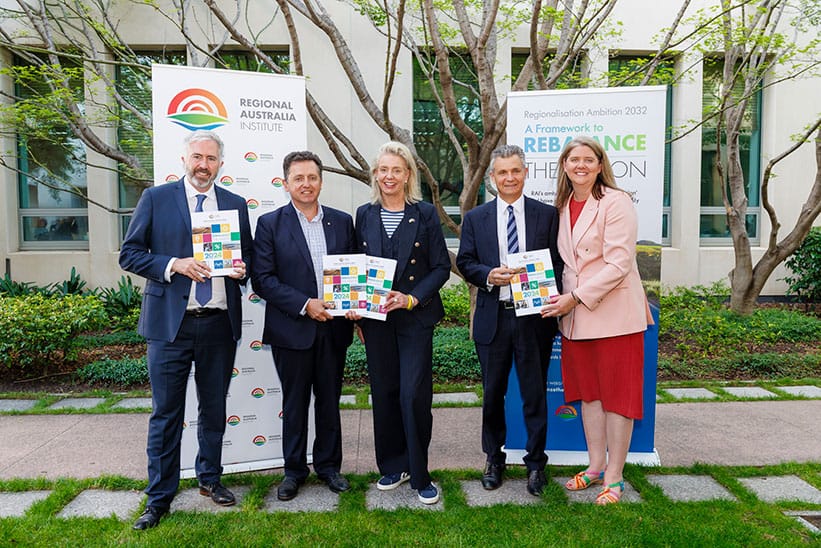
RAI CEO Liz Ritchie said the research should ring alarm bells for policymakers, industry and regional leaders.
“Demand for regional living has never been higher, but as a nation we are not keeping pace with delivering the fundamental building blocks that are needed as we rebalance the nation,” Ms Ritchie said.
The new market research comes at the same time as the release of the RAI’s Year 2 Progress Report on the Regionalisation Ambition, which shows key regional metrics tracking housing, education and migration have gone backwards over the past 12 months, including:
- The regional rental vacancy rate decreasing (1.3 per cent in 2024 v 1.5 per cent in 2023).
- Regional building approvals declining (down 9.4 per cent between May 2023 and May 2024).
- The regional student school attainment rate dropping (67.3 per cent in 2022 v 71.4 per cent in 2021).
- The percentage of migrants settling in the regions falling (16.5 per cent in 2022/23 v 18.6 per cent in 2021/22).
“Regional Australia is simultaneously experiencing two unprecedented transformations – a once-in-a-lifetime population shift and the net zero transition, which is increasing demand and need for improved services and infrastructure in regional communities,” Ms Ritchie said.
“Falling behind on critical targets is not in the nation’s best interests and we can’t afford to squander this opportunity to better our country.
“Many regions are already struggling with housing, particularly rental markets, and until region-specific policy measures are put in place, this will only be further magnified.”
RAI member and Advance Cairns CEO Jacinta Reddan said the population of Far North Queensland had grown by 5.2 per cent over five years, putting pressure on local housing supply.
“In the past year alone, growth in the Cairns region accelerated to 1.8 per cent. If this trend continues, we could see the region grow to more than 280,000 residents by 2026 – far surpassing current government projections.” Ms Reddan said.
“In Cairns, the rental market remains tight – over the past 50 months since July 2020, 40 of those months recorded a vacancy rate of no higher than 1.0 per cent.
“The housing demand from new residents, coupled with ongoing regional development needs, requires swift action from policymakers to ensure that Far North Queensland has the resources and infrastructure to accommodate this population shift.”
Ms Ritchie added that regional employers were also crying out for skilled workers, with nearly 76,000 jobs currently available across regional Australia.
“We know migrants can help fill these roles. However, fewer overseas arrivals are ending up in our regional communities and that needs to change,” Ms Ritchie said.
“In addition, the gaps are widening between metropolitan and regional students when it comes to education. This is deeply concerning given we know the jobs of the future will require more post-school qualifications.”
Launched in 2022, the Regionalisation Ambition is a 10-year framework for creating a more prosperous, productive and inclusive regional Australia, which the RAI reports on annually.
The Year 2 Progress Report shows, of the 17 targets measured over the past year, 10 are moving in the right direction, including:
- The regional recruitment difficulty rate easing (63 per cent in 2023 v 69 per cent in 2022).
- The number of medical practitioners working in regions increasing (353 FTE per 100,000 population in 2023 v 334 FTE in 2021).
- Regional Australia’s younger population (15-39 years) share rising (30 per cent in 2023 v 29.8 per cent in 2021).
Ms Ritchie said this movement, turning the dial on some of the biggest issues regional Australia is facing, should be celebrated.
“However, without continued improvements on measures around housing, education and migration there would continue to be a challenge for any government to play catch up,” Ms Ritchie said.
Ms Ritchie acknowledged the work the Federal Government is undertaking, notably the creation of the Housing Australia Future Fund, its response to the recommendations within in the Australian Universities Accord and the confirmation of the Regional Migration Settings Review.
“The foundations for implementing change are being laid, including through the Regional Investment Framework, but now we must build the structures to deliver that,” Ms Ritchie said.
“The RAI is calling for a long-term plan for regional Australia’s future that considers population movement, the skilled workforce requirement, service provision and infrastructure needs. Given Australia’s changing population pattern, this is vitally important.”
“A place-based decision-making model, that would enable regions to have a greater say on how federal, state and territory government funding is spent is also critical. There are responses to issues around housing and the attraction of overseas arrivals already underway in regional Australia and they deserve to be heard.
“Likewise, regional communities need further support to play a bigger role in the net zero transition – through improving communication and having a seat at the table to ensure long-standing benefits are delivered to the regions alongside solar panels, wind turbines and transmission lines,” Ms Ritchie concluded.
The Year 2 Progress Report on the Regionalisation Ambition can be found here.
An interactive dashboard tracking the progress of the Ambition’s targets is available online.

