

Serena Kirby, Denmark Bulletin
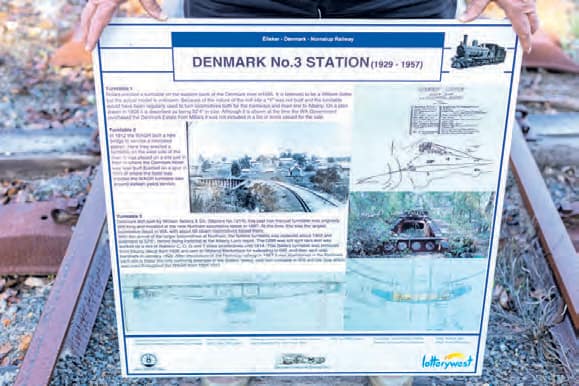
The Denmark Historical Society is in the process of erecting information signage along the Denmark – Nornalup Rail Trail.

The 38 signs provide historical background about the origins, significance and role that the old Elleker-Denmark-Nornalup railway line played in opening up the surrounding areas for grazing and settlement.
In the 1880s Charles and Edwin Miller were contracted by a private company to construct the Great Southern Railway which was to run from Beverley to Albany.
This contract also led to the establishment of the Millar brothers’ first timber mill in Torbay and by 1889 they had added a railway junction at Elleker which enabled the Millars to better service their nearby timber mill.
Demand for timber at this time was at its peak due to the economic and infrastructure growth brought on by the gold rush in Kalgoorlie.
By the late 1890s the Millar brothers had established several mills near Denmark which resulted in rapid development of the Denmark town site.
The Elleker-Torbay-Denmark railway line serviced these mills.
When Millars shut their mills in 1905, they also abandoned the railway and the State Government eventually stepped in and purchased the railway line and so-called ‘Denmark Estate’.
It was envisioned that the railway line would continue on to Pemberton and create a link from Albany to Perth but the line only got as far as Nornalup and due to a lack of government funds it was never completed.
In its final decades, the railway line was used for general freight purposes until its closure in the late 1950s.
Coordinator of the signage project Ross McGuinness said he and the Denmark Historical Society had been working on the project for some time and a recent $11,000 Lotterywest grant had enabled it to proceed.
DHS has added about $5000 to the project.
“Walking trails, locally and around Australia, have become increasingly popular and the signage gives walkers the chance to learn a bit about the history of the trail they are on,” Ross said.
The signs will include historical photos and drawings and information about the various stations as well as the buildings and water tanks that once existed to support railway operations.
Ross said the City of Albany has been approached to develop similar signs along the Albany section of the railway but some areas of the initial line have been absorbed into privately-owned land making them inaccessible.
This article appeared in the Denmark Bulletin, 30 May 2024.

