Patricia Gill, Denmark Bulletin
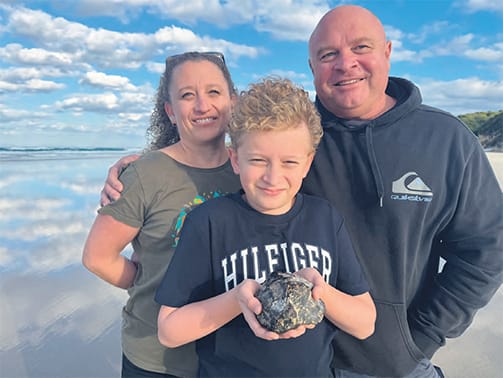
Ryan Clarke made the find of a lifetime, a 328g lump of mostly black substance, ambergris, or ‘floating gold’, last week on Ocean Beach.
Ryan was walking his dogs on the beach and casting a lure to catch some salmon at low tide when he spotted the lump washed up in the shallows at the sand bar.
As far as he knows his is the second discovery in WA in recent years, the first in the Great Southern, of the waxy substance which covers ingested squid beaks in the gut of one per cent of sperm whales.
“As soon as I picked it up, I knew what it was,” Ryan said.
Often called whale vomit, the substance is valuable in the perfume industry as a fixative to enable the scent to last and, reportedly, is worth $59,000 a kilogram.
But under Australian law being part of an endangered species it is illegal to sell, trade or export ambergris.
Ambergris forms in the sperm whale’s gut to protect it against the sharp squid beaks.
Sperm whales are found in deep water such as the Bremer Bay canyon feeding almost exclusively on squid.
Ryan has reported his find to the Department of Biodiversity, Conservation and Attractions and also to the Great Southern Museum in Albany.
The definitive identification is that the waxy, light substance floats on water, smells sweet and passes a hot needle test.
Ryan heated a needle and inserted it into the sample and it melted and released a strong musky scent.
“It oozed like tar, gave a little white smoke and smelled sweet and earthy,” Ryan said.
He believes the ambergris is between 10-50 years old.
He was given the option of keeping the sample or donating it and has opted to donate the specimen to the Great Southern Museum after talking to the regional manager, Catherine Salmaggi.
Testing at the museum will reveal more precisely how long the ambergris has floated in the ocean.
Ryan, his wife Rebecca and son, Joshua, 12, want to share the find with others in the region, especially Denmark people.
Visible to the naked eye are remnants of squid beaks in the ambergris which also forms a whiteish coating due to oxidation.
Brownish/gold on the specimen indicates ageing.
In 2019 at Lancelin tour operator Peter Fullarton found ambergris said to be worth $70,000, the only other West Australian find in recent years, and donated it to the WA Museum due to the export and selling restrictions.
There have been three other finds in recent years elsewhere in Australia, one at Streaky Bay, South Australia, in 2006 weighing 14.75kg estimated to be worth more than $1 million.
Ryan describes his find as an ‘absolute treasure’.
“People spend their whole lives looking for this and never find it,” he said.
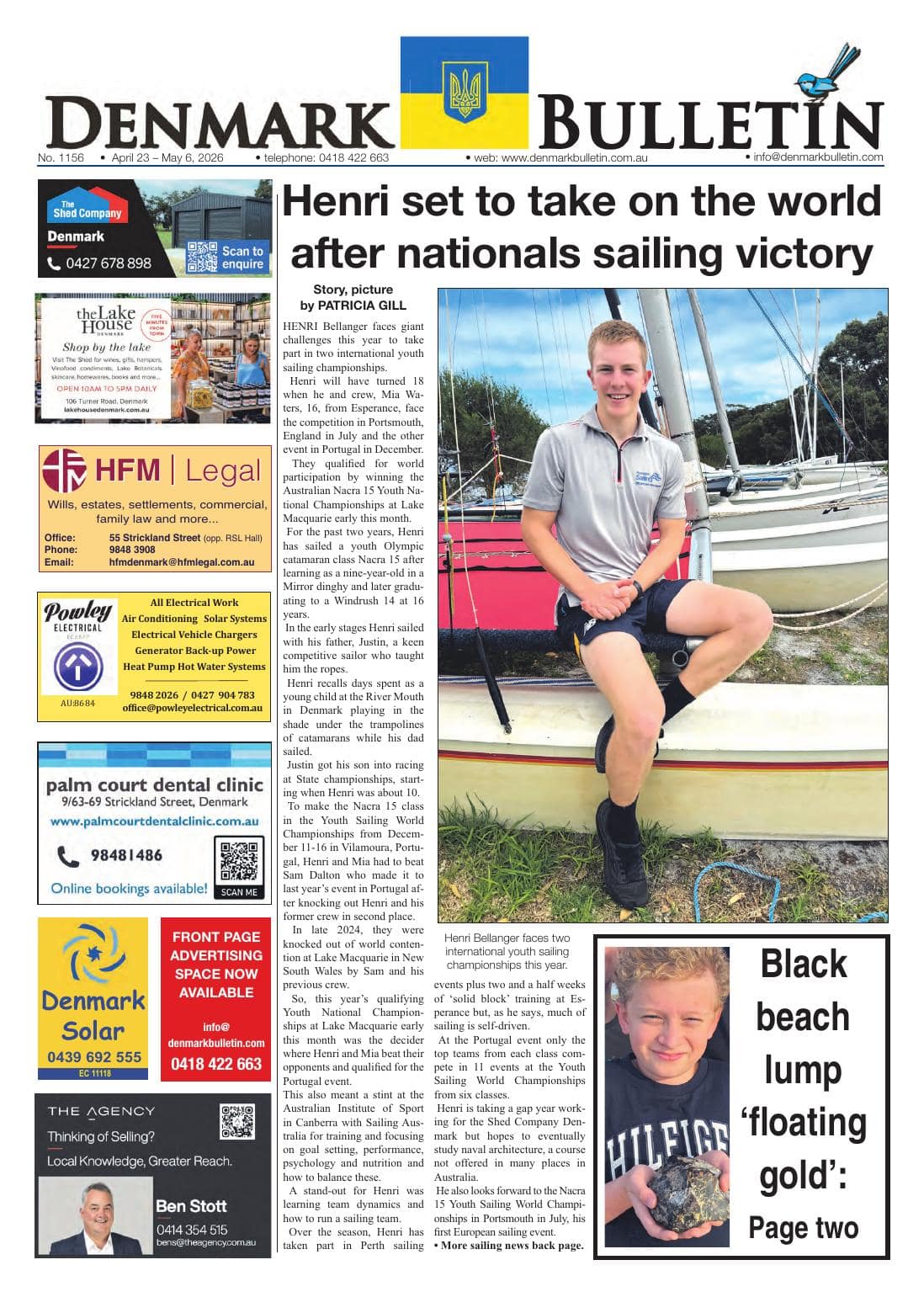
This article appeared in Denmark Bulletin, 23 April 2026.