

“These processes are so private, so closed and so favouring the developers.”
This frustrated comment came from Fiona Walsh, as she closed her address to the NT Development Consent Authority (DCA).
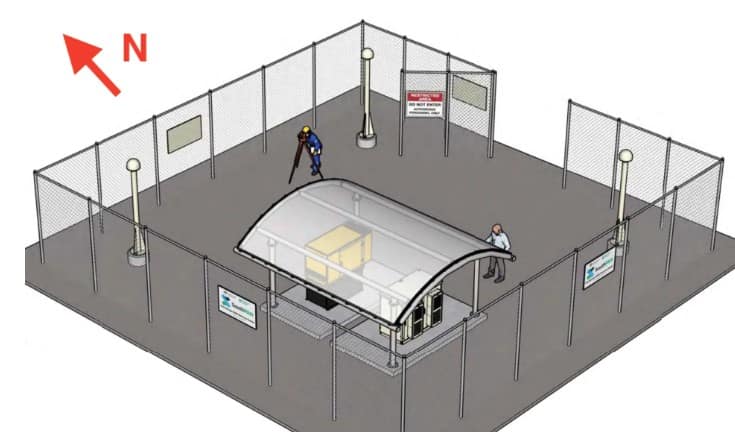
It was considering the application for a permit by the US defence contractor Lockheed Martin, via its Australian branch, for a global navigation satellite station near the Ilparpa claypans.
The facility clearly has military as well as civilian uses although the proponent for the developer only spoke to its civilian uses.
As the DCA is surely acting in the interest of the community, it could be assumed the authority would closely examine any possibility of public risk, such as being dragged into an armed conflict. There is no sign that it had.
The DCA gave the green light to the application, five members accepted and none rejected the proposal. Their decisions are flying in the face of objections and concerns raised by local residents as well as Aboriginal sacred sites custodians.
This is as per usual: For decades, and under governments of either colour, the DCA and its predecessors have disregarded the wishes of the public in favour of the applicants.
Examples: Denis Hornsby promoted a development of two-hectare blocks in the south-eastern corner of the municipality.
He outraged buyers, who had already spent their money with him, by selling much smaller blocks on land left over.
Mayor Leslie Oldfield presented a letter of objection with some 70 signatures. The DCA counted it as just one single objection because it was just one letter, and approved Hornsby’s application.
Increasingly, so-called rural residential land is being used for commercial purposes, in some cases blatantly approved by the DCA.
Its members are not elected but but appointed by the Minister, currently Joshua Burgoyne.
They are, as usual, local establishment figures: Chris Neck, from a trading dynasty; builders Darren Burton, Matt Cunningham and Sean Heenan; and Allison Bitar who describes herself as a “self-made entrepreneur”. Burton, Heenan and Bitar are also members of the town council which gets two nominations which the Minister has to accept.
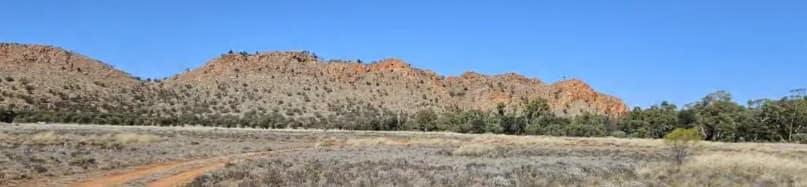
Also present were prominent Arrernte women Camille and Veronica Dobson AM and their colleague, Fiona Webb. Camille Dobson and Veronica Dobson objected to the installation’s proximity to two women’s sacred sites (above).
They gave the authority a candid account of the location’s Altyerr (Creation) narrative. Camille also noted that this was one of the few undeveloped areas close to Alice Springs that was accessible to custodians and the wider public.
Dr Walsh, a noted scientist with a PhD in Anthropology and Botany, a B.Sc. Zoology and 34 years of experience in Alice Springs, was expressing her concern about rare and fragile flora and ecosystems in the area of the proposed facility and its access. She noted that the high risks of further spread of buffel grass weeds.
In this case many species of plants and animals of the Coolibah swamp are affected. She says cabling and access tracks would affect plant populations.
She also stated her familiarity with the sacred site and connecting songline; in 2023 she recorded a video of traditional owners greeting Aboriginal visitors to the Two Sisters site.
Dr Walsh lamented that local Aboriginal people suffer “1000 cuts” through intrusions on their land.
None of this appears to be specifically reflected in the subsequent conditions for the consent.
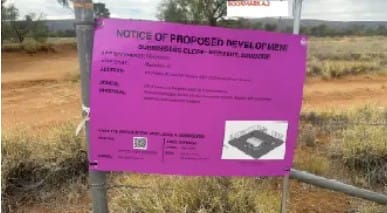
Dr Walsh criticised the “very small pink sign with tiny writing” to alert the public driving by to the application, and the brevity of the time for submissions – two weeks.
DCA chairperson Suzanne Philip explained that sacred sites were not under the control of the DCA.
The meeting minutes record: “The DCA is not an authority under the … Sacred Sites Act, and the issuing of a Development Permit does not mean that the matters of the Sacred Sites Act have been addressed.”
Ms Philip acknowledged that on February 3, the Aboriginal Areas Protection Authority (AAPA) had written to the DCA recommending that Peter Stanley, of Masterplan NT, which is acting for Lockheed Martin Australia, should apply for an Authority Certificate.
That had not taken place by April 15 when the DCA gave consent to the facility. And AAPA told the Alice Springs News on June 16 it still had not been done.
Ms Philips clearly leaves open these questions: What would happen if Lockheed Martin does not apply for a certificate? What if they do but the AAPA says “no”? Is the US company just going to pay a fine and that’s all?
How come the representative body of the traditional owners can be ignored while the DCA had complied with the requirements of at least nine other instrumentalities?
These included the Regional Land Use Plan 2016, the NT Planning Act 1999, the Town Council, Power and Water Corporation, Department of Lands, Planning and Environment, the Water Act 1992, the NT Heritage Act 2011 (“there are no known natural, social, cultural or heritage values on the site”) and the Environment Protection Act 2019 (“referral is not required”).
Objector Fiona Webb asked if another location could be considered.
Rory Mahony, appearing for Lockheed Martin Pty Ltd, said, yes, but other sites “had their own constraints from a technical and regulatory perspective”. The DCA accepted this obscure statement as an answer.
Ms Webb pointed to the social significance of the site for the broader Alice Springs community, for recreational and conservation purposes, as well as the sacred women’s dreaming site area, including at least two hills immediately east and all clay pans in the surrounding area.
One of the objectors proposed the installation be located within the Pine Gap.
The DCA made no effort to produce clarity about any military significance of the “telecommunications facility” – full name Global Navigation Satellite System (GNSS) of the Southern Positioning Augmentation Network (SouthPAN).
According to ChatGPT, without augmentation, ordinary GNSS positioning is typically accurate to about five to 10 metres. SouthPAN’s corrections can improve this to sub-metre accuracy, and for some services, to around 10 centimetres.
ChatGPT says the most authoritative figure currently available is that SouthPAN is being built around 35 dedicated GNSS reference stations being added to existing positioning infrastructure already operating in Australia and New Zealand.
According to ChatGPT SouthPAN is not a military system, but it “absolutely has military and defence applications”. The Alice Springs News contacted Masterplan and Lockheed Martin, explaining that we always double-check information from AI, and sent them a 362 word summary from ChatGPT.
It included this: “Although not built as a military system, SouthPAN’s high-precision positioning (down to ~10 cm) can clearly support: Military logistics and vehicle navigation; UAV (drone) navigation; maritime patrol and fleet movements; disaster-response operations involving the ADF; joint civilian–military emergency operations.
“Defence industry reporting explicitly notes that SouthPAN enables navigation for drones and unmanned vehicles, which have obvious defence relevance.”
Masterplan and Lockheed Martin flicked our enquiry to Geoscience Australia which flicked it back to us, recommending that we contact the Department of Defence.
We did that at 12.09pm yesterday but haven’t had a reply by the time of going to press.
This article appeared on Alice Springs News on 25 June 2026.

