

Mike Gillam, Alice Springs News
On March 3 the Bureau of Meteorology recorded an impressive monsoon trough containing four tropical lows each with the potential to develop into a cyclone, hugging the coast of northern Australia.
The Tropical Low, designated 34U by the BOM, developed into Category 5 Severe Tropical Cyclone Narelle before making landfall at Cape York Peninsula on March 20 as a high end Cat. 4.
This late season cyclone impacted widely, causing extensive flooding across Queensland, Northern Territory and Western Australia.
It caused catastrophic damage to the remote town of Exmouth, triggered record flooding along the Daly River, and affected three states across more than 4,500 km of Australian territory.
Unlike Top End communities that endured intense rainfall and serious flash floods, much of Central Australia was treated to protracted misty rain with sporadic downpours. Watching the nightly news and especially the inundation of the Daly River community I experienced a form of survivor guilt.
I called to check on friends in Katherine before beginning this essay, much delayed as it happens by other imperatives such as controlling resurgent buffel. While the response of endemic plants, fungi and insects is dazzling I’m conflicted in the knowledge that a shocking weed, buffel grass is reaching a new peak, one that will threaten far flung communities throughout inland Australia.
March rainfall varied across our region with Hele Crescent experiencing somewhere north of 300mm, a mostly gentle, soaking rain, the amazing benefits of a tropical low without the violence of a cyclone proper.
Road conditions made travel problematic and the surging price of fuels a great incentive to focus on the town and environs and enjoy the art of walking.
Someone asked if I thought this was the new normal and sure, it seems probable that we will experience a growing subtropical influence and hopefully that might help to offset rising temperatures.
That said, the town has experienced similar conditions in the past. There’s an often quoted statement that the Todd River ran for nine months, in 1974 I believe, but it would be more accurate to add that sometimes it was a trickle between significant flows.
The tropical low of early 2026 proved a delight for anyone interested in Centralia’s moisture loving detritivores during a period of perfect rain and humidity. Fortunately the town has made a strong investment in native gardens and these provide a wonderland for inquisitive adults and children alike. For those with manicured lawns and little else, exploration further afield to less traumatised terrain is strongly recommended.
Landcare restoration sites and nature strips where residents have removed buffel over the years are the best places to observe the fecund response of nature to this sublime autumn rain.
Low cloud occludes the early morning sun and I feel the silken tension of spider webs across my face before backing up and circling around, more attentive now to the webs stitching the gaps between mulga and witchetty.
Every leaf blade wider than spinifex holds, tiny lenses of water creating sparkling scintillas of light in the morning mist while underfoot the ground has acquired a new sponginess.
The germination of new plants, profoundly satisfying for the Landcare community, has stimulated a notable insect and therefore insectivorous bird response, a pattern repeated wherever buffel grass is absent.
As I explore the nature strip of Hele Crescent it occurs to me that I’m still doing at 70 years of age what motivated me at five, searching out the secrets of miniature gardens and mysterious invertebrates. The Jesuits famously claim that a child of seven reveals the adult of the future, implying that certain interests, passions and individual characteristics are forged early.
In a regional town where the natural world is so close, albeit bedevilled by the presence of buffel grass, I worry that some children are missing out but I know of passionate teachers who also assume a lay environmental educators role in the town’s schools.
The resplendent nature strips have come a long way from the days when they accommodated two vehicles abreast and parents were forced to navigate the perilous bitumen road wheeling their prams or shepherding children.
Restoration of the compacted soil with endemic plants has attracted sacred moths while active lines of hairy processionary caterpillars diligently announce the start of cooler autumnal weather.
Moths and butterflies are everywhere and I don’t believe it’s an exaggeration to say that every genus of plants is supporting at least one distinctive species of caterpillar.
Hawkmoths, often called sphinx or humming bird moths, lunge and pirouette expertly back and forth across the night sky as they try to shake hungry bats, “dog fights” briefly illuminated in the street lights. Each morning I take a meditative walk through our native gardens, including the nature strips of the crescent.
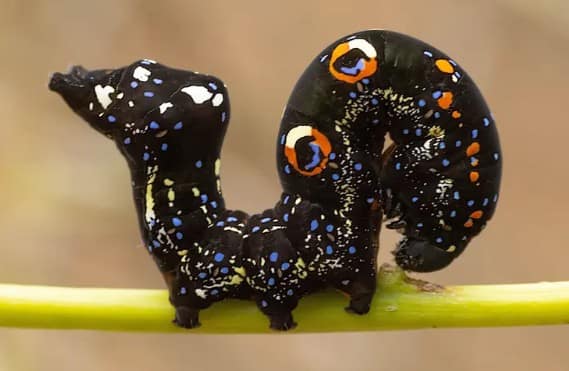
Within one week the cascading green wall of snake vines were stripped of leaves by the crazily beautiful larvae of the fruit piercing moth, spectacular eye spots rear up in display while tucking their vulnerable heads out of harm’s way.
One visitor asked how we were controlling the clearly destructive caterpillars, I mean where’s the spray response, some canned version of acid rain? I pointed to the ground, peppered by bright green dung, the nitrogen that will promote luxurious fresh growth in a few weeks.
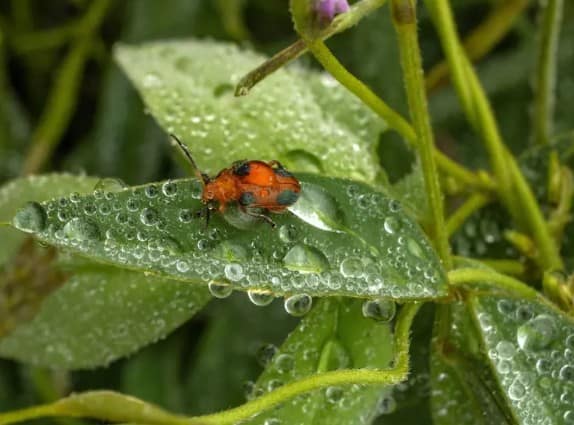
The fruit piercing moth is also very beautiful with its vivid orange underwings and strange horn like appendage used for stabbing fruit.
After dark and between heavy downpours, tarantula like barking spiders take the opportunity to emerge, digging new burrows in the soft soil, a decision sometimes stimulated when their homes are flooded.
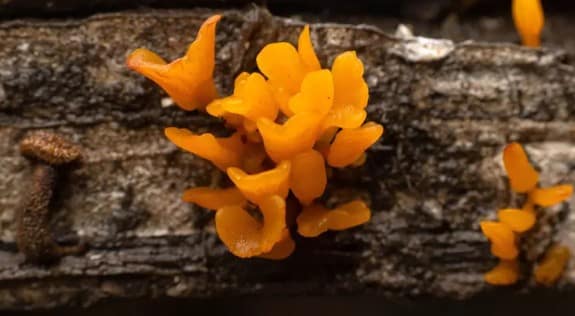
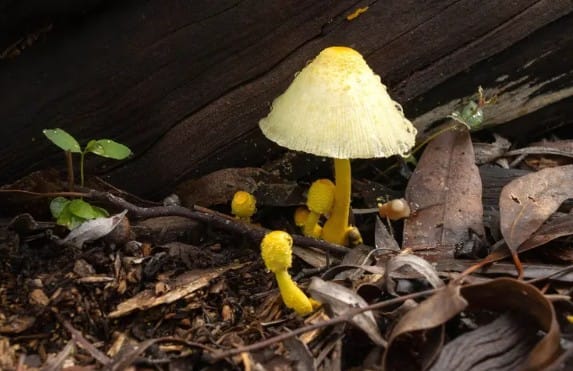
Underground fungi erupt in a wondrous display of fruiting bodies, for some, a rare opportunity to proliferate in the glorious misting rain. The fungi habitat of every fallen rotting log is verified by colonies of fruiting bodies, at times so abundant they begin to resemble a maritime coral reef.
For a story published by the Alice Springs News in March 2021 I photographed a community of fungi decorating a large fallen coolabah log, part of a registered sacred tree that had been gutted by fire. The logs quickly transformed and assumed the important role of habitat.
I was intrigued by one delicate fungi, a group of three umbrellas that I didn’t recognise issuing from a crack in the rotting log. Five years later the spores of this fungi appear to have colonised another log some thirty metres away and I’m finally able to photograph the lurid yellow individuals that ultimately grow into those delicate umbrellas I’d included in the earlier story.
Among the familiar tan coloured and vivid yellow green slime moulds I notice curious patches of green, resembling astro turf, clearly masticated by what? I’m walking on the edge of town where watercourse meets mulga and rocky hills. Here and there are small piles of euro dung and a mound of fresh soil where something has decided to dig a burrow alongside, probably a beetle.
In the half-light an outpouring of insect biodiversity, centipedes, beetles and various sci-fi characters emerge from the pores of the saturated earth. Curious puffs of “smoke” indicate a rising exodus of ant and termite alates performing their ritual of mating and dispersal, protein packages that will soon attract the attention of circling kites.
I managed to photograph a small “carcass beetle” returning home and I know they are fond of dung but I’d like to confirm this. How to confirm the astro turf maker without digging it up and rendering it homeless?
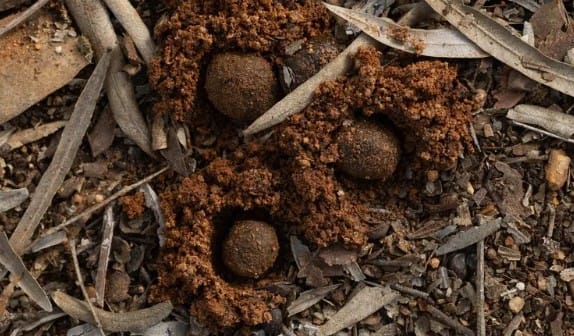
I found a tasty looking turd several times greater than the diameter of the hole and placed it over my known beetle entrance. After a few minutes the dung began to wobble.
Returning to the miscellaneous beetle hole thirty minutes later, the euro dung had disappeared so I’m able to confirm it was a beetle but have no idea how many species of detritovores are processing dung.
I count 24 holes in a square metre, each aerating the soil, improving moisture absorption and transporting fertiliser parcels underground. Density of “beetle” holes, doubtless including centipedes and spiders, are discontinuous and the relationship with euro dung is sporadic.
Early one morning I photograph a tight grouping of three dung that have begun their slight downward movement, taken overnight by unseen subterranean force/s. With an absence of entrance holes this might be the work of the larval offspring of beetles.
There are some convenience costs to all that seed production.
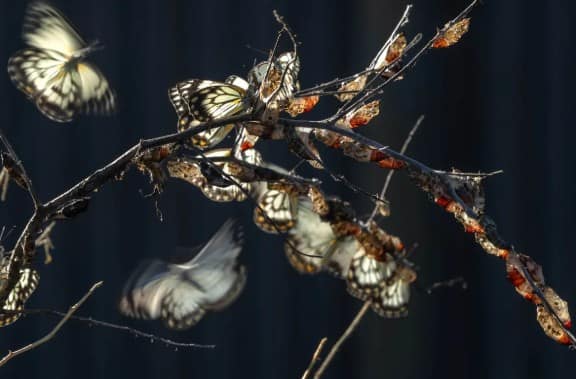
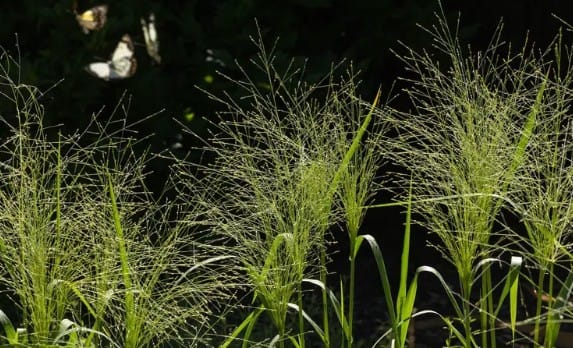
Grasshopper numbers were peaking by early April and news of a mouse plague in South Australia does not come as a surprise. Furtive diamond and bar shouldered doves have discovered the metre high tussocks of native panicum growing under our clothes line and the clouds of caper white butterflies jostling for space on perching branches of the native passionfruit, rustle gently as cellulose wings clash at sunset.
It’s the first of May when I finally return to finish this story, the butterflies are still numerous and the lighting even more perfect. The sun has moved north and its early rays find a gap in the trees illuminating the crystalis cases of the caper whites turning them into tiny lanterns.
According to weatherzone, there are signs a very strong, or super El Nino could develop in the tropical Pacific Ocean in the coming months.
Buffel is holding its moisture longer around Alice Springs but in areas of lower altitudes with hotter autumn temperatures and drier geography the fire season has already arrived. In our town area, grass fires are imminent.
I fear we are in for a horror spring and summer but fire danger throughout the winter months will also be taxing and scary. Sales of weed-eaters, slashers and fire units are doubtless soaring.
In Alice Springs, the impacts of tropical cyclones are typically benign, nature’s fury attenuated and calmed somewhat by time and especially distance.
The same can be said of flooding events and although there is much hand wringing and very little action invested, we don’t experience the annual flooding of our FNQ or Daly River friends so here its business as usual.
We’ll have to wait patiently for the essential tragedy to cut through the complacency of our leaders. There is however one natural disaster of our own creation that we can’t escape and that’s the terror of fast moving and potentially lethal grassfires.
As a young man in the 1970s I remember walking and hopping through a grassfire in mulga country before the dust suppression madness of buffel planting really took hold in communities and even national parks where better bollards would have sufficed. The buffel invasion has radically increased fire intensity, behaviour and risks.
With Territory day celebrations accompanied by a fire-works bonanza on 1st of July I do hope the town has the common sense to plan to review and adapt in the clear interests of public safety. Maybe, restricting the act of discharging explosives by all and sundry to within designated public areas, for example the show grounds and several large green ovals, attended by ambos with fire services on standby.
Hell, we might come to appreciate the benefits of behaving like the rest of the country, their “nanny state” policies doubtless well informed. Dare I say behaving like responsible grown-ups, members of a civil society.
Yes, there will be economic impacts, doubtless some of our retailer mates will sell fewer explosives and the vets will prescribe less drugs to quell pet neuroses. I also predict the fire services, police, hospital and organisations such as the RSPCA and Landcare will pick up the savings!
Perhaps some families who go without essentials so parents can play out fantasies of being #1 powder monkey or Rambo for a couple of days might benefit also.
Thinking for a moment, beyond our town of 25 square kiometers, there are much bigger risks to citizens of inland Australia where people live with NO fire-fighting services and backup.
Out of sight and out of mind, some families will of course take their bumper pack of skyrockets to outlying communities. From my observation slashing of the buffel peak is at best, barely adequate, limited by a lack of skills, equipment and resources.
Typically fire-fighting options involve a garden hose rarely located where it’s needed at short notice. Competent and effective buffel control has added a huge extra cost burden on communities that is still not seen as a priority by funding agencies.
Timing of the fireworks season is also very er, rubbery. Yes, a couple of days soon becomes months because there is no way this stupid shit is confined to the legal period and no-one to my knowledge has been charged under the Dangerous Goods Act for misusing fire-works illegally in our town.
If our police are unable to enforce existing legislation, then surely that’s reason enough to make changes! I’m dreaming of course, we must wait patiently for a substantial disaster to shore up our lack of courage and validate some-one in authority taking action.

Comment by Mike Gillam
Apologies, butterfly wings are primarily made of chitin, not the closely related cellulose of plant cell walls.
This article appeared on Alice Springs News on 1 May 2026.

