


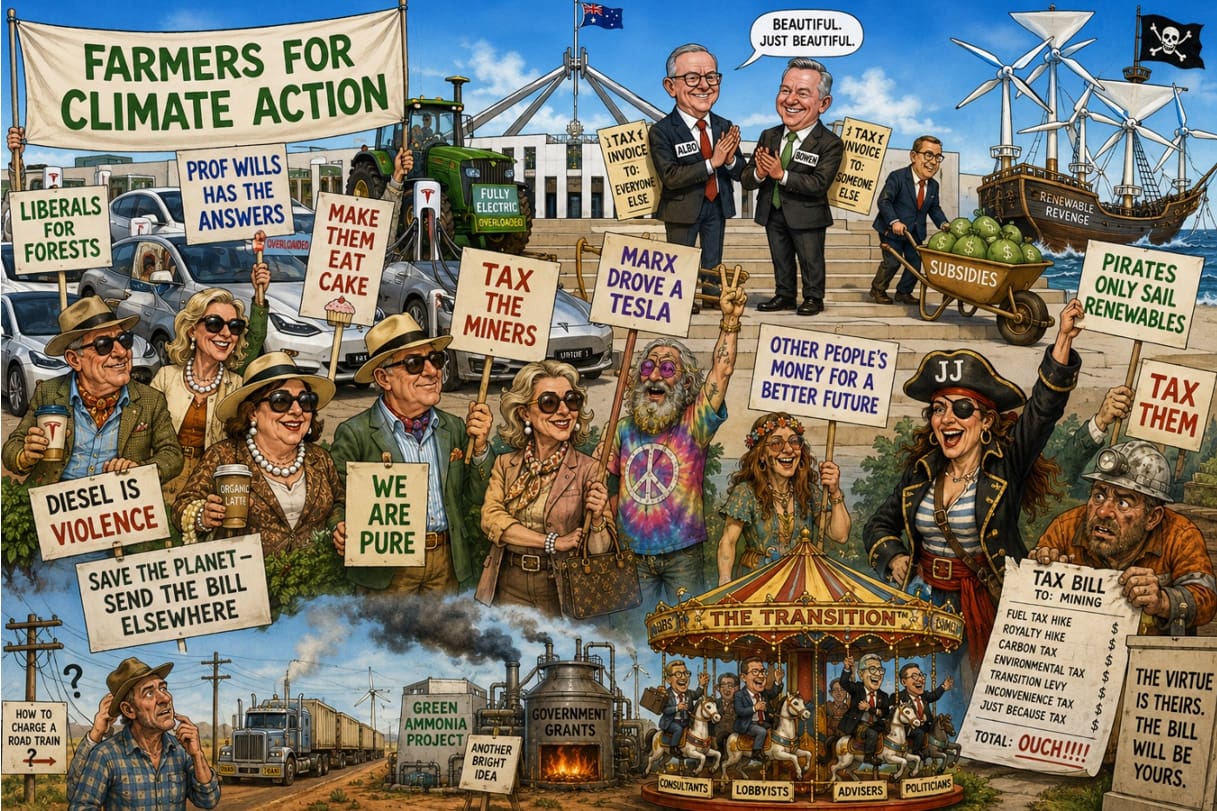
Farmers for Climate Action has produced a report ‘Energy Sovereignty for Regional Australia: Protecting Farmers, Powering the Future’ arguing that Australia’s transition away from diesel should be accelerated through electrification, subsidies, infrastructure investment and changes to fuel tax arrangements.
The report’s central argument is that farmers should be protected from the costs of climate policy while governments encourage a faster transition to renewable energy and electric machinery. Yet the proposed solution largely involves shifting those costs onto somebody else, particularly the mining sector and taxpayers.
That raises a broader question. When did advocacy become less about persuading people to voluntarily embrace change and more about finding another group to pay for it?
It is a pattern that has become increasingly common in modern public policy. The cause may be climate change, animal welfare, heritage protection or environmental conservation. The language is invariably noble. The benefits are enthusiastically promoted. The costs are often treated as somebody else’s problem.
The formula is remarkably consistent. A select group within a profession, industry or community discovers a moral cause, declares itself its champion and then uses the credibility of the group it claims to represent to advocate policies whose costs are overwhelmingly borne by others.
Liberals for Forests was probably the first example I encountered. Here was a subgroup of Liberal Party supporters, many living in Perth’s leafy western suburbs and enjoying polished jarrah floors in their own homes, campaigning to shut down native forestry across regional Western Australia. The environmental virtue accrued to those making the argument. The job losses, mill closures and economic pain were borne by timber towns hundreds of kilometres away.
Since then the model has become almost a cottage industry. Lawyers for Aboriginal Rights campaign for stronger Aboriginal heritage protections while farmers, miners and developers absorb the delays, compliance costs and uncertainty. Doctors for Animal Rights demand ever higher welfare standards while livestock producers pick up the tab. Architects for Climate Change advocate ever more ambitious net-zero housing standards while new home builders carry the additional cost.
The issue is not whether the causes are worthy. Most are. The issue is whether those advocating change are willing to bear the consequences themselves. Too often the virtue belongs to the campaigners while the invoice belongs to somebody else.
Imagine for a moment if we had a lobby group called Farmers for Land Rights. One can only imagine the enthusiasm with which other farmers would embrace mandatory Aboriginal heritage surveys over every paddock, fence line and dam. Imagine Farmers for Tibetan Independence and the outrage from barley and wine producers when China responded by closing its markets to Australian exports. Imagine Farmers for Animal Rights demanding PETA-approved welfare standards while feedlots, piggeries and poultry producers picked up the bill. Imagine Farmers Against Firearms explaining to sheep producers why feral dogs are best managed through understanding and dialogue.
The point is that when a small group chooses to campaign under the banner of an entire profession, industry or community, it also assumes responsibility for the consequences. If you claim to speak for farmers, then farmers are entitled to ask whether you are representing the industry or simply using the credibility of the industry to advance a political cause that many farmers may not share.
Which brings us back to Farmers for Climate Action and its latest report on “energy sovereignty”.
The report starts from a simple premise. Diesel dependence is the problem. Electrification is the solution.
From there, much of the discussion focuses on the benefits of accelerating the transition. Regional resilience. Energy sovereignty. Lower emissions. Improved supply chains. Greater productivity. The challenge, according to the report, is identifying the policies, subsidies and tax changes required to get there faster.
What receives far less attention are the questions every farmer asks before making an investment. What does it cost? What are the risks? What happens if the assumptions are wrong? And who ultimately pays if the promised savings fail to materialise?
Throughout the report there is surprisingly little attention paid to the scale of the undertaking being proposed. We are told electric tractors and trucks are vastly more efficient than diesel and can save farmers up to 70 or 80 per cent of their fuel costs. With the right policies, Australian farmers are assured they will be beneficiaries of an electrified future.
What is largely missing is any serious discussion about how that future actually works on a broadacre grain farm, in a country town or across a regional freight network.
Let’s face it, farmers could rush out tomorrow and buy an electric tractor. The Fendt e100 is one of the few commercially available models, producing around 90 horsepower. It may be perfectly suited to vineyards, orchards and dragging around field bins, but it bears little resemblance to the big machinery required to seed or harvest thousands of hectares across the Wheatbelt.
At the other end of the scale there is a growing range of electric prime movers. Volvo’s FH Electric produces an impressive 724 horsepower, proving that electric motors are more than capable of delivering serious performance. The challenge is not horsepower. The challenge is carrying enough energy to perform the task and then finding somewhere to recharge it.
The Volvo electric carries around 540kWh of batteries equivalent to 7 Teslas and offers a practical range of roughly 300 to 400 kilometres under load. That may be entirely adequate for urban freight operations. It is a very different proposition for trucks hauling grain, fertiliser and livestock across regional Australia.
The problem becomes even more obvious when we move beyond the vehicle itself and consider the infrastructure required to support it. A modern broadacre farm is rarely located beside a high-voltage transmission line capable of supplying the charging requirements of electric headers, trucks, tractors and utes operating during seeding and harvest.
One can only imagine how impressed the farmers at the end of the spur line would be if a fleet of electric trucks rolled into town each night and plugged into megawatt-scale chargers that tripped out his power.
The report largely assumes these challenges can be overcome through network upgrades, public investment and improved infrastructure. Perhaps they can.
What receives far less attention is the scale and cost of that undertaking. Who pays for the transmission upgrades? Who funds the additional generation capacity? Who pays for the charging infrastructure and the substantial investment required across thousands of farms and regional communities?
The report assumes government can solve these problems. Perhaps it can. But there is remarkably little discussion about what it will cost, who will bear those costs and why so few of them appear in the economic calculations presented to justify the transition.
That is the recurring weakness throughout the document. The policy options are discussed in detail, but the engineering challenges are barely acknowledged, and the costs are largely invisible. Time and again the report assumes that once governments provide incentives, regulators create the right framework, public finance institutions direct capital towards preferred technologies and taxpayers fund the necessary infrastructure, the practical difficulties will somehow resolve themselves.
The report’s faith in government planning would be more reassuring if Australians had not spent the past four years watching the Albanese Government struggle to deliver its existing energy transition.
We were promised power bills would be $275 cheaper. Instead, Australians have faced rising electricity costs while governments pursue a transition requiring thousands of wind turbines, tens of millions of solar panels, mega batteries, and more than 10,000 kilometres of new transmission lines crossing regional Australia that are meeting fierce resistance across farming communities that are expected to host them.
Yet despite this experience we are asked by Farmers for Climate Action to believe that governments can simultaneously electrify transport, agriculture and regional industries with little political resistance and no cost to farmers.
At a certain point an obvious question arises. If the economics are as compelling as claimed, and renewables are so much cheaper, why is such extensive government involvement required?
Why in fact have the usual climate favourites, green ammonia and biofuels, struggled so badly if they are genuinely cheaper?
Green ammonia has absorbed billions of dollars in announcements, grants and government support, yet over 60 projects have been delayed, downsized and abandoned because the economics refuse to cooperate. I notice Farmers for Climate action do not talk about what green fertiliser might actually cost farmers. Given the panic that accompanied recent urea price spikes, many growers would find today’s fertiliser prices positively nostalgic compared with a future built around mandated use of green urea.
Biofuels suffer from a similar problem. The concept sounds attractive until someone starts doing the arithmetic on how much more diesel would have to be taxed to make it viable to build biofuel plants across Australia.
The irony is difficult to miss. Farmers for Climate Action repeatedly argues that farmers should not bear excessive costs associated with climate policy. Most farmers would agree. Yet the transition outlined in the report would require billions of dollars of investment and somebody ultimately has to pay. The report’s answer is not to eliminate those costs, but to transfer them to somebody else.
Fortunately, the report appears to have identified a willing source of funding. Another group of primary producers. The miners.
The logic is simple enough. The miners use diesel. The miners receive fuel tax credits. Therefore the miners should help fund the transition.
What Farmers for Climate Action may not have considered is the precedent such arguments create. Today’s target is mining. Tomorrow it could just as easily be agriculture.
The miners are rich. The miners use diesel. The miners can pay.
It does not take much imagination to see how that argument evolves in the hands of governments searching for revenue.
The farmers are asset rich. The farmers use diesel. The farmers can pay.
After all, governments have already targeted shareholders, landlords and investors. Why would large agricultural landholders be immune if policymakers decide diesel use, fertiliser emissions or old dirty diesel farm machinery should also contribute more? Once a Labor government discovers that one group of the capitalist class is willing to throw another under the bus, it may conclude both groups can afford to contribute.
That is the danger. By arguing that miners are wealthy enough to absorb higher costs, Farmers for Climate Action is helping establish a principle that may one day be turned against farmers themselves.
History suggests political movements built on making somebody else pay eventually run out of other people’s money. When that happens governments start looking for a new group to tax, regulate or blame.
A minority of farmers speaking as if they represent the whole community should be careful about helping establish a precedent that future governments may find impossible to resist.
By all means, be a farmer who supports climate action. But instead of demanding others pick up the tab, or asking government to impose the costs on the wider community, step up and lead by example.
Park up the old Chamberlain beside the field bin and buy the eFendt. Swap the LandCruiser ute for an electric BYD. Replace the Mack prime mover with a Volvo FH Electric. Install the solar panels, batteries and charging infrastructure needed to keep it all moving. Then fund the whole exercise with the soil carbon credits you have generated.
Demonstrate that the economics genuinely stack up before asking somebody else to make the sacrifice and potentially throwing the rest of the industry under the bus.


Mr Wittington’s analysis of the FCA report seems mostly concerned not with with energy sovereignty part, but “the bill”.
He suggests it shouldn’t be the miners who pay, because, and this is more a theory than a fact, that will eventually mean farmers too. And there he gives up on energy sovereignty. It’s too expensive and it’s too hard.
But there are a couple of issues with this line of thinking. Firstly, mining companies currently use around a quarter of Australia’s total diesel, 3.5 times more than agriculture does. And secondly, the miners really are clearly incredibly large, and profitable.
A $50 million cap on the less than 20 big miners’ annual rebate wouldn’t make a big difference to them, although they might hasten their shift to renewables.
And, as the FCA suggests, the Government “should earmark a significant portion of the savings (from limiting the miners’ rebate) for a dedicated regional energy shift program that helps farmers adopt best-fit biofuels, electrification and enabling infrastructure.”
Trevor’s real fear is that the necessary infrastructure is expensive. And yes, it is. But the awful truth is that the cost of not dramatically slowing the rate of climate change will be more than money. And we will only have ourselves, and our buck passing, to blame.