


Western Australian Legislative Assembly — Private Members’ Business, Wednesday, 17 June 2026
Motion: That this House condemns the Cook Labor Government’s lack of support for Western Australia’s primary industries and biosecurity, as evidenced in the most recent State Budget, and calls on the Government to properly back the people and industries that feed, clothe and sustain this State.
After almost a decade in opposition, the Liberals and Nationals have rediscovered their appetite for holding ministers to account. The hunt is on for political scalps before the next election and, if I were the Minister for Agriculture, I would not be sleeping particularly well.
Every new biosecurity threat shines a brighter spotlight on years of declining investment in the Department of Primary Industries and Regional Development.
Each fresh outbreak—whether Queensland fruit fly, H5 bird flu, polyphagous shot-hole borer, varroa mite or the next pest waiting offshore—raises the same uncomfortable question: has Western Australia done enough to protect its $20 billion agricultural industry?
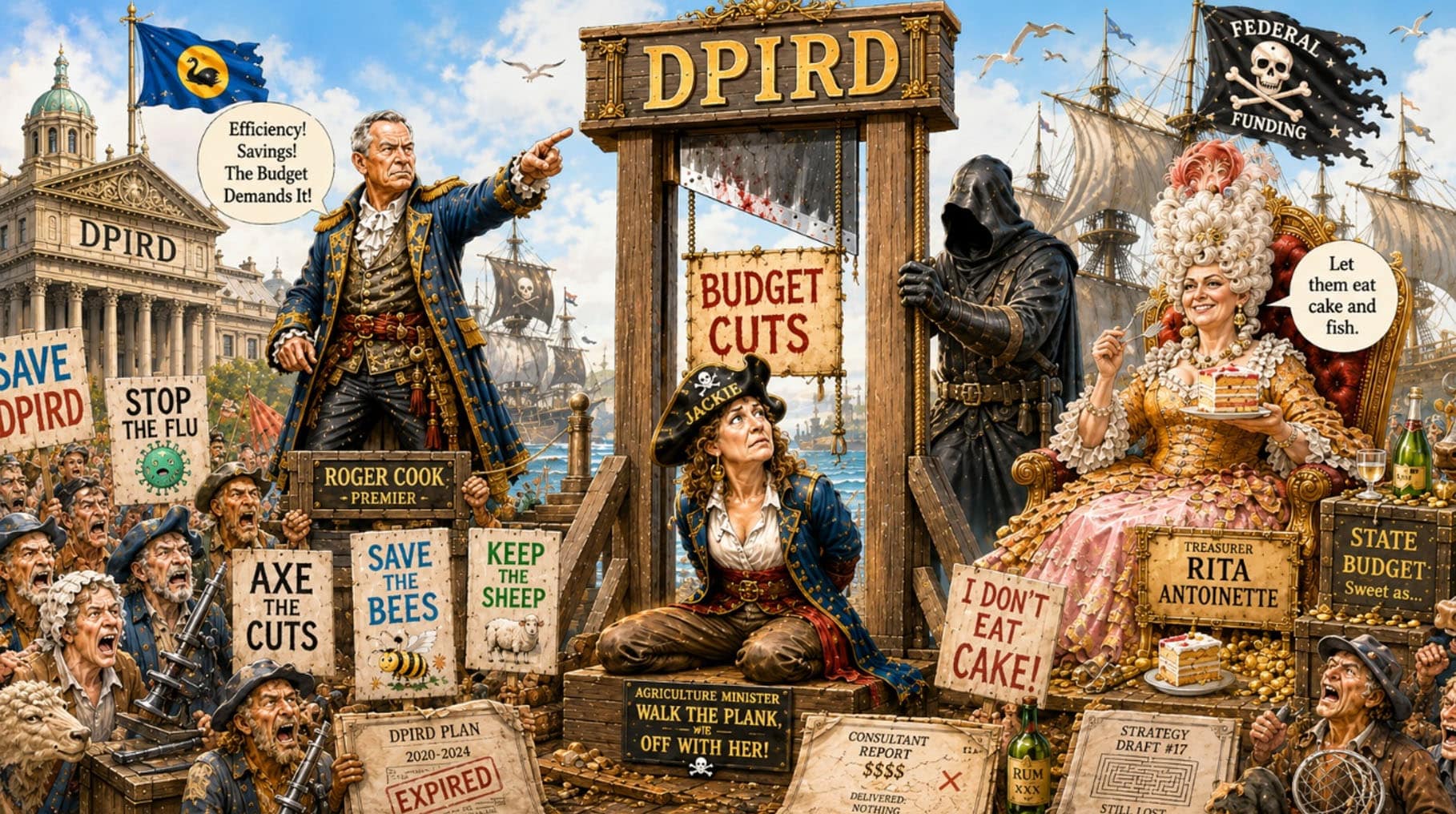
The Minister for Agriculture is left defending budget decisions she almost certainly did not make—or, perhaps just as concerningly, could not influence—while the Treasurer sits on the State’s overflowing coffers.
In politics, it is not only the Premier who makes or breaks a minister. The Treasurer can quietly starve a portfolio of resources until success becomes almost impossible.
The Premier may ultimately swing the axe, but the Treasurer sharpens it.
If H5 bird flu devastates the poultry industry, varroa mite breaches our biosecurity defences or another major pest gains a foothold in Western Australia, it will not be Treasury officials standing before the cameras. It will be the Minister for Agriculture.
Unless the Government reverses the reduction in DPIRD’s biosecurity funding and rebuilds its frontline capability, the Minister’s political future will increasingly depend on luck rather than policy. Her best chance of surviving the next biosecurity crisis may simply be to be reshuffled before it arrives.
That is not a strategy for protecting Western Australian agriculture. It is a strategy for political survival.
The parliamentary debate was revealing—not only for what Opposition members said, but for how seriously the Government appeared to take the issue.
Lachlan Hunter
Nationals Member for Central Wheatbelt and Shadow Minister for Agriculture and Food
“Year on year, we have seen the numbers from Treasury go down for the Department of Primary Industries and Regional Development. For 2025–26, it was $833 million; for 2026–27, it went down to $727 million; 2027–28, down to $541 million; 2028–29, down to $489 million; and 2029–30, down to $467 million.”
Scott Leary
Nationals Member for Albany and Shadow Minister for Tourism and Heritage
“There is one beekeeper inspector for DPIRD to cover all Western Australia, and biosecurity checks are done by volunteers.”
“Queensland has lost 80 per cent of its hives since the mite incursion, and that is not where we want WA to be.”
“Jack’s position is clear: restrict imported honey, give Australian beekeepers a chance to operate in a fair market and protect WA’s extraordinary biosecurity advantage.”
“That is 14 days of silence on varroa mite, biosecurity and imported honey.”
“A beekeeper who is the backbone of pollination services across the region is asking reasonable questions about biosecurity and imported honey—and waiting weeks for a reply.”
“The foxes, I should note, are not filing paperwork while they wait.”
Bevan Eatts
Nationals Member for Warren–Blackwood and Shadow Minister for Forestry and Aged Care
“Biosecurity is simple: it keeps pests out of crops, workers in jobs and food on shelves. When it works, no-one notices. When it fails, the damage can last for decades—maybe even forever.”
“Government should invest before a crisis, not after it.”
“We remain one of the last major varroa-free jurisdictions in Australia.”
“Preparedness is not a plan on a shelf. It is the surveillance and technology in place before an incursion, not after.”
“Without healthy bees, avocado crops, pome crops and stone-fruit crops are all at risk.”
“With varroa, we still have a chance—and the Government should take it.”
“The people who feed, clothe and sustain this State deserve better. They deserve a government that invests in prevention.”
Sandra Brewer
Liberal Member for Cottesloe and Shadow Treasurer
“Agriculture and Fisheries Biosecurity and Integrity … will have $23 million slashed.”
“The Government cannot justify 6.9 per cent expenses growth across the board while cutting biosecurity.”
“We have a unique and fragile environment in WA that must be defended and preserved.”
“The service that secures our biosecurity … will have to manage in 2029–30 with a budget just two-thirds the size of what it took to defend this State in 2025–26.”
Liam Staltari
Liberal Member for Carine, Shadow Minister for Education, Early Childhood and Disability Services, and Opposition Whip
“Why is the borer suddenly here? It could well be because this Government shut down forestry here in WA, forcing us to import foreign timber, which puts us at greater risk of imported pests coming here. It is a major, major issue. Our reliance on imported products makes it harder to maintain biosecurity.”
Kirrilee Warr
Nationals Member for Geraldton and Shadow Minister for Local Government and Fisheries
“We are going from a $727 million investment in DPIRD to $467 million. That is a significant drop. What does that mean? It means less for biosecurity and less for industries seeking to diversify. It means less for research and innovation, and less support for the people working hard to provide for the people of this State.”
Then came the Government’s response.
Hannah Beazley
Labor Member for Victoria Park, speaking on behalf of the Government
“I want to start with the member for Vasse because she spoke about an initiative that is very close to my heart: our container deposit scheme and Containers for Change.”
Lachlan Hunter rose on a point of order.
“I would like to remind the minister that we are debating an agricultural motion before the House, not an environmental motion. I would ask her to come back to the topic, which is about supporting primary industries in Western Australia.”
The Deputy Speaker directed the minister to resume her seat.
Beazley then continued:
“I turn now to regional development. One of our most popular investments, and something I can talk to very well as a regional minister, is our Regional Economic Development grants—our RED Grants.”
Hunter rose again.
“Point of order. This is the second time now. The minister is talking about Regional Economic Development grants. That has nothing to do with the motion before the House.”
Dry Farmers Summary: When a government is challenged over declining investment in biosecurity, one might reasonably expect it to defend its record on biosecurity.
Instead, the minister began talking about recycling containers and regional grants.
The pests, diseases and wild dogs threatening Western Australian agriculture are unlikely to be distracted by either.

