


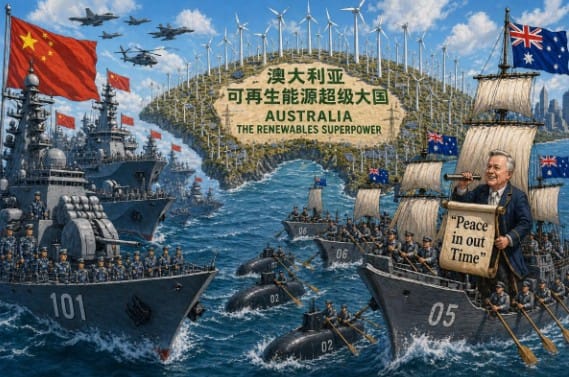
In the 1930s, Winston Churchill warned that Europe was sleepwalking into danger. Across the chamber, Neville Chamberlain insisted all would be well. “Peace in our time,” he said—a comforting line, right up until Hitler crossed into Poland.
We are seeing a modern version of that same delusion play out today. Only this time, it is not just tanks rolling across Eastern Europe or bombs falling in the Middle East—it is fuel tankers not arriving at our ports, fertiliser shipments not being secured, and a government still convinced the solution to the world’s problems is addressing global warming while the world warms up for war.
In the middle of a fuel and fertiliser squeeze—conflict in the Middle East, tightening shipping lanes, and global competition for supply—Australia finds itself in the extraordinary position of underwriting fuel imports while ruling out the very domestic capacity that would reduce that dependence.
“The future of our energy system is renewables firmed by storage, not new fossil fuel generation,” says Chris Bowen.
Australia’s energy policy has become an exercise in contradiction.
On one hand, the Bowen as energy minister is stepping in to underwrite diesel imports, quietly acknowledging that supply chains are fragile, global markets cannot be relied upon in a crisis, and the system does not deliver security on its own.
On the other, he insists that expanding exploration and building new refineries is “not realistic,” even as the country scrambles to secure fuel from overseas.
So let’s get this straight. We will pay to import fuel, insure the risk for private companies bringing it in, and even contemplate a government-run shipping line—but we will not build the capacity to produce more fuel ourselves.
That is not strategy. That is ideology.
And it is not just fuel. The same thinking runs through fertiliser. Nitrogen does not appear by magic. It is made from gas. No gas, no urea. No urea, no yield. It is that simple. Yet, in the middle of a global fertiliser shock, we continue to place barriers in front of domestic oil and gas development and show little appetite for building new urea capacity.
Instead, we talk about regenerative agriculture as though it can replace nitrogen at scale. Carbon farming is discussed as if it were food production.
Like Chamberlain in the 1930s, Bowen is left waving signed agreements as if they are guarantees of supply—when in reality they are little more than promises that dissolve the moment markets tighten and nations act in their own interests.
You cannot run a modern agricultural system on regenerative ideals any more than you can run an industrial economy on intermittent power. Physics, chemistry, geo politics and balance sheets intrude. They always do.
Just ask Sri Lanka. In 2021, under Gotabaya Rajapaksa, synthetic fertilisers were banned overnight in pursuit of an “organic” vision. Crop yields fell, food shortages followed, and the government itself did not survive the experiment. It was ideology meeting biology—and biology won.
Germany offers the industrial version. Under Angela Merkel, the Energiewende shut nuclear, leaned heavily into renewables, and left the system exposed to Russian gas. When that supply tightened, the response was not purity but panic—coal plants reopened, LNG was rushed in, and the bill landed with industry.
New Zealand tried the cleaner narrative. Under Jacinda Ardern, offshore oil and gas exploration was banned in 2018. The signal was clear. The consequences followed: tighter supply, higher prices, and a return to coal imports to keep the lights on.
And then there is Canada under Justin Trudeau. Carbon policy tightened, pipelines stalled, and oil sands development was boxed in. The resource did not disappear—only the incentive to develop it. Investment drifted, costs rose, and value shifted offshore.
The pattern is consistent: the modern version of Chamberlain believes they have found carbon zero in our time, they announce the transition in theory, ignore the constraints in practice, then scramble when political and economic reality bites—back to coal, back to imports, back to the very things policy was meant to replace.
Meanwhile, under Donald Trump, the United States pursued a far more blunt approach: “drill, baby, drill.” Crude, but effective. He might have no idea how the Middle East works but he knows what powers the US economy. And it’s not renewables.
Since the beginning of the climate change movement, Australia has steadily dismantled its refining capacity and effectively shut down its oil exploration sector. In the late 1990s and early 2000s, we had eight refineries and we were 80 per cent self sufficient in oil. Today, we have two and we import 80 per cent of our fuel needs.
The justification was economic efficiency and the need to follow global agreements that every other country ignores. It was great to grandstand on the global stage and cheaper to refine elsewhere—primarily in Asia—and ship the finished fuel into Australia. In the minds of the green teal left it all made perfect sense.
Until the fuel ran out.
At precisely the point we should have been expanding supply—opening new basins, backing gas development and maintaining coal—we went the other way. Moratoria on fracking, tighter approvals on offshore oil and gas, and a steady political drumbeat against new coal projects have made investment slower, riskier and, in many cases, uneconomic.
The message to capital has been clear: proceed anywhere but here. We don’t need your money as the wind and sun is free.
At the same time, billions have been channelled into subsidising wind and solar while dispatchable capacity is pushed out of the system. We have discouraged what works and subsidised what only works when the weather cooperates.
What we gained in global accolades from the green left, we gave up in resilience.
That trade-off looks neat on a policy platform—until geopolitical reality smashes into it.
When war disrupts supply and countries stop exporting refined fuel, it is too late to say “I told you so.” At that point, you are just another country bidding desperately for fuel and fertiliser.
For a resource-rich nation now sending its Prime Minister cap in hand to Asia for diesel and urea, Mahathir Mohamad’s warning from the 1990s about Australia becoming the “poor white trash of Asia” reads less like provocation and more like foresight.
At the time, it was dismissed as colourful rhetoric. Three decades on, after exporting the raw materials, closing the refineries, constraining exploration and urging the rest of the world toward unrealistic net zero targets, it reads less like an insult and more like a quiet ambition—as though we have decided the best way to atone for being wealthy, Western and resource-rich is to stop acting like it, and settle into the habits of a country that lines up to buy back what it once produced.
The government should be embarrassed when it has to underwrite imports. But rather than using this moment to rethink what went wrong, it has doubled down on the assumption that imports will always be there—for fuel, fertiliser, and at the rate we are going, food as well.
This is the central contradiction of modern energy policy: the belief that we as an island nation can outsource production without outsourcing our food, economic and national security.
Every litre of diesel we import carries exposure—to geopolitics, shipping constraints and foreign pricing power. Every tonne of fertiliser we fail to produce domestically leaves Australian farmers at the mercy of global markets that do not prioritise Australia.
And yet the response remains rooted in signalling rather than substance.
There is a broader historical pattern here. Governments occasionally fall under the influence of ministers who mistake ideological clarity for economic reality—who believe that if the settings are morally correct, the outcomes will follow.
They will not.
Chris Bowen is shaping as our modern-day Neville Chamberlain—not in scale, but in instinct: a belief that conviction can substitute for capability. History tends to be unforgiving of that.
Markets respond to price, risk and incentives—not idealism. The world runs on realpolitik, not idealism.
The uncomfortable truth is that Australia has been has caught unprepared and is now improvising. It assumed supply would always be there. It assumed global markets would always function smoothly. It assumed shocks were someone else’s problem.
They are not.
We are a trading nation—but we are also a long way from everywhere. Distance matters. Logistics matter. Sovereign capability matters.
Fuel matters. Fertiliser matters.
If this crisis does not prompt a serious rethink—if war-driven disruption, supply shortages and government intervention do not shift the dial—it is hard to know what will.
Because the next shock will come. It always does.

