


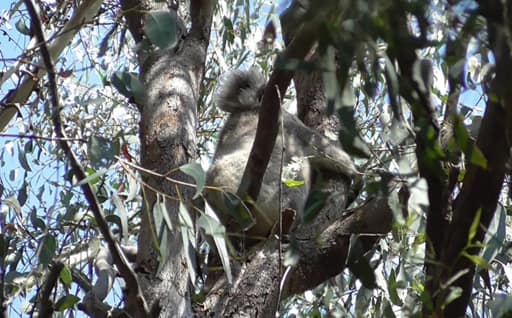
This article relates to the ongoing debate on Australian Rural & Regional News: Open for Debate: Koalas.
Landline’s segment about koalas last Sunday, Need for Trees: Charity plants half-a-million trees to help save koalas – ABC News would have been better directed at the need for common sense. It referred to the preordained finding from the NSW Inquiry in 2020 that koalas were headed for extinction by 2050. This finding was ridiculous because koalas were invisible when Europeans arrived. Now there are many more koalas over a much wider area.
The NSW finding and the Commonwealth Endangered listing of northern koalas were based on expert guesstimates dressed up as science. There were supposedly only 36,350 koalas in New South Wales and 215,820 in South Australia and Victoria where they are not officially endangered. The NSW Department of Climate Change Etc. has since released its NSW koala baseline survey technical report 2025. This report, based on some real data, estimates that there are 274,000 koalas in New South Wales – eight times more than was thought. The endangered listing is inappropriate.
Even then, the report ignores the historical baseline when explorers and settlers saw no koalas because they were confined to thick forests at densities below about 0.03 per hectare. This includes about 72 per cent of the current distribution according to the report (Table 5). Compared to historically sustainable densities, 28 per cent of the current distribution of koalas is in an irruption phase with densities greater than 0.02 per hectare or two koalas per hundred hectares. But the report doesn’t mention the historical irruptions and crashes in koala numbers or the invasions of areas previously unable to support koalas which now support high densities that are unsustainable in the long term.
Landline told us that koalas in the Northern Rivers are being killed by cars, dogs, disease and habitat loss. Six koalas per month are being hit by cars around Bangalow and the survival rate is only 20 per cent.
Landline said the solution is to plant more trees and that koalas can use trees that are only 18 months old. In fact, hungry koalas can use seedlings before they’re even planted, as shown in another story from the Northern Rivers. Claude the koala eats thousands of nursery seedlings intended for NSW wildlife corridor – ABC News
The problem isn’t a shortage of trees, it’s an overabundance of koalas. Crashes in numbers during the Federation and Millennium Droughts illustrate that high densities are unsustainable. Ecological history of the koala and implications for management | Wildlife Research | ConnectSci
Australian Rural & Regional News asked a few further questions of Vic
ARR.News: If explorers and settlers didn’t see koalas how can anyone know that they were at densities of about 0.03 per hectare then?
Vic Jurskis: Koalas were invisible then. Current research suggests that koalas become visible at densities of about 0.03 to 0.1.
ARR.News: Especially as it’s taken current tech to get anything like a baseline of numbers in 2025. How can a count back then be credible? And even so things have changed since any historical baseline. How can you be sure your view of sustainable densities is better?
Vic Jurskis: Koala numbers have crashed during droughts when at high densities, low density virtually invisible koalas have survived OK.
ARR.News: At all events, surely planting trees is a good thing for the environment generally regardless?
Vic Jurskis: Best thing would be planting trees and using the renewable timber resource. But plantations are invaded by koalas and the animal welfare problem arises.
ARR.News: What do you think the solution is? How do you think koalas can be got to and kept at the right numbers in enough of the right areas to give them a buffer when disasters such as fire come along and kill them in large numbers, possibly even whole colonies?
Vic Jurskis: Koalas on the North Coast and elsewhere continued to increase through the Black Summer fires when large numbers were killed. The pragmatic solution at the end of the 19th Century was to shoot koalas and export their skins. The problem is not a conservation problem but an animal welfare problem. Diseased, wasted and seriously injured koalas should be euthanised. Instead millions of dollars are spent researching diseases that are consequent to overcrowding. Frequent mild burning should be re-introduced in forests to improve their health, reduce their carrying capacity for koalas and restore their ability to support truly endangered wildlife requiring open sunny habitat, for example Hastings River mouse, broad-headed snake, Imlay Mallee.
Vic Jurskis is the author of The great koala scam : green propaganda, junk science, government waste & cruelty to animals, Connor Court Publishing, 2020.
Related stories: Koala


I have seen koalas on the Edward’river and the Wakool river weren’t there 70 years ago when I went there regularly with my Dad there on the river system pulled up to chat on the phone at Tocomwall one day Victorian side of the bridge and little brown one was in a sapling next to the track
Thanks Ronald,
There were no koalas when the Goulburn River was settled in 1839. By the 1860s there were thousands.