


“We economists don’t know much, but we do know how to create a shortage:
just fix the price below the market level.”
— Milton Friedman.
Economics is a complicated discipline, but on one point it is remarkably clear about how shortages occur. Prevent prices from adjusting and you will get one.
The basic lesson from Economics 101 is simple. When supply tightens, prices rise. As prices rise, some buyers drop out, demand falls and the market eventually finds a new equilibrium.
Scarcity, in a functioning market, does not produce rationing. It produces higher prices that balance supply and demand.
That, at least, is how a market economy is supposed to work.
Which makes the current fuel situation across Western Australia somewhat puzzling.
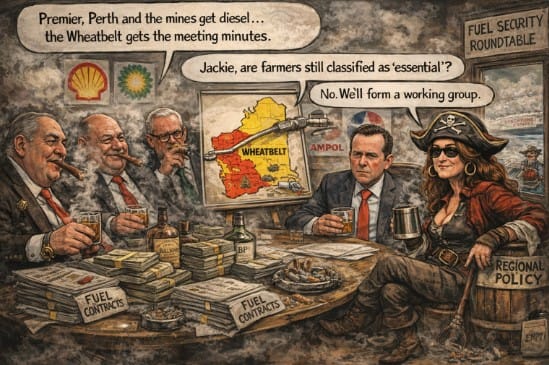
Across the Wheatbelt fuel is being rationed. Farmers ordering 25,000 litres are told they can only receive 8,000. Truck drivers pulling into country service stations expecting to fill an 800-litre tank are occasionally capped at half that.
Yet drive through Perth and the metropolitan fuel system appears to be operating normally. No ration notices. No capped pumps. No anxious motorists sneaking jerry-cans into the back of Hiluxes.
Even the state’s largest fuel consumers appear to be operating as usual. The mining sector alone consumes roughly 40 per cent of all fuel imported into Western Australia, yet there have been no reports of fly-in fly-out workers being sent home because the diesel tanks have run dry.
Which presents a small intellectual puzzle.
If supply is tight, why does it appear that only some parts of the state are experiencing shortages?
If markets were functioning in the way every first-year economics student is taught, the answer would be simple. Prices would rise.
The price difference between Kwinana and somewhere like Koorda or Kondinin would widen until fuel began flowing outward from the coastal terminals to wherever demand was strongest. The further you moved from the port, the higher the price would climb. That price signal would dampen demand, redirect supply and eventually clear the shortage.
Markets have been solving problems like this for centuries.
But that mechanism does not appear to be operating.
Instead something more curious is emerging: selective rationing. Some customers receive full deliveries while others are told supply is “limited”. Some regions operate normally while others quietly tighten the taps.
Which raises an uncomfortable question.
If price is not determining who receives fuel, what is?
Thomas Sowell once observed that the first lesson of economics is scarcity: there is never enough of anything to satisfy everyone who wants it. The first lesson of politics, he added, is to ignore the first lesson of economics.
History suggests that when markets are prevented from allocating scarce goods through price, another system replaces it: administrative allocation.
Queues replace price. Paperwork replaces markets. Decisions migrate quietly from open exchanges into private conversations.
And those closest to the centres of economic or political power tend to fare rather better than those further away.
One does not need to stretch the imagination too far to see the resemblance.
On paper Western Australia appears to possess ample fuel infrastructure. Total storage capacity across the state sits somewhere between two and 2.7 billion litres.
Most of that capacity is clustered around the Kwinana industrial strip south of Perth.
BP Australia alone holds roughly one to 1.1 billion litres of storage capacity at the former Kwinana refinery complex. Ampol operates another 400 to 600 million litres of storage in the same precinct. Viva Energy maintains between 300 and 500 million litres across facilities at Kwinana and Fremantle.
Impala Terminals runs a large Kwinana Bay terminal with around 225 million litres of capacity, while industrial storage used by companies such as Chevron, mining operators and aviation suppliers adds another 200 to 300 million litres.
Outside Perth, regional depots in Geraldton, Bunbury and Kalgoorlie together account for roughly 100 to 200 million litres.
It sounds like an enormous system.
Western Australia burns roughly 20 to 23 million litres of fuel each day. Mining consumes about 8 to 9 million litres daily. Road freight accounts for roughly 4 to 5 million litres. Passenger vehicles use around 4 million litres, while agriculture burns roughly 2 million litres depending on the season.
Aviation, marine transport and various industrial uses account for another one to two million litres.
In theory, if every tank in the state were filled to capacity, Western Australia could hold somewhere between 95 and 130 days of fuel consumption.
Which sounds comforting.
Until you realise that most tanks rarely sit anywhere near full, in fact most sit on average at about a quarter of their capacity.
Even then much of the fuel stored in those facilities is already committed under supply contracts. The system is designed for constant turnover. Ships arrive, unload their cargo, tanker fleets distribute fuel across the state and the process repeats.
Most depots operate with only one to three weeks of operational stock.
In other words, Western Australia runs a just-in-time fuel system.
When ships arrive on schedule the system works beautifully. But when shipping slows, demand spikes or nervous motorists begin topping up tanks unnecessarily, the buffers disappear very quickly.
At that point the crucial question emerges.
Does the market determine who fills their tanks, or does proximity to commercial power determine the outcome?
Fuel importers will insist the system is still operating normally. They are fulfilling contractual obligations and maintaining supply to their branded retail networks. That may well be true.
But fuel is not just another commodity. It is a critical input into almost every sector of the modern economy. As a result it sits inside a complex web of licences, legislation and emergency powers.
For decades Australian governments have spoken confidently about the importance of maintaining a ninety-day strategic fuel reserve.
If that promise had ever been meaningfully delivered, the current concerns would barely register.
Instead Australia typically holds somewhere between twenty and thirty days of supply under normal operating conditions. Most of that fuel is privately owned.
Technically the Commonwealth does hold crude oil in the United States Strategic Petroleum Reserve in Texas because Australia lacks the deep salt caverns required for large-scale storage near our remaining refineries.
But crude oil sitting on the other side of the Pacific is not particularly helpful to a farmer in Kondinin waiting for a diesel tanker.
Which leaves the country reliant largely on the fuel already sitting in privately owned tanks around Kwinana.
Western Australia does, however, possess one tool that many people forget exists.
The Liquid Fuel (Emergency Provisions) Act 1947 gives the state government sweeping powers to monitor and direct fuel supply during disruptions. Under the legislation importers and wholesalers can be required to report stock levels, shipment schedules and distribution patterns.
In extreme circumstances the government can even direct where fuel is sent.
Used properly, those powers could provide something currently missing from the public debate: transparency.
Where is the fuel? How much exists? Who is receiving it? At what price?
If metropolitan tanks were full while country depots and farmers were being rationed, the government could theoretically intervene and redirect supply.
Yet governments almost never reach for this lever. There are several reasons for that.
The first is psychology.
Invoking emergency fuel powers sends a powerful signal that something serious may be happening. Fuel markets are extraordinarily sensitive to perception. The mere suggestion that governments are “monitoring fuel supplies” can trigger panic buying faster than any actual disruption.
Sometimes governments announcing the crisis creates the crisis.
The second problem is political.
Once governments begin directing fuel distribution, they inevitably find themselves deciding who deserves the last tanker of diesel.
Hospitals and emergency services are obvious priorities. After that things become complicated rather quickly.
Should mining receive priority supply? What about road freight delivering supermarket food? Agriculture during seeding? Remote communities? Aviation? Fisheries?
Every sector has a legitimate claim. Every decision becomes political.
It is far easier for governments to declare that markets allocate fuel efficiently than to explain at a press conference why one industry will receive diesel while another will not.
There is also a quieter administrative issue.
Running a genuine emergency fuel allocation system requires detailed real-time information: terminal inventories, depot stock levels, tanker movements and shipping schedules.
The legislation allows this information to be collected, but the automated systems required to process it have never really been built.
Like many emergency powers, the machinery exists largely on paper.
And that paper is probably sitting in a filing cabinet somewhere.
So governments default to a softer strategy.
Roundtables. Coordination frameworks. Carefully worded statements about “monitoring the situation closely”.
Most of the time the system recovers by itself.
When supply tightens, prices must rise quickly enough to discourage unnecessary demand and attract additional cargoes into the market.
Economists call it a scarcity signal.
Motorists tend to use different language.
Either way it works.
But only if the signal is allowed to function.
If prices are suppressed — whether through political pressure, regulatory hesitation or quiet conversations in corporate boardrooms — demand does not fall.
Which means someone, somewhere, must instead be rationed.
At the moment that appears to be the Wheatbelt.
And it is not an ideal moment for farmers to be wondering whether diesel will arrive in time for seeding.
When that flow slows, farmers and country towns tend to notice first.
The reason is simple. Fuel companies naturally prioritise their largest customers — metropolitan retail networks and major industrial clients — before smaller regional depots.
This is precisely the type of situation emergency fuel legislation was designed to address.
Yet the government appears reluctant to use it, or even to hint that it might even though its designed for times like this.
There is, of course, another option.
Rather than waiting for a crisis to reallocate our existing limited reserves or for Canberra to eventually solve Australia’s chronic fuel security problem, Western Australia could simply act itself.
The state could amend the Liquid Fuel Emergency Provisions Act or introduce licensing conditions requiring major importers and the big miners to maintain ninety days of onshore diesel reserves within the state.
Emergency vehicles should all be moved to diesel engines to simplify reserve requirements.
Such policies would not eliminate fuel shocks, but they would ensure the system contains genuine buffers rather than relying entirely on ships arriving on schedule from Singapore or legal sticks to beat the importers into supplying the bush.
And in the meantime, if the government wished to send a clear signal that supply stability matters, and it was not taking any risks that the current war will continue it could take a far more direct step.
The Premier could pick up the phone to the governments Singapore office and tell them to buy a old 60,000-tonne tanker at a cost of around $10m and fill it on the spot market for another$100m. 10 days later it would be parked off Fremantle sending a very clear signal that the supply problem has been fixed and the state is not beholden to big oil companies.
Sometimes the fastest way to calm a market is to show that someone, somewhere, is still capable of acting like a government.

