


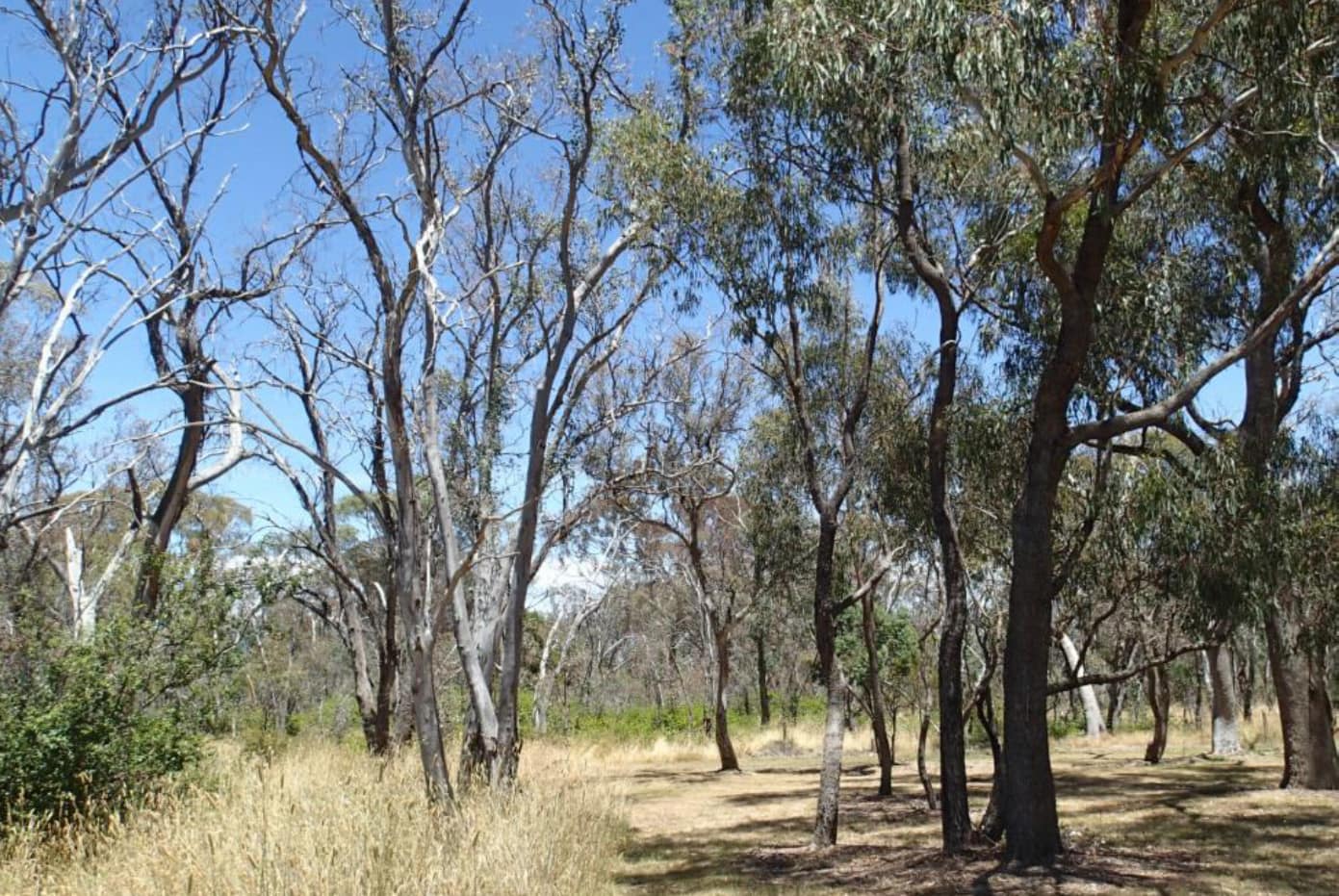
Conservation area on the left, mown rest area on the right.
Photo: Vic Jurskis
Ed: Since this article was published, Vic Jurkis and Dr Brookhouse have been exchanging views on the snow gum dieback. The outcome of this exchange is here: Snow gum dieback, fire management and pests – Vic Jurskis and Matthew Brookhouse exchange views
Dr Brookhouse and the Snow Gum Summiteers (Snow gum dieback raises fears for largest river system) should look at the history and basic ecology of chronic eucalypt decline or so-called dieback.
In 1848 Surveyor Townsend was short of feed for his bullocks in the alps because “the country throughout the whole survey was burned” by Aboriginal people gathering Bogong moths. At the same time, he wrote “the lower parts of the country were burning, and I was prevented in almost every instance from getting angles on any distant points by the dense masses of smoke obscuring the horizon in all directions”. The high country was frequently and mildly burnt by many different groups gathering for feasts and travelling their separate ways home.
European graziers moved their stock in to feed on the new growth and burnt on their way home to create new growth for the next summer. After the initiation of the Snowy Hydroelectric and Irrigation scheme and creation of Kosciuszko State Park, grazing and burning were reduced. But the Hume Snowy Bushfire Prevention Scheme was established in 1951, and mild burning was used to good effect.
With the advent and expansion of the National Parks and Wildlife Service from the mid-70s, burning was progressively reduced. The Hume Snowy scheme was disbanded in 1986. Severe wildfires affected the park in 1978, 1983, 1988, 2003 and 2019. The fire regime shifted from frequent mild fires to less frequent, high intensity fires. Bogs that were formerly protected by mild fires were burnt out and corroboree frogs were critically endangered.
Alfred Howitt saw insect plagues and eucalypt canopy decline and death on the Gippsland Plains and at Omeo in the 1860s. He identified the cause as disruption of Aboriginal burning. Frequent mild burning maintains healthy soils and microclimate promoting healthy eucalypt roots and resilience to drought, waterlogging and fire. Fire suppression creates soil and microclimatic changes that adversely affect eucalypt roots and promote competing vegetation.
Eucalypts with sick roots are more susceptible to drought, waterlogging, fires and pests, parasites and diseases. In the initial stages of chronic decline, eucalypt canopies thin and competing vegetation thickens. Arbivores are promoted because roots are weaker, leaves are softer, younger and more palatable and nutritious. Phorocantha beetles and grubs are presumably more able to penetrate the bark and feed in the more nutritious sapwood of sick trees. Pests, parasites and diseases are symptoms and contributors, not causes of chronic eucalypt decline.
Native eucalypts and their native pests are co-evolved. As the pests sharpen their attacks, the eucalypts sharpen their defences. The pests’ numbers are controlled naturally by the shortage of suitably stressed and weak hosts to enable them to complete their life cycle, when the beetles fly off to infect more weak trees.
Luckily some researchers are looking to the root of the problem rather than the beetle grubs: Do dieback-affected Eucalyptus pauciflora subsp. niphophila have fewer roots colonised by ectomycorrhizae than healthy trees? Ectomycorrhizae in dieback-affected Eucalyptus pauciflora spp. niphophila. (2023).
Field Studies in Ecology, 4(1).
https://studentjournals.anu.edu.au/index.php/fse/article/view/805
Chronic decline of eucalypts is not a consequence of climate change. This is obvious from fence line contrasts where well managed stands remain healthy as unmanaged stands decline. The obvious solution to the problem is adaptive management – reintroduction of frequent mild burning while there are still some relatively heathy stands of snow gum. Some could be left to decline further for comparison to keep the researchers busy.
Vic Jurskis is the author of The great koala scam : green propaganda, junk science, government waste & cruelty to animals, Connor Court Publishing, 2020.


Environmentalists and government bureaucrats still under the influence of European thinking fail to understand the way Australian ecosystems have evolved in the presence of fire. Fire is not a foreign element, but part of the environment, started by lightning, or over the eons by Aboriginal people. Until our national park managers start to listen to people like Vic Jurskis, the bush will only continue to decline.
Well said, Vic, an important contribution. But will it be read by those responsible for park and forest management these days? I doubt it.
Thanks yorkgum41. Those responsible for park management come under the Dept. of Climate Change etc.. They have no need to read it because they have the Climate Cop-Out.
It is unfortunate that the snow gum research appears to be following a similar path to some other die back research, including bell minor die back.
In some research, bell miners were blamed for forest decline. A systemic view shows these birds were actually responding to greater food resources (insects). These insects were responding to greater nutritious soft leaf resources caused by changing soil chemistry, which affects tree health and stimulates an unnatural abundance of epicormic shoots. A change in forest management (less regular burning) was a precursor to changing soil chemistry and tree health.
In 21st century dieback research, it seems that too often, a systematic (whole system) approach,
is replaced by assuming a primary symptom of decline is causing the decline. Changes in soil chemistry and forest health need to be monitored over decades. Too few scientists have the patience to do this. Consequently, more and more science has less and less relevance to actually reversing chronic tree decline.
Dieback is affecting millions of hectares of forest that are now carrying leafy canopies of epicormic crowns. The decline only seems to be obvious to some researchers, when the tree canopy thins or else, the trees are dead and being consumed by grubs, borers and beetles, that are responding to an increasing food supply, decades in the making.