


Market laws no longer apply in Ukrainian fields.
But Ukrainian farmers have learned to thrive in this toxic environment.
Key agricultural indicators in 2025
The Ukrainian-Russian war has been going on for four years. Despite this unfavorable situation, agriculture remains a strong part of the Ukrainian economy. Agriculture accounts for 20 per cent of the national GDP. Agricultural production accounts for approximately 11 per cent. The processing industry contributes another 9 per cent.1 Eleven agricultural companies and 14 food processing companies are among the top 100 taxpayers in Ukraine.2
According to forecasts, the volume of gross agricultural production in 2025 may increase by 3 per cent compared to the same figure in 2024, reaching $US25.3 billion (UAH 1.09 trillion). In particular, the volume of crop production will amount to $US20.2 billion (UAH 870 billion). This is 3.4 per cent more than in 2024. Livestock production will be at the level of $US5 billion (UAH 217 billion). This is 1.5 per cent more than in 2024.3
Agriculture is characterised by one of the highest profitability rates among all sectors of the Ukrainian economy. Typically, agricultural profitability is three times higher than the average profitability of the entire Ukrainian economy.4 In different years, the profitability of Ukrainian agriculture varies from 13.6 per cent to 36.4 per cent.5 In 2025, the most profitable crops were peas (50 per cent profitability), sunflower (35 per cent), and soybeans (25 per cent).6
By the end of 2025, the cost of growing agricultural crops was as follows. Cultivation technologies and intensification levels account for approximately 30-45 per cent of total costs. In some regions with intensive farming—central and southern Ukraine—this share can reach 45-50 per cent, especially with high NPK application rates. Other cost items account for smaller percentages. Seed costs will account for 15-20 per cent, plant protection products (PP) 10-15 per cent, fuel and maintenance 10-12 per cent, and land lease, depending on the region, 10-25 per cent. The remainder will be administrative and other expenses.7
Harvest and export of grain and oilseed crops for the 2025/2026 season
In the fall of 2025, winter grain was sown on an area of 5.4 million hectares. This is 4 per cent less than the previous year. Winter repack was sown on 1.1 million hectares. This is 4.7 per cent less than the previous year.8 Sowing of spring crops has not yet begun. However, under favorable weather conditions, the 2026 harvest of grain and oilseed crops in Ukraine could reach 84.5 million tons, of which 50 million tons could be exported.9 The projected harvest and export volume are greater than in 2025. In 2025, the total grain harvest amounted to 81.4 million tons. This is more than in 2024, when the harvest was 79 million tons.9
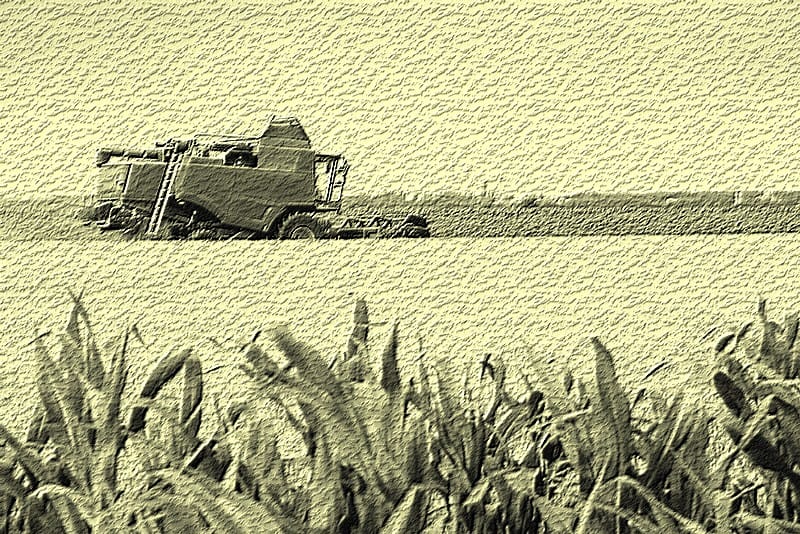
The wheat harvest in 2025 is 22.5 million tons (in 2024 – 22.4 million tons). Potential wheat exports in 2025/2026 could be 16.5 million tons. The barley harvest in 2025 is 4.9 million tons (in 2024 – 5.6 million tons). Potential exports in the 2025/2026 season will be 2.3 million tons. The corn harvest will be 32 million tons (in 2024 – 25.9 million tons), and potential exports in the current season could reach 25 million tons. The sunflower harvest in 2025 is 11.5 million tons (in 2024 – 12.8 million tons). Almost all sunflower seeds will be processed in Ukraine – 11.4 million tons.
Exports will be approximately 50,000 tons. In 2025, the rapeseed harvest is 3.2 million tons (3.8 million tons in 2024). Exports in 2025/2026 could be approximately 2.1 million tons. In 2025, the soybean harvest is approximately 5 million tons. In 2024, the harvest was 6.8 million tons. Potential exports in 2025/2026 could be 2.5 million tons. The remaining soybeans will be processed in Ukraine because the law restricts soybean exports in the same way as rapeseed.9
The 2025 harvest will allow for the export of approximately 49 million tons of grain and oilseed crops. This is more than in 2024, when exports totaled 46.7 million tons.9 However, due to increased Russian shelling of Ukrainian Black Sea ports, agricultural export volumes may decline. Port equipment has been severely damaged. Frequent power outages are also having a negative impact. Without power, a significant amount of loading and unloading equipment is inoperable. As a result, export volumes at the end of 2025 will be lower than in the same period in 2024.
The wheat exports for July–December are projected to reach 7.8 million tonnes (down 20 per cent year-on-year), representing a 47 per cent realisation of export potential. Before the full-scale invasion, Ukraine exported 65–75 per cent of its annual exports in the first half of the season. However, this year, the situation is not on Ukraine’s side: harvests in both the Southern and Northern Hemispheres are plentiful. Therefore, Ukrainian grain is competing with Australian and Argentine grain.
Barley. Approximately 1.2 million tons were exported from July to December. This is 37 per cent less than the previous year. Export volume during this period amounted to 46 per cent of the export potential.
Corn. From September to December 2025, Ukraine exported approximately 5 million tons of corn, 34 per cent below last year’s rate. These figures are the lowest in the last decade. The start of the corn season was delayed due to late harvesting, and the situation was subsequently complicated by logistical problems.10
The export volume and total profits for Ukrainian agricultural producers from the 2025 harvest will be known by mid-2026. However, it is already possible to summarise how Ukraine’s agricultural market has changed during the war.
Changes in the agricultural market due to war
The main change: the law of supply and demand is broken. The market has descended into chaos because geopolitics (including war) can override everything else! Farmers may have a good harvest. There will be good demand and high prices for this grain. But military action will disrupt logistics, and the farmers will go bankrupt! It’s like a thriving farm being destroyed by a hurricane or earthquake. It’s the end of a successful business.

All agricultural producers can become victims of sudden changes. And the cause is not only military action but also political decisions. For example, five countries neighbouring Ukraine introduced special regulations for Ukrainian agricultural exports. As a result, the European agricultural market ceased to be unified. It fragmented into different parts. Market segmentation has complicated the work of Ukrainian farmers. A misstep in logistics, contracts, or financing can destroy margins even with a good price. Demand is growing for customised strategies, scenario planning, and short decision-making cycles. Mass decisions are becoming less effective. It’s highly likely that 2026 will be a year of growth not in volumes, but rather competition for margins.11
In a challenging business environment, many farmers are trying to ensure a guaranteed profit. To this end, farmers are focusing on crops that are easier to grow and transport. Therefore, winter barley and rye plantings have been declining in recent years. Winter wheat and rapeseed plantings, on the other hand, have been increasing. This is because winter wheat is a staple crop with stable demand, while winter rapeseed is a highly profitable crop with a well-developed export market.12
Agricultural producers’ attitudes toward logistics have also changed. During wartime, delays in the transportation of goods often occur, significantly increasing the cost of transportation services. Many company managements have decided that purchasing their own vehicles is cheaper than hiring contractors. This trend is especially evident in maritime shipping. Before the war, only one agricultural company owned its own ships. However, after the war began, three more agricultural companies purchased ships for export. One company recouped its ship purchase costs in just one year!13
Let’s be honest. Only large and wealthy companies can afford ships. Medium-sized firms are actively purchasing specialised railway cars for transporting wheat. The total number of railcars owned by Ukrainian agricultural producers has increased significantly since the beginning of the war. At the end of 2025, these companies owned 20,000 railcars! Firms that purchased railcars report that operating their own railcars costs 20-40 per cent less than renting them.14
Results
Ukrainian agricultural producers have managed to adapt to the changing market environment. In this new reality, farmers have little influence on events. Survival depends on the ability to adapt to circumstances, which in most cases are force majeure. This makes Ukrainian agriculture the most extreme agriculture in the world. Therefore, only true professionals and farming enthusiasts can engage in this business. The war didn’t kill Ukrainian agriculture. The war made Ukrainian farmers better! Didn’t it?
References
1. https://delo.ua/ru/news/dolya-agrosektora-v-vvp-strany-sostavlyaet-okolo-20-ministr-439487/
2. https://uga.ua/meanings/borotba-za-vrozhaj-yak-apk-ta-harchova-promyslovist-pidtrymuyut-ukrayinsku-ekonomiku-ta-napovnyuyut-byudzhet/
3. https://delo.ua/economy/borotba-za-vrozai-yak-apk-ta-xarcova-promislovist-pidtrimuyut-ukrayinsku-ekonomiku-ta-napovnyuyut-byudzet-454214/
4. https://www.rbc.ua/rus/news/gosstat-nazval-samye-rentabelnye-otrasli-1624029577.html
5. https://www.apk-inform.com/ru/news/1530428
6. https://agroreview.com/ru/publikaczii/rejtingi/samye-prybylnye-kultury-2025-goda/
7. https://uga.ua/meanings/ozymi-2026-na-yakyh-kulturah-zoseredylys-agrariyi-a-yaki-vypaly-iz-sivozminy/
8. https://agroportal.ua/publishing/infografika/ozimi-2026-na-yakih-kulturah-zoseredilis-agrariji-a-yaki-vipali-iz-sivozmini
9. https://uga.ua/news/uza-eksport-zerna-v-2025-2026-mr-potentsijno-mig-by-sklasty-49-mln-t-pry-vrozhayi-v-81-4-mln-t/
10. https://ukragroconsult.com/news/ukrayina-zernovyj-eksport-u-pershij-polovyni-sezonu-2025-26-chy-ye-miscze-dlya-czinovogo-optymizmu/
11. https://ukragroconsult.com/news/nevyznachenisty-yak-nova-norma-yak-agrobiznesu-zaroblyaty-v-2026-roczi/
12. https://uga.ua/meanings/ozymi-2026-na-yakyh-kulturah-zoseredylys-agrariyi-a-yaki-vypaly-iz-sivozminy/
13. https://elevatorist.com/blog/read/955-morska-logistika-hto-z-ukrayinskih-agroholdingiv-volodiye-sudnami-dlya-perevezennya-produktsiyi
14. https://elevatorist.com/blog/read/952-hto-maye-naybilshe-zernovoziv-v-ukrayini-oglyad-agrokompaniy