

As the WA sheep industry watches in disbelief the rollout of the federal government’s transition package — where $139 million seems to be evaporating before our eyes — one thing is becoming painfully clear. The design of the funding means the vast majority of sheep producers impacted by the end of live exports won’t see a cent. Unless, of course, they place a high value on the growing mountain of strategies and road maps that consultants are being generously paid to produce.
What should have happened was simple. Set aside the few million earmarked for shearers and livestock transporters, then divide half of the remaining pool among producers who can demonstrate they earned income from sheep in the past two years and are still in the game. The balance should have been directed toward underwriting a robust futures market.
On my rough back-of-the-envelope calculations, each producer might have received something like 10 per cent of last year’s sheep income — a fraction of what the live-export ban has cost them, and a fraction of what it takes to pivot into more intensive production. But at least everyone affected would have received something.
Instead, what we have witnessed resembles a fairly enthusiastic feeding frenzy around the transition slush bucket. Instead, we have money being wasted left right and even over east.
My personal favourite is the $800,000 allocated to Sheep Producers Australia to develop a National Sheep Flock Strategy. Why we are funding a plan to grow the national flock while the Western Australian flock is in steep decline is a question that deserves more airtime.
That $800,000 would arguably have been better spent asking a more basic question: why, in 2026, with real-time global data available on everything from frozen concentrated orange juice to lean hog carcasses, are farmers still stuck with spot prices in the sale yards where prices fluctuate wildly, day by day, pen by pen?
Why are sheep producers still relying on stock-agent whispers, saleyard gossip, rural-press snippets and gut feel to understand where the market sits? Why, after the live-export ban, are there still no robust tools for price discovery and forward contracting — the very instruments grain growers, cattle feeders and energy traders take for granted?
These are not academic questions. They go directly to confidence. Grain growers can open a phone app and instantly see ASX futures, Chicago Board of Trade prices, exporter cash bids and even Ukrainian harvest updates in real time. They can lock in grain prices, fertiliser, interest costs and margins months ahead. You can even pre-book the airfare for your New Zealand workforce. Everywhere there is a functioning market, there is a forward price.
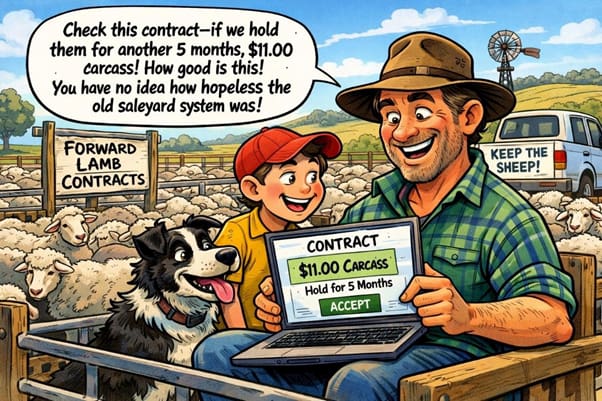
In sheep, the world of forward contracts barely exists in WA. At best, the bigger processors offer short-term tactical contracts when it suits them. WAMMCO, who should have led the industry with long term contracts, occasionally pays retrospective bonuses — $6 million last August — but that does little to help a producer decide in December whether to feed lambs or sell stores. Volatility, in this system, is not a flaw. It is a feature.
Coles and Woolworths are a key part of the problem. They do not provide processors with six- or twelve-month signals, despite locking in supply for milk, coffee, berries and a long list of fresh products well in advance. The ACCC’s 2025 inquiry into supermarket power confirmed what most in the paddock already suspected: certainty for almost everyone except the sheep industry. If the chains can contract chicken and pork a year ahead, it is fair to ask why lamb remains the exception.
There is something almost quaint about the way sheep pricing still operates. Shearing technology has barely shifted in a century, and the price-setting mechanisms are not far behind. The phase-out of live export could have been the circuit-breaker — the moment to finally give farmers meaningful forward cover. Instead, the industry has been treated to consultation fatigue and essentially zero structural reform.
The live-export decision was the ideal moment to co-fund a summer forward-pricing model. A properly designed reserve-price style mechanism could have underwritten confidence while the market adjusted. Yes, reserve prices stir uncomfortable memories of the wool collapse, but government underwriting itself is hardly radical.
Canberra is already guaranteeing floor prices for rare-earth minerals to counter Chinese dumping. If it is good enough to de-risk lithium miners, it is reasonable to ask why sheep producers are apparently expected to absorb the full blast of market volatility.
Imagine a sliding scale of 700–1100c/kg on a government-backed forward contract for the next 12 months. Feed companies would lock in grain. Farmers would invest in sheds and feeding infrastructure. Banks might even sleep better at night. Instead, a noticeable slice of the transition funding that could have funded a futures trading floor for lamb has circled back into administration of the transition, with the remainder dispersed across consultants, roundtables and discussion papers. Reports have been written. Strategies have been launched. But on the ground, very little will have changed by the time the money runs out.
What we will be left with, in policy terms, is hope. Hope that the market holds up until the last boat sails. Hope that processors keep bidding up prices in the sale yards. Hope that new premium markets materialise overseas. Hope, it seems, has become a recognised policy instrument.
But hope does not service overdrafts.
Without live export, WA producers now carry one of the highest seasonal risk loads in the country. Feed, water and heat risks all peak through summer — precisely when price visibility tends to disappear. Processors argue that longer contracts would expose them to unacceptable risk, yet retail margins suggest someone in the chain is managing volatility quite comfortably.
Supermarkets and processors tend to capture returns early in the cycle, while growers receive bonuses, if they arrive at all, well after the key decisions have been made.
What’s the point of having the rural press reporting excitedly about “record lamb prices,” if it’s only one pen? Cameras flash, agents celebrate and processors politely shrug knowing that the average will be in their favour. But the economics of the industry are not built on the occasional headline. Lamb is ultimately priced on kilograms of carcass sold into domestic and export contracts that processors have visibility on months in advance. But when saleyard prices lurch week to week, much of that movement is noise rather than genuine price discovery of value for producers.
With only a handful of major processors dominating WA kill capacity, the scale of short-term price swings often raises more questions than it answers. Processors typically have clear visibility on domestic retail demand, export orders, plant capacity and freight. What they are not obliged to share is forward price intent. Transparency would narrow margin advantages, so opacity persists.
The obvious question is why the sheep industry has struggled to build credible hedging tools when so many comparable sectors have managed it. Lamb is perishable, certainly — but not uniquely so. Chilled product can hold for months and frozen product far longer. Dairy futures exist. In the United States, lean hog, live cattle and Class III milk contracts trade well forward. Yet Australian lamb remains largely anchored to auctions and private deals.
The reason is not technical impossibility. It is incentives. Volatility is highly profitable when you are not the one feeding the animal.
Globally, the templates already exist. On the Chicago Mercantile Exchange, live and feeder cattle trade up to two years forward, while lean hog futures underpin pork export programs and Class III milk allows processors to manage margins 18 months out. Corn and soybeans routinely trade years ahead, forming the backbone of global feed pricing. Europe lists dairy, sugar and cotton contracts out several seasons, and both New Zealand and Brazil have developed forward livestock and milk pricing tools. Perishability has not stopped innovation anywhere else.
Only in Australia does lamb still lean heavily on handshake-pricing and short-dated grids.
A relatively modest slice of the transition funding — including roughly $30 million that flowed back into federal administration — could have helped change that. The Commonwealth could have commissioned a standard forward-contract template with transparent specifications and deductions, funded a public finishing-cost calculator linked to ASX grain and hay prices, and underwritten pilot fixed-price Jan-June contracts with processors. The ASX already clears wheat, barley and wool futures. Hosting a lamb forward-contract is not beyond the technical frontier.
None of this is radical. Grains, cattle and dairy already operate in this world.
So why has it not happened?
Because opacity is profitable. Supermarkets squeeze processors through private supply arrangements. Processors squeeze growers through the prearranged ceilings they set prior to the auctions kicking off. The producer remains the risk sponge.
Australia’s sheep industry now sits at a genuine fork in the road. One path leads to continued volatility, limited transparency and gradual contraction of the flock. The other points toward forward curves, clearer price signals and a future farmers can invest in.
Until sheep producers can glance at their phones and see a credible forward price six months out and lock in a legally enforceable deal, Australia’s oldest agricultural industry will continue staggering around bleeding growers, sheep and confidence. The government has wasted millions on planning the future of a dying industry when all they needed was a guaranteed future price.
Related stories: Live exports