

Renewable Energy Inquiry told of too many flaws and no coordination
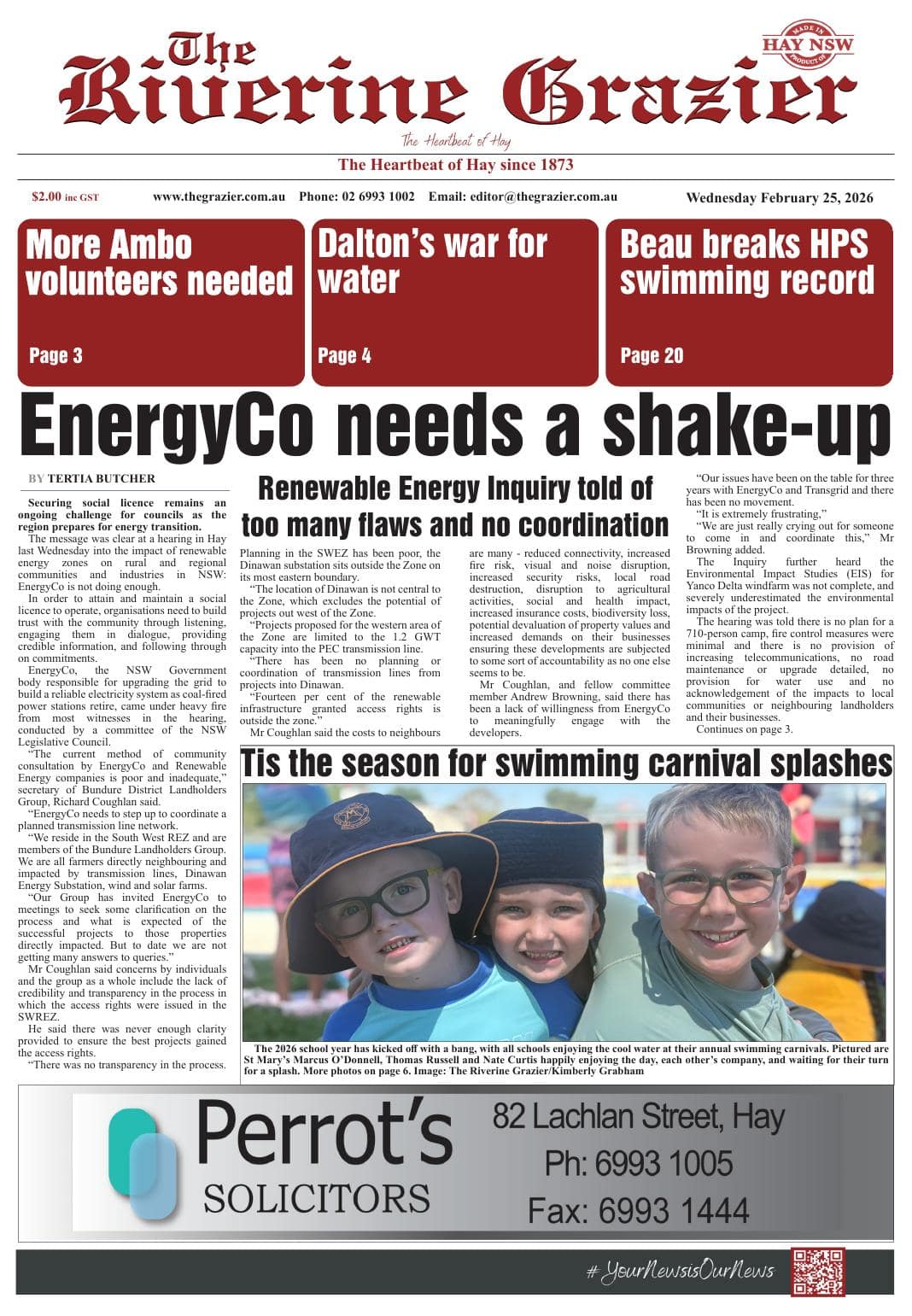
Securing social licence remains an ongoing challenge for councils as the region prepares for energy transition.
The message was clear at a hearing in Hay last Wednesday into the impact of renewable energy zones on rural and regional communities and industries in NSW: EnergyCo is not doing enough.
In order to attain and maintain a social licence to operate, organisations need to build trust with the community through listening, engaging them in dialogue, providing credible information, and following through on commitments.
EnergyCo, the NSW Government body responsible for upgrading the grid to build a reliable electricity system as coal-fired power stations retire, came under heavy fire from most witnesses in the hearing, conducted by a committee of the NSW Legislative Council.
“The current method of community consultation by EnergyCo and Renewable Energy companies is poor and inadequate,” secretary of Bundure District Landholders Group, Richard Coughlan said.
“EnergyCo needs to step up to coordinate a planned transmission line network.
“We reside in the South West REZ and are members of the Bundure Landholders Group. We are all farmers directly neighbouring and impacted by transmission lines, Dinawan Energy Substation, wind and solar farms.
“Our Group has invited EnergyCo to meetings to seek some clarification on the process and what is expected of the successful projects to those properties directly impacted. But to date we are not getting many answers to queries.”
Mr Coughlan said concerns by individuals and the group as a whole include the lack of credibility and transparency in the process in which the access rights were issued in the SWREZ.
He said there was never enough clarity provided to ensure the best projects gained the access rights.
“There was no transparency in the process.
Planning in the SWEZ has been poor, the Dinawan substation sits outside the Zone on its most eastern boundary.
“The location of Dinawan is not central to the Zone, which excludes the potential of projects out west of the Zone.
“Projects proposed for the western area of the Zone are limited to the 1.2 GWT capacity into the PEC transmission line.
“There has been no planning or coordination of transmission lines from projects into Dinawan.
“Fourteen per cent of the renewable infrastructure granted access rights is outside the zone.”
Mr Coughlan said the costs to neighbours are many – reduced connectivity, increased fire risk, visual and noise disruption, increased security risks, local road destruction, disruption to agricultural activities, social and health impact, increased insurance costs, biodiversity loss, potential devaluation of property values and increased demands on their businesses ensuring these developments are subjected to some sort of accountability as no one else seems to be.
Mr Coughlan, and fellow committee member Andrew Browning, said there has been a lack of willingness from EnergyCo to meaningfully engage with the developers.
“Our issues have been on the table for three years with EnergyCo and Transgrid and there has been no movement.
“It is extremely frustrating.”
“We are just really crying out for someone to come in and coordinate this,” Mr Browning added.
The Inquiry further heard the Environmental Impact Studies (EIS) for Yanco Delta windfarm was not complete, and severely underestimated the environmental impacts of the project.
The hearing was told there is no plan for a 710-person camp, fire control measures were minimal and there is no provision of increasing telecommunications, no road maintenance or upgrade detailed, no provision for water use and no acknowledgement of the impacts to local communities or neighbouring landholders and their businesses.
Yanco Delta approval under the microscope as Inquiry continues into impacts of REZ
– Decommissioning has not been addressed
The Inquiry heard Yanco Delta Wind Farm now must seek numerous modifications to its development through the EPBC (Environment Protection and Biodiversity Conservation Act) due to its inadequate initial EIS.
Landholders believe Yanco Delta Wind Farm gained rushed approval for reasons outside required consideration.
Mr Coughlan said Government agency regulatory requirements for Yanco Delta have been relaxed in the push to roll out renewable energy with haste to accommodate emission targets.
Hay Shire Council was represented by Executive Manager – Economic Development and Tourism, Alison McLean who told the Inquiry that compared to neighbouring LGAs, Hay experienced fewer direct impacts from transmission projects such as Project Energy Connect (PEC) and VNI West.
“This has assisted in facilitating more positive discussions about Hay’s role in the energy transition,” Mrs McLean said.
“However, securing social licence remains an ongoing challenge, particularly as the community faces the construction phase’s disruptions, including transport, accommodation, water, waste and longterm community impacts.
“The scale and location of proposed REZ developments remain uncertain.
“Once the South West REZ access tender is announced, Council will require significant resources and support to maintain the community’s social license, resource an infrastructure build of this scale, and maximise opportunities.”
Murrumbidgee Council has dealt separately with four State significant wind farms and one state significant solar farm, all seeking connection to Dinawan.
In addition, prior to the development of the SW REZ, two state significant solar farms were approved and built at Coleambally and Darlington Point.
Murrumbidgee Council Director Planning and Infrastructure, Garry Stoll said this experience has provided Council with extensive first-hand knowledge of the impacts, challenges and disappointments that the development of renewable energy projects create.
“It also reinforces our belief that these developments offer no positive outcomes for our communities,” Mr Stoll told the Inquiry.
“In fact, Council and the community have reached the conclusion, that whilst we do not want these things in our area, if they are coming, we will attempt to leverage the maximum amount of benefit from them for our communities as possible.
“However, even in this endeavour we have been continually thwarted by the efforts of the NSW Planning and Environment Energy Assessments team, EnergyCo and the developers themselves.”
Mr Stoll raised concern over the visual impacts of potentially up to seven major transmission lines converging at one location, either into or from the Dinawan Substation of the Kidman Way between Coleambally and Jerilderie.
He said Council was also concerned with the heavy demands placed on local roads and an influx of thousands of construction workers with the need for accommodation camps.
He said there would be new demands on potentially scarce resources such as water, and other services provided by local government.
“The creation of the renewable energy zones are all state and federal government projects,” Mr Stoll told the Inquiry.
“Projects in Murrumbidgee Council within the REZ will only benefit the renewable energy developers themselves and about six landowners.
“Yet the impacts of the construction, ongoing operations, loss of visual amenities, community divisions, economic, loss of available telecommunication services are all impacts, costs and burdens that will be borne by our Council now and into the future.”
Next week: Further concerns raised by Balranald Shire Council, Edward River Council and Riverina and Murray Joint Organisation (RAMJO).
This article appeared in The Riverine Grazier, 25 February 2026.
