


Rabobank, Media Release, 3 July 2025
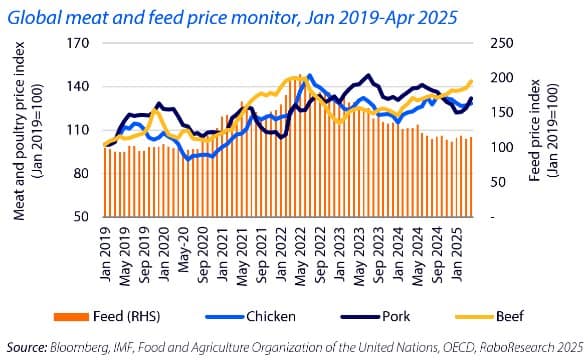
The global poultry industry has seen a relatively strong start to the year, sustained by rising animal protein prices and lower feed costs compared to last year. However, recent developments, including the announced (and postponed) US import tariffs, bird flu outbreaks in key regions, and the Israel-Iran conflict, are introducing significant uncertainty. According to RaboResearch’s latest animal protein report, these factors are poised to impact global trade and market dynamics substantially.
Geopolitical tensions are expected to impact poultry markets
Despite strong fundamentals for the global poultry market, supported by high beef and egg prices and stable feed costs, geopolitical tensions are weighing on the global economy. The IMF has downgraded its global GDP growth forecast by 0.5 per cent. This uncertain economic environment, coupled with avian flu outbreaks, is affecting poultry market stability.
“We have adjusted our global production forecast for 2025 from 2.5 per cent -3 per cent growth to 2 per cent – 2.5 per cent growth, with potential further reductions if the conflict escalates,” explains Nan-Dirk Mulder, Senior Analyst – Animal Protein with RaboResearch. “While global markets are expected to remain resilient, regional variations are likely, influenced by geopolitical events, their economic repercussions, and the evolving bird flu situation.”
Potential trade war and escalation of the Israel-Iran war would have economic repercussions
The United States’ imposition and subsequent postponement of significant import tariffs in April have left the possibility of a trade war looming. Should trade agreements be reached, the US poultry sector could expand its market access, potentially disadvantaging local producers or competing exporters. Conversely, a prolonged trade war could restrict US access, benefiting other exporters like Brazil, Thailand, Russia, and the EU. Both scenarios carry economic implications, with a trade war potentially leading to price inflation, particularly affecting economies with the highest tariffs, notably in Asia and Africa, and indirectly influencing poultry markets. Additionally, the global feed ingredient market’s reliance on a few countries could lead to short-term volatility and a heightened focus on resource security in the long term.
The development of the Israel-Iran war could affect global economic growth and the chicken industry. The Middle East is a significant import market for poultry, and an escalation of the conflict may affect global trade. Brazil, and to a lesser extent the US, Turkey, and Ukraine, are major exporters to the Middle East. Increasing conflict could heavily affect their exports, in addition to any impacts on local industries.
Impact of disease outbreaks on global trade
Global poultry trade reached historic highs in the first quarter of 2025. But bird flu outbreaks, along with potential tariff impacts and geopolitical developments, including the Israel-Iran conflict, are likely to disrupt trade dynamics. “The Brazilian bird flu outbreak in May has significantly affected global trade, with 40 per cent of Brazilian exports blocked by major importers. The hatching egg trade is also severely impacted by outbreaks in Europe, Brazil, the US, and previously in New Zealand,” says Mulder. “We expect supply to remain tight, posing challenges for countries reliant on imported hatching eggs, particularly in the Middle East, Africa, and Latin America.”

