

Recently, a group of keen locals; Emma Dickinson, Ashley Dickinson, Jo Ussing, Graeme Ussing, Craig Deckert, and Mikala Deckert, as team DUDs, participated in the Great Aussie Hike.
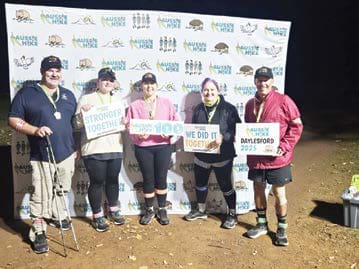
The Hike is an extremely challenging two-day, 100-kilometre adventure through Daylesford & Wombat State Forest. The purpose of the hike is to highlight and raise awareness of the difficulties faced by people living with disabilities who want to participate in physical activities. Ten per cent of school-age kids in Australia live with disability, and while many love sport, only half will be able to participate in physical activities. Despite the benefits of staying active, cost, accessibility, and exclusion make it extremely difficult for people with disabilities to have the same opportunities to participate, as compared to the general population.
The first day of the Great Aussie Hike begins with registration and scrutineering at 6 am. The course is 50 km from Blackwood to Daylesford. Compulsory gear includes maps, UHF radios, first aid kits, water, reflective clothing, head torches, snacks, and snake bite kits, although with the temperature below zero it is hard to believe snakes could be a concern.
Teams must check in together at all official ‘wellness stops,’ and those who don’t make cut-off times are picked up by one of the many official support vehicles. Team support crews, in this case, Graeme Ussing, also have a busy time at these stops, replenishing food and water, as well as tending to any gear malfunctions and treating minor injuries. Qualified First Aid providers and physiotherapists are on course to help with not-so-minor injuries.
At the end of each day, food is supplied by the Rapid Relief Team, well known in emergency services for their quick response time and ability to feed crowds quickly. The First Aid crew and Physiotherapy team have long lines of tired and sore walkers.
The second day is another 50-kilometre trek, from Moorabool to Daylesford via Hepburn Springs. Hiking this far in winter means starting and finishing in the dark and necessitates the use of head torches and reflective gear. This is another time that support crews are vitally important, as head torches malfunction or get lost. Even with a good torch and reflective gear, walking in the dark along the narrow and steep blackberry-lined banks of Daylesford lakes is unsettling to say the least. Hikers who are tired and fatigued must maintain a high level of vigilance and awareness of their surroundings.
Team DUDs spokesperson Jo Ussing said ‘our team wasn’t able to do as much fundraising as we would have liked, as our inclusion in the event was a last-minute decision. However, we still raised more than $600, mostly from people we approached to join us and who, in turn, thought we were crazy. While the hike was challenging and extremely tiring, it was also a lot of fun and a great chance to get outdoors, see new places, and meet new people. I would urge anyone thinking about it to give it a go. There are 30 and 50 kilometre hikes for those thinking 100 is just a bit too far.’

This article appeared in Nhill Free Press & Kaniva Times, 2 July 2025.

