


The legal perils of taxing unrealised gains
The Albanese government, fresh from electoral victory and emboldened by a tighter alliance with the Greens, has wasted no time signalling its intentions: the nation’s nest eggs are in its sights with their plans to tax unrealised gains on super accounts over $3m.
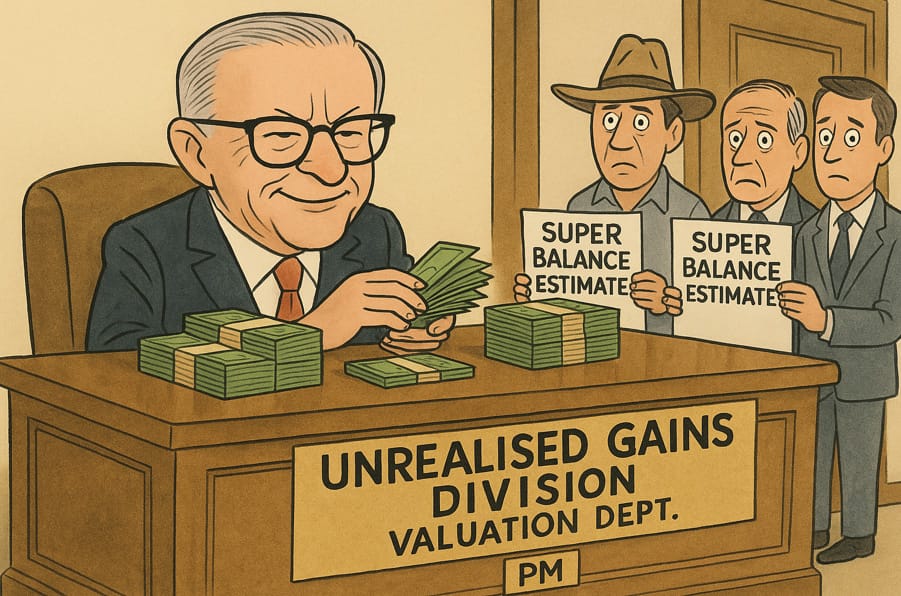
It was a policy that seemed to go with minimal challenge by Dutton during the election campaign, no doubt paralised in fear that he would be accused of pandering to the 80,000 slightly more wealthy who have saved hard for their retirement.
For the progressive Left this nest egg is ripe for the raiding as this isn’t your standard tax grab on income or capital gains. No, this is something altogether more audacious—a proposed tax on unrealised capital gains within large superannuation balances. In other words, the government wants to tax profits that haven’t been made yet, assets that haven’t been sold, and value that hasn’t been banked. The taxman is no longer content with your earnings; he now wants your projections.
It’s a dangerous shift in the philosophy of taxation, and one that poses deep constitutional and legal questions. Under Australian law, capital gains tax is levied when a real-world transaction occurs: a sale, a disposal, a transfer. That is, there must be a CGT event. To move from realisation to valuation is to redefine what it means to gain—and in doing so, the government is not taxing wealth, but possibility. This distinction is more than academic; it lies at the heart of our tax system’s legal integrity.
Let’s not forget that Australia’s power to tax is broad but not limitless. Under Section 51(ii) of the Constitution, the Commonwealth may impose taxation, but under Section 51(xxxi), it may not acquire property on unjust terms. So when the ATO turns up to assess tax on money that hasn’t been realised—on paper profits that may vanish in the next market cycle—is it still taxation? Or is it something closer to compulsory acquisition?
This question strikes at the very foundations of our legal tradition. Since the Magna Carta in 1215, when barons forced King John to relinquish his power to seize property at will, Western legal systems have recognised the centrality of property rights. The principle that the Crown cannot take without consent, compensation, or due process was enshrined in the Bill of Rights 1689, and carried through centuries of common law into the High Court’s modern doctrine. As recently as JT International SA v Commonwealth [2012] HCA 43, 250 CLR 1, the Court reaffirmed that while taxation is not necessarily acquisition, it must not cross into confiscation.
Yet what else can we call a regime that taxes growth without sale, and which leaves taxpayers to foot the bill on the basis of fluctuating market values? Would the government refund the taxpayer if the value falls? Of course not. Like the house that always wins, the tax office will take its cut on the way up and disappear on the way down. That’s not symmetrical taxation—it’s structural expropriation. And if the taxpayer must sell assets simply to pay this tax, we are edging into the realm of constructive acquisition—where ownership is rendered meaningless by force of law.
Superannuation is, fundamentally, private property. It is not charity from the state, nor a government-backed entitlement. It is the product of decades of deferred wages, accumulated and managed with the intention of personal retirement security. For Canberra to demand tax based not on income, but on an assumed trajectory of future worth, is to treat super not as your property, but as a public reservoir—tapped at will when fiscal appetite demands it.
And make no mistake, the appetite is growing. Today it’s your super. Tomorrow, perhaps, your farm. If property can be taxed on valuation alone, why not your family home? Why not the retirement block on the beach, or even the livestock on your paddock, if someone behind a desk decides they’re worth more this year than last? This is the logic of a state that no longer respects the difference between ownership and obligation. It is the slippery slope from liberal governance to arbitrary extraction.
We’ve been here before. Australia once dabbled in death duties and wealth taxes—both eventually scrapped for being economically distorting and morally corrosive. Yet here we are again, watching the state use fairness as a cloak for fiscal opportunism, while quietly testing the waters for the next intrusion. The rhetoric is always the same: equity, sustainability, shared burden. But underneath it lies an enduring truth: governments rarely give up power once they’ve claimed it. And taxing unrealised gains is a power grab unlike any we’ve seen in generations.
If this measure is legislated and survives legal challenge, it will set a dangerous precedent: that value alone is taxable, regardless of liquidity, intention, or capacity to pay. That holding property is, in itself, a taxable offence. That wealth—no matter how paper-thin—is now fair game.
Such a tax may yet be challenged in the High Court. Legal scholars will rightly question whether it constitutes an acquisition of property under Section 51(xxxi), especially in cases where the taxpayer is effectively forced to liquidate just to comply. They may argue it violates the principle of legal certainty, or even the implied freedom of political communication if its burden falls disproportionately on politically unaligned demographics.
If ever there was a case for the National Farmers to rally the troops to donate to the fighting fund I think this is the one. But even if such a case succeeds, the damage will be done. The sheriff will have knocked. And others will follow as this government is now locked into power for the next two terms unless the Liberals get crazy brave and find the next Giorgia Meloni, the current Italian Prime Minister. If you have not seen her in action google her image up, she is an attractive bold unapologetic conservative leader blending charisma with conviction in a way that has revitalised the Italian right. As the first female Prime Minister of Italy she defies the progressive Left’s narrative by leading a nationalistic, family values first agenda while remaining strong public support. No future unrealised capital gains tax on her watch.
But back to what Albo has installed for the wealth creators and savers in Australia. It is tempting to view his raid on future earnings as a mere policy misstep, a treasury overreach to be corrected in the next Budget cycle. But it is more than that. It is a signal—a test of how far a government can push before public resistance hardens into constitutional reckoning. For now, the proposal is aimed at those with large super balances, the so-called wealthy elite. But history shows that when the tax base is laid, it rarely narrows—it expands. First the few, then the many.
To tax unrealised gains is to tax potential. And in doing so, the state not only undermines property rights—it undermines the very incentive to invest, to grow, and to plan. It tells citizens that success is not to be celebrated, but pre-emptively penalised. That the fruits of labour are ripe for picking even before they’ve matured. It replaces fiscal responsibility with valuation gamesmanship, and economic liberty with bureaucratic guesswork.
In a just tax system, you pay based on what you earn—not what someone thinks you might. The moment that line is crossed, taxation ceases to be a civic duty and starts to look a lot more like legalised seizure. And if the courts won’t stop it, then perhaps the voters must. Before the sheriff comes for more than just your super.

